Solar System
Home

Power Conversion System

Commercial High‑Frequency Hybrid Inverter (30–200kW) | Modular PCS for C&I Energy Storage Systems
Commercial High‑Frequency Hybrid Inverter (30–200kW) | Modular PCS for C&I Energy Storage Systems
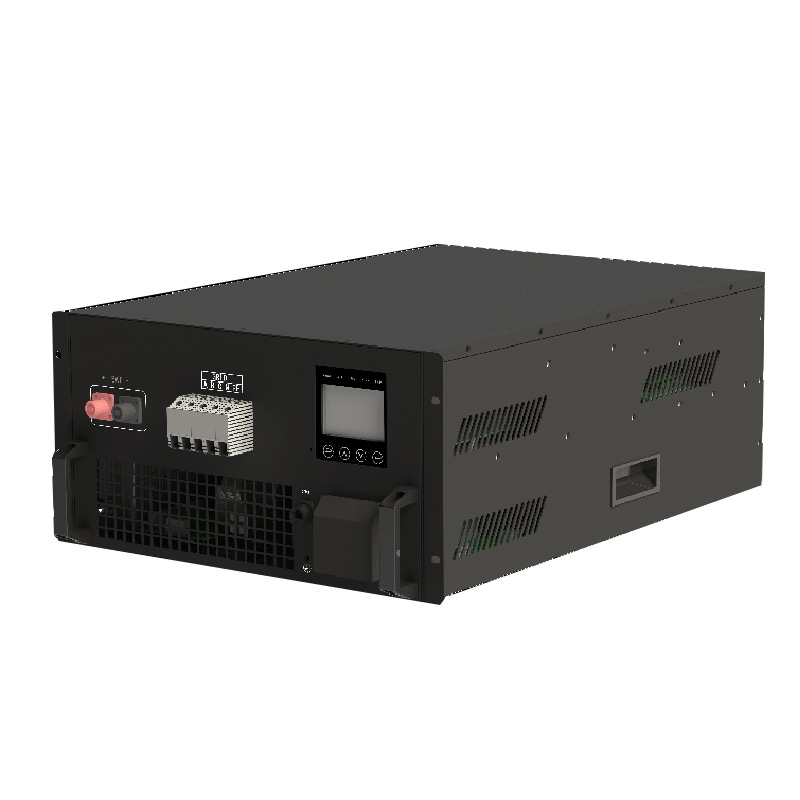
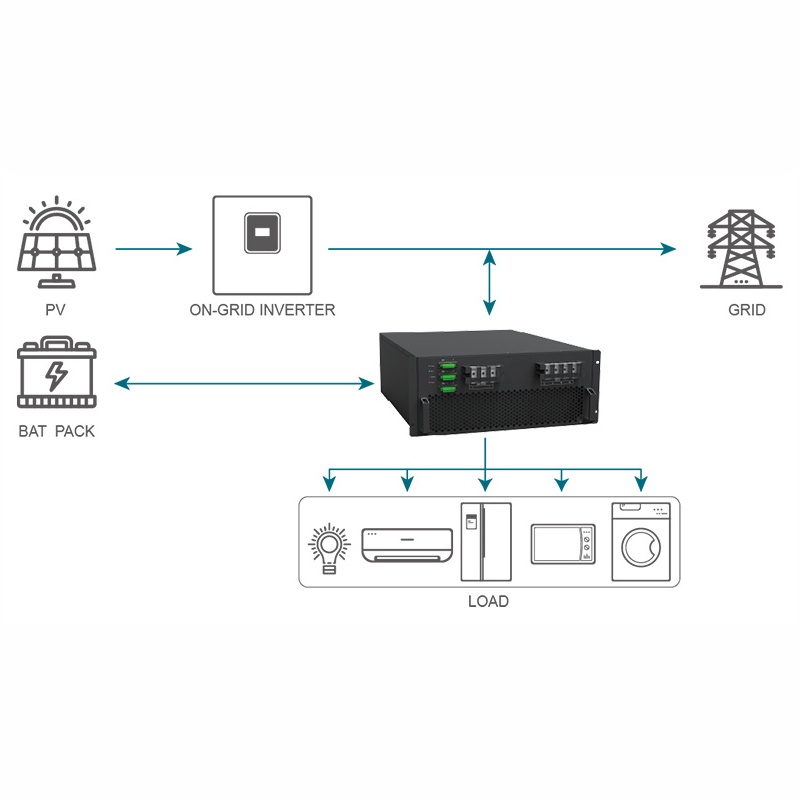
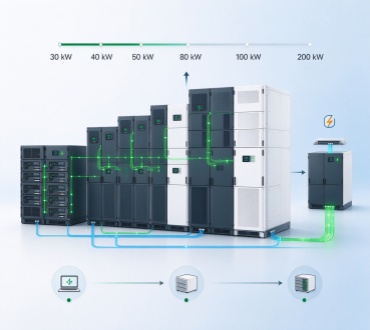
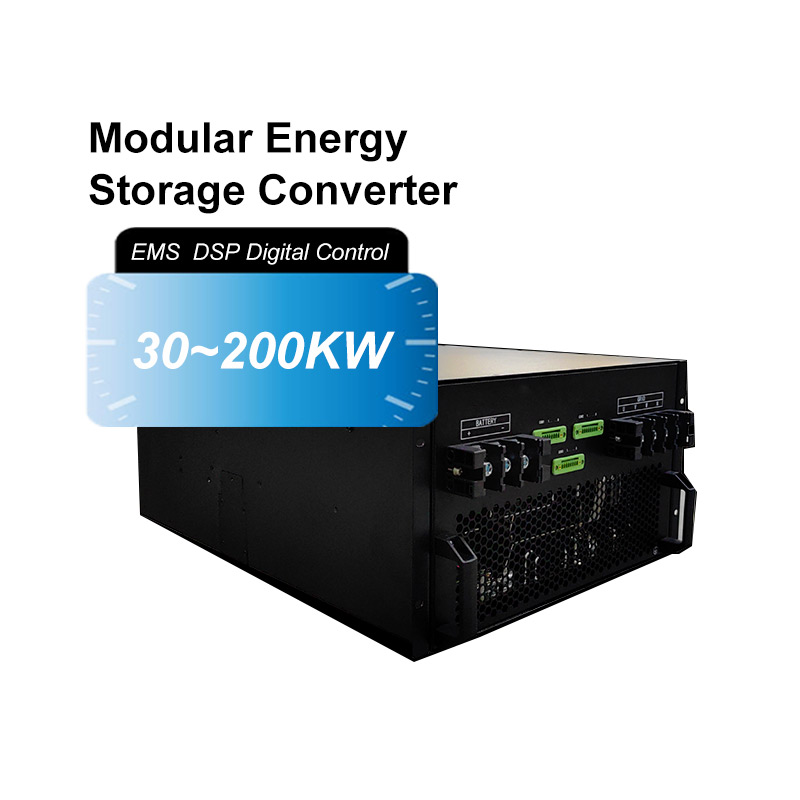
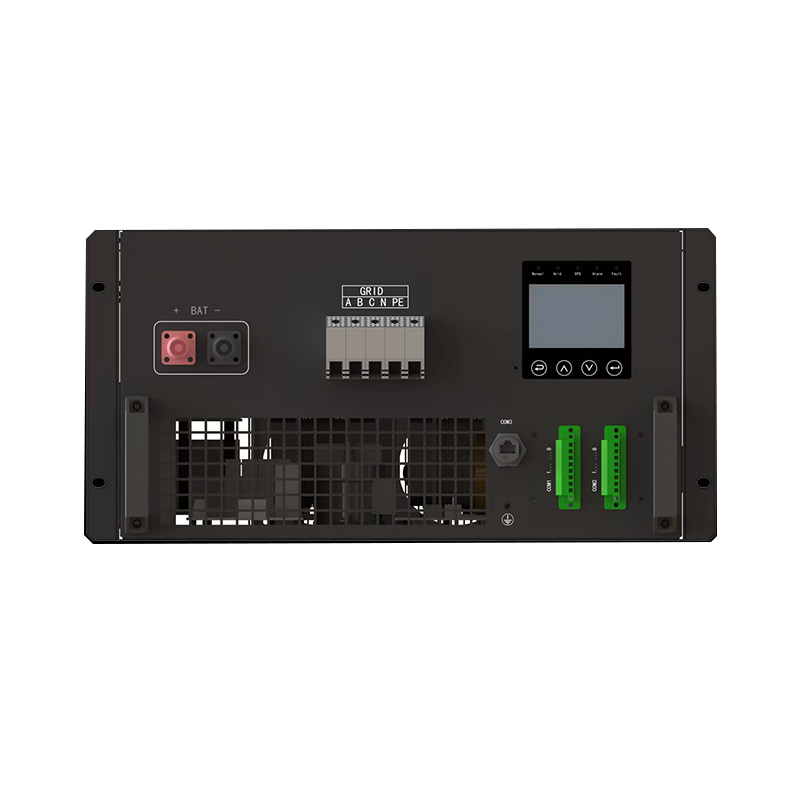
The Commercial Hybrid Inverter (30–200kW) is a high‑frequency, modular PCS (Power Conversion System) engineered for medium‑to‑large‑scale energy storage applications. It integrates bidirectional AC/DC conversion, high‑speed MPPT, grid‑forming/off‑grid capabilities, and advanced EMS communication, enabling stable operation in complex commercial environments.

Its DSP digital control platform ensures precise power management, fast response, and compatibility with lithium battery systems (LFP/NMC). The modular design allows scalable deployment, making it ideal for EPC contractors, distributors, and integrators building C&I solar‑plus‑storage systems.

  • Item No :

    GM-LEG100K
  • Payment :

    TT/LC
  • Product Origin :

    China
  • Custom Made :

    Yes
  • Shipping Port :

    Shanghai, Nanjing, Ningbo, Guangzhou, Shenzhen, etc.
  • Lead Time :

    20 days
  • Warranty :

    3 years
  • Product Details
Page Overview

This Commercial High‑Frequency Hybrid Inverter (30–200kW) is designed for commercial and industrial (C&I) solar‑plus‑storage applications. With EMS‑ready DSP digital control, high conversion efficiency, and modular architecture, it supports flexible deployment in factories, microgrids, data centers, EV charging stations, and energy storage projects.

The system meets global C&I ESS requirements, offering grid‑tie + off‑grid switching, bidirectional power conversion, and multi‑mode operation for peak shaving, backup, and energy arbitrage.


Key Features
Commercial High‑Frequency Hybrid Inverter
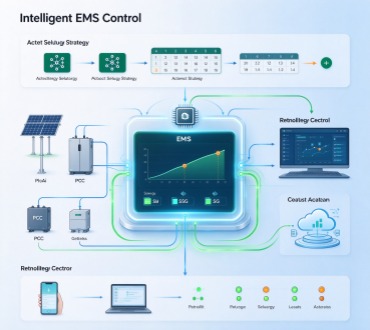
This Commercial High-Frequency Hybrid Inverter (30–200kW) is a high-performance PCS (Power Conversion System) specifically designed for commercial and industrial energy storage projects. Utilizing a high-frequency topology and a DSP digital control platform, it achieves efficient bidirectional AC/DC conversion, rapid dynamic response, and precise power regulation, making it suitable for deployment in various scenarios such as factories, microgrids, commercial buildings, and EV charging stations. Its modular architecture supports flexible combinations from 30–200kW, meeting the capacity configuration needs of EPCs, system integrators, and distributors in different projects. The device is compatible with LFP/NMC battery systems and seamlessly interfaces with EMS, BMS, and SCADA via CAN/RS485/Ethernet, enabling multiple operating modes such as peak-valley arbitrage, peak shaving and valley filling, backup power switching, and photovoltaic-storage DC coupling. As a core energy storage device for the global C&I market, it boasts high reliability, strong scalability, and engineering friendliness.
Read More
An outdoor photograph of an engineering project showcases a commercial and industrial lithium battery energy storage container system and a high-frequency inverter control cabinet. The main subject is the side of a white container, with the words 'LI-ION ENERGY STORAGE SYSTEM' printed in black on the left corrugated panel. The container's side door is fully open, revealing a row of compactly connected gray electrical control cabinets. These cabinets feature intelligent LCD monitoring panels, red and green indicator lights, large strip-patterned louvered ventilation holes, and warning signs with yellow lightning bolt symbols. Several thick black power cables extend from the bottom of the container, neatly connected to a separately installed gray outdoor distribution box via a sturdy steel support structure. The front of the distribution box also bears a bright yellow lightning bolt high-voltage warning triangle. In the lower left corner of the image, a professional maintenance worker wearing gray overalls, a white safety helmet, a fluorescent yellow safety vest, and white gloves is using a handheld infrared thermal imager to conduct temperature safety checks on the electrical connections of the power station equipment. The entire scene showcases the rigorous industrial operation and maintenance process of modern clean energy infrastructure.
Wide Range of Applications

Applicable to various scenarios such as grid-side energy storage, user-side energy storage, power generation-side energy storage, industrial and commercial energy storage, microgrids, and off-grid systems

Read More
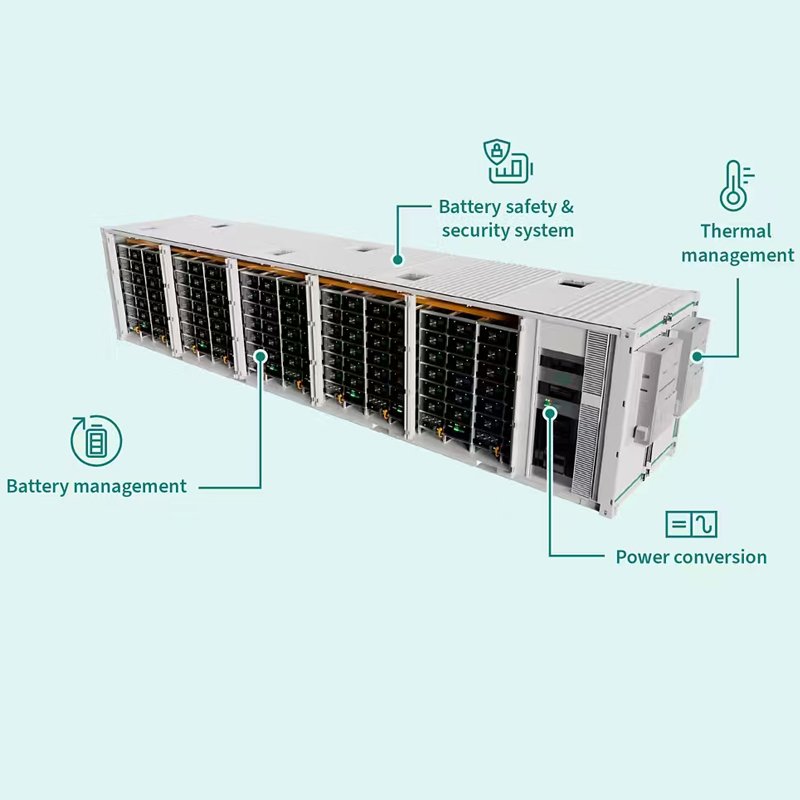
This is a technical analysis image showcasing the internal structure and hardware markings of an integrated commercial and industrial energy storage cabinet. The main subject is a gray metal electrical cabinet with an open door, featuring a compact internal structure. On the left side of the cabinet, a white 'Liquid cooling module' with a metal mesh is installed at the top, while the 'PCS' (Power Conversion System) power unit is integrated at the bottom. In the wide main aisle in the center of the cabinet, five layers of standard black battery packs are vertically stacked, labeled 'Battery cluster'. Each battery pack panel is equipped with orange high-voltage cables, black data cables, a switch knob, and a yellow high-voltage triangle symbol. Airflow or piping components are installed in the gaps at the top of the battery clusters, labeled 'Fire protection system'. The inside of the open right-hand door panel of the cabinet is covered with dense control and communication cables and a microprocessor module, labeled 'EMS' (Energy Management System). Five blue rectangular text labels with rounded corners are distributed around the cabinet, with thin blue arrows pointing precisely to the corresponding hardware locations, providing a comprehensive analysis of the internal structure of the efficient and safe industrial and commercial distributed energy storage cabinet.
High Reliability

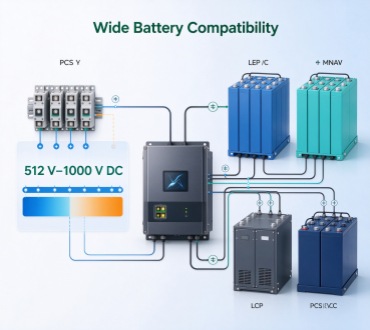
Modular design allows for quick and easy replacement, and failure of a single module does not affect overall operation; wide range DC voltage input, suitable for different types of energy storage batteries

Read More
This is a 3D model and diagram combination against a pure white background, showcasing the structural analysis of a commercial and industrial high-frequency hybrid inverter energy storage system. On the right side of the image is a group of industrial integrated energy storage units arranged in parallel: at the far left is a white energy storage converter cabinet labeled 'Power Conversion System (PCS)', with a grid-like ventilation hole and a yellow high-voltage warning sign on the cabinet door; following closely behind are four white battery cabinets with glass windows, labeled 'Battery Energy Storage System' below. On the left side of the image is a striking red dashed square frame, connected to the PCS cabinet on the right by dashed lines. The frame enlarges the internal structure of the converter cabinet after the door is opened, showing its dual-row modular design: the upper part vertically plugs in four gray 'AC/DC Modules' with miniature dual cooling fans, while the lower part integrates a large air circuit breaker, shunts, and an intelligent power distribution control panel. The entire image uses clear black English labels and red directional arrows to intuitively and thoroughly deconstruct the core hardware components of industrial and commercial energy storage systems.
Intelligent and Efficient

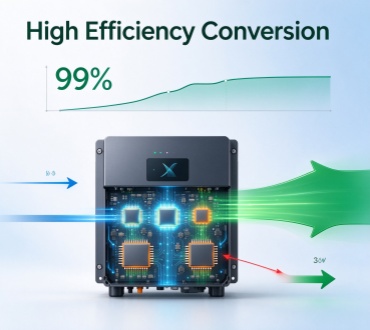
This Commercial Hybrid Inverter use advanced power devices and control algorithms to improve power conversion efficiency; support EMS access to achieve remote monitoring and optimized scheduling

Read More

System Components

High‑Frequency Power Conversion Module

• Bidirectional AC/DC conversion

• High efficiency for C&I loads

• Stable under fluctuating grid conditions

DSP Digital Control Unit

• Real‑time power regulation

• Fast response for load changes

• Supports advanced EMS algorithms

Industrial‑Grade Cooling System

• Intelligent air‑cooling

• High reliability in harsh environments

• Low maintenance


Wide‑Voltage Battery Interface

• Supports 512V–1000V battery banks

• Compatible with LFP/NMC

• High‑current charge/discharge


Grid‑Tie & Off‑Grid Switching Module

• Seamless transition

• Supports microgrid operation

• Ensures power continuity


EMS/SCADA Communication Interface

• CAN/RS485/Ethernet

• Cloud monitoring support

• Easy integration for EPC projects


Technical Specifications

Model GM-LEG30K GM-LEG60K GM-LEG100K GM-LEG125K GM-LEG200K
DC Side
DC Voltage Range(V) 650-900 650-900 650-900 650-900 1060-1500
Number of Input Channels 1 1 1 1 1
Supported Battery Types Lithium battery, lead-carbon battery, lead-acid battery
AC Side (grid-connected)
Rated Power (KW) 30 60 100 125 200
Maximum Power (VA) 33000 66000 110000 138000 220000
Maximum Output Current (A) 48 95 159 198 184
Rated Grid Voltage(V) 3/N/PE,230/400 3/N/PE,230/400 3/N/PE,230/400 3/N/PE,230/400 3/PE,690
Rated Grid Frequency(Hz) 50/60(±5%)
Total Current Waveform Distortion Rate <3%(rated power)
DC Component <0.5% In
AC Side (off-grid)
Rated Output Power (KW) 30 / 100 125 200
Maximum Output Power (VA) 33000 / 110000 138000 220000
Overload Capacity 110% long-term operation / 110% long-term operation 110% long-term operation 110% long-term operation
Rated Output Voltage (V) 3/N/PE,230/400 / 400 400 400
Rated Frequency (Hz) 50/60 / 50/60 50/60 50/60
AC Voltage Distortion Rate <3% linear load / <3% linear load <3% linear load <3% linear load
With Unbalanced Load Capacity 100% / 100% 100% 100%
General Parameters
Maximum Efficiency 98.0% 98.0% 98.0% 98.0% 99.0%
Protection Function DC reverse connection protection, AC short circuit protection, grid monitoring, island protection, surge protection
Isolation Transformer NO
Protection Level IP20
Cooling Method Intelligent air cooling
Relative Humidity ≤95% (no condensation)
Operating Temperature (°C) -30~+55
Altitude (m) 3000
Display Touch screen/external
Dispatch Communication Method Ethernet, RS485
BMS Communication Method RS485、CAN
Communication Protocol MODBUS-RTU/TCP
Reference Weight (Kg) 40 40 50 50 86
Reference Size (W*D*H) (mm) 483*650*240 483*650*240 436*650*256 436*650*256 720*640*270

Updated June 10, 2026

Contact the GreenMore team


Application Scenarios

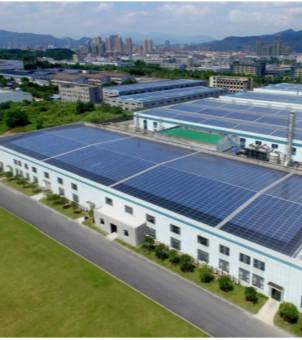
  • This is a wide-angle panoramic aerial photograph of a green, modern industrial park. The foreground and middle ground feature several massive, elongated, modern white industrial buildings with multiple windows. The flat roofs of these buildings are entirely covered with large arrays of deep blue solar photovoltaic panels, shimmering in the sunlight. A smooth black asphalt road runs alongside the buildings, lined with neatly planted green spherical trees, connecting to a spacious green lawn demonstration area. In the background, the view extends beyond the low-rise factory buildings to a dense cluster of city skyscrapers on the distant horizon, and further still, rolling green mountains. The sky is pale blue with wispy white clouds. The photograph's expansive view and distinct color layers vividly showcase the grand ecological scene of the industrial park's large-scale application of photovoltaic and energy storage clean energy.
    Factories & industrial parks
    Modular PCS delivers flexible expansion and fast deployment for smart, stable industrial energy management.
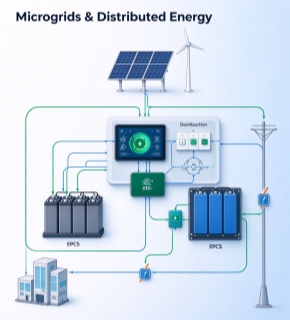
  • A diagram illustrating the architecture of a microgrid system and the interconnection of distributed energy resources against a pure white background. At the center of the image is a large white circle with the words 'Microgrid' printed in bold black lettering. Centered on this microgrid's core circular ring, eight physical photographs and simple line drawings radiate outwards via thin black lines, representing different electrical assets and loads: The upper left shows a black-and-white line drawing of a modern house, labeled 'Local Loads'; the left side shows a photograph of a large black solar panel under a blue sky, labeled 'Solar Generation System'; the lower left shows a white model of a three-bladed wind turbine, labeled 'Wind Generation System'; directly below is a photograph of a large green and black industrial diesel generator, labeled 'Diesel Generator'; the lower right shows a second set of solar panel photographs (labeled 'Solar Generation System') and a yellow cylindrical energy storage battery icon (labeled 'Energy Storage Systems'); the right side displays a simple line drawing of a gray high-voltage transmission pole and wires, labeled 'Utility Grid'; and the upper right shows another line drawing of a house with a blue roof covered in solar panels, also labeled 'Local'. Above it is another yellow cylindrical energy storage battery icon labeled 'Energy Storage Systems'. The entire diagram is clearly structured and fully demonstrates the ecological topology of a microgrid integrating multi-source complementary distributed energy.
    Microgrids & distributed energy systems
    Enable local generation, storage, and autonomous control to deliver stable, efficient, and resilient power independent of the main grid.
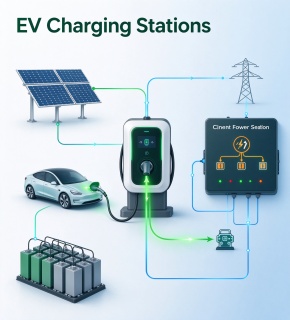
  • This is a 3D concept model of a modern solar EV charging station against a pure white background. The main subject is a modern steel-structured carport extending in both directions, with a slightly inverted A-shaped roof neatly covered with black and white photovoltaic solar panels. A row of bright green, long, enclosed electrical enclosures hangs beneath the longitudinal main beams of the carport. On a gray, hardened concrete platform below the carport, several charging bays are arranged side-by-side, among which three white, vertical DC charging piles are clearly visible: the first one on the left is shorter, with a long black cable and a green charging nozzle hanging from its front; two gray bollards also stand on the ground to the left. On the right, two taller, box-type charging piles are arranged in sequence, also with neatly arranged charging cables and green connectors. The entire model uses a right-side perspective, with a modern and technologically advanced design that intuitively presents the structural form of a new energy photovoltaic-energy storage-charging carport.
    EV charging stations
    Use solar‑plus‑storage and smart power control to deliver stable, fast, and lower‑cost charging while reducing peak‑time grid stress.
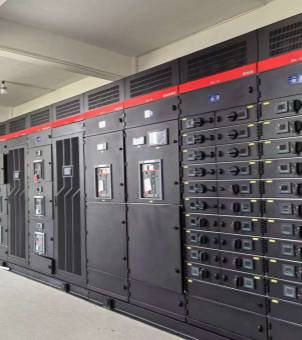
  • This is a real-world indoor photograph of a modular power conversion system cabinet array. The main subject is a row of large, dark-black industrial electrical distribution cabinets standing side-by-side, extending neatly. A striking bright red horizontal decorative strip adorns the top of each cabinet, above which are large, mesh-like ventilation vents. The cabinet array is divided into different functional areas from right to left: the two cabinets on the right employ a high-density modular drawer-style structure, vertically stacking more than twenty identical small power supply units. Each unit has a rotary black physical switch knob on the left and a miniature LCD data monitoring screen on the right, illuminated with a blue-green backlight. The cabinets in the middle feature large, enclosed black metal doors, inlaid with a medium-sized LCD monitoring display, square buttons, and red emergency shut-off or indicator handles. The cabinets on the left have vertically grilled, perforated ventilation doors. The entire server room floor is a gray-white hardened cement floor or anti-static floor, with white architectural ceiling beams visible above. The image, taken from a side angle, showcases the professional, rigorous, and high-tech hardware deployment of the data center's core power room.
    Data centers & telecom stations
    Ensure uninterrupted, high‑reliability power through redundant storage, precise power conditioning, and rapid backup switching for mission‑critical operations.
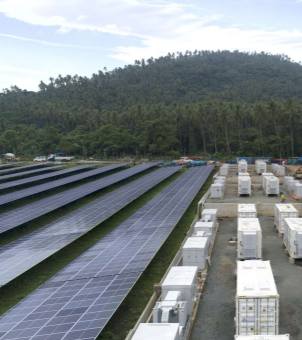
  • This is a panoramic outdoor photograph taken from above, showcasing a large-scale, centralized ground-mounted photovoltaic (PV) power generation and containerized energy storage power station. On the left is a vast plain, with rows of long, dark blue ground-mounted PV panels arranged neatly and densely, stretching parallel into the distance. On the right, the ground has been hardened and paved with gravel, neatly divided into several longitudinal channels. Two rows of more than ten large, light-colored containerized lithium-ion battery storage units and converter compartments are parked in a standardized manner, each container equipped with a lifting structure and heat dissipation module on top. In the background of the entire PV-storage base is a massive, towering hill covered with lush, dark green trees, above which is a pale blue sky dotted with large areas of layered white clouds. The entire image demonstrates a modern, mega-scale PV-storage complementary project that integrates new energy infrastructure with the natural environment.
    Solar‑plus‑storage EPC projects
    Deliver bankable, fast‑deployable clean‑energy systems that combine PV generation with intelligent storage to ensure stable output, peak‑shaving, and higher project ROI for utility, C&I, and microgrid applications.
 

More business ESS applications


Why Choose This System?

  • Designed for commercial‑grade reliability

  • Modular 30–200kW architecture for scalable deployment

  • Compatible with global C&I ESS standards

  • EMS‑ready for advanced energy management

  • Ideal for EPC, distributors, and integrators

More commercial energy storage solution


FAQ

Q1:Is the inverter suitable for large commercial projects?

A1:Yes. The 30–200kW modular design supports factories, microgrids, and multi‑unit ESS deployments, making it ideal for EPC and C&I integrators.

Q2:Does it support EMS/SCADA integration?

A2:Yes. It supports CAN, RS485, and Ethernet for seamless integration with EMS, BMS, and SCADA systems.

Q3:What battery types are compatible?

A3:Compatible with LFP and NMC battery systems across 512V–1000V voltage ranges.

Q4:Can the inverter operate off‑grid?

A4:Yes. It supports grid‑tie, off‑grid, and microgrid modes with seamless switching.

Q5:Is OEM/ODM customization available?

A5:Yes. Branding, communication protocols, and system configuration can be customized for distributors and project developers.


Page Summary

This Commercial High‑Frequency Hybrid Inverter (30–200kW) delivers high‑efficiency bidirectional conversion, modular scalability, and advanced EMS‑ready control.Designed specifically for industrial and commercial solar energy + energy storage projects, it is suitable for projects such as factory energy storage, microgrids, and electric vehicle charging stations.

leave a message
If you are interested in our products and want to know more details,please leave a message here,we will reply you as soon as we can.

Subscribe To Our Newsletter

Please Read On, Stay Posted, Subscribe, And We Welcome You To Tell Us What You Think.

GreenMore is a company specializing in the research and development and manufacturing of energy storage systems, with products covering residential energy storage, commercial and industrial energy storage cabinets, and BIPV products. We have long-term partnerships with global distributors, EPC teams, and system integrators to provide stable and reliable energy solutions for residential, commercial parks, microgrids, and off-grid scenarios. In terms of production and engineering, GreenMore has OEM/ODM capabilities, enabling customized development based on the technical requirements and project needs of different markets. Our products have obtained multiple international certifications and are deployed in various regions, establishing a stable supply chain and comprehensive technical support services.
Wechat WhatsApp
No. 69 Olympic Sports Street, Nanjing, Jiangsu, China

Copyright @ 2026 GM Tech All Rights Reserved. Network Supported

Sitemap / Blog / Xml / Privacy Policy

leave a message

leave a message
If you are interested in our products and want to know more details,please leave a message here,we will reply you as soon as we can.
submit

Home

Products

WhatsApp

contact