
Welcome to GreenMore
Welcome to GreenMore
A stackable battery is a home energy storage system built from separate modules that sit on top of each other. Instead of replacing a 5 kWh unit with a 10 kWh one when your needs grow, you add another module of the same type. The modules share a common base, communicate over a single bus, and appear to the inverter as one larger battery. This modular approach is why stackable systems are popular with homeowners who want to start small and add capacity over time.
Each module contains its own cells and a battery management system that monitors voltage, current and temperature inside that module. The modules are linked in parallel on a common DC bus so the combined capacity adds up, while the inverter sees the stack as one battery. Communication with the inverter runs over CAN, RS485 or a vendor-specific protocol, and the bus master (usually the first module) reports the state of charge for the whole stack. Because the modules share a design, they age together and the BMS can balance them as a group, which is simpler than trying to mix different generations.
The main benefit is staged investment. A household that only needs a few hours of evening backup can begin with two modules and add more when an electric vehicle arrives or when the solar array is expanded. A stackable system also reduces waste: a failed module can often be replaced without scrapping the whole unit, and the same hardware can be moved if the home is relocated. The trade-off is that the system is tied to one product family — you cannot typically add a competitor's module, and the manufacturer's stated maximum stack size is a real limit, not a suggestion.
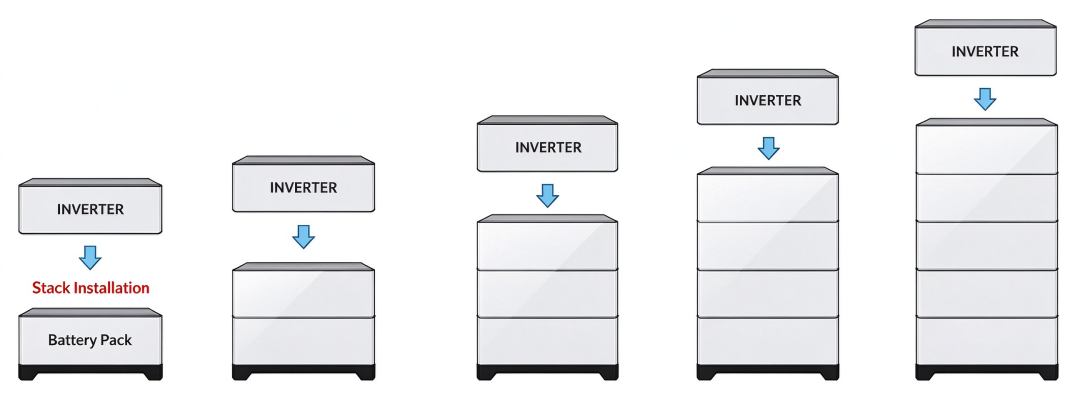
GreenMore stacked modular energy storage battery
Stackable batteries are a good match for homes that plan to grow: a small solar array now with a larger one later, a current combustion car that will be replaced by an electric vehicle, or a household that is adding a heat pump. They are less compelling for homes that already know exactly how much storage they need and will never change — in that case a single larger wall or rack unit may be simpler and sometimes cheaper per kWh. They are also not the right answer for utility-scale projects, where containerized battery cabinets with a separate PCS are the norm.
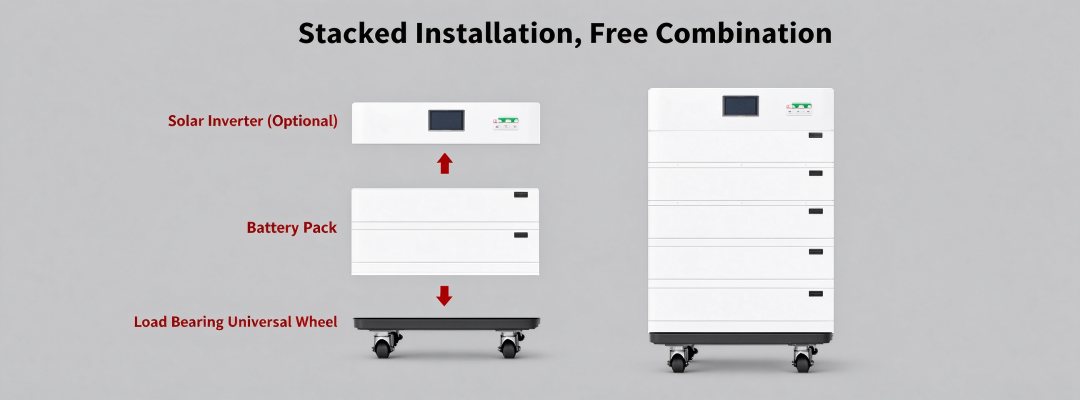
GreenMore's customizable stackable energy storage batteries
You can see our residential range on the home energy storage category page. If you want to work through whether a stackable system fits your load profile and future plans, use the contact page and share your current bill, expected new loads and whether you have or plan solar.
In principle yes, if they are the same model and generation from the same manufacturer. Mixing different chemistries, voltages or BMS generations is usually not supported and can cause the pack to limit itself to the weakest module.
The limit is set by the manufacturer for each model, based on the BMS, bus current and inverter rating. Exceeding it is not safe. Ask for the datasheet and check the stated maximum before planning expansion.
Neither is universally better. Wall-mounted units save floor space and are cleaner for small capacities. Stackable systems scale more cleanly when you expect to add capacity. The choice depends on how much storage you need now, how much you may need later and where the unit will live in the home.
Not if it is the same model added within the manufacturer's stated limit and installed per the guide. Adding a third-party module or exceeding the maximum stack size typically does void it. Confirm this in writing before buying.
Peter works with distributors, installers and system integrators to size residential and commercial storage around real load profiles. He focuses on LiFePO4 systems that match the inverter, grid rules and backup needs of each destination market.
Stay up to date with GreenMore. We share new BIPV solar tile releases, product and certification updates, and field notes from our projects — no fluff, just the things that matter to installers, distributors, and system integrators. If there's something you'd like to see covered, drop us a line — we read every reply.




Copyright @ 2026 GreenMore All Rights Reserved.  Network Supported
Sitemap / Blog / Xml / Privacy Policy


