
Welcome to GreenMore
Welcome to GreenMore
By Peter Lu, Product Engineer at GreenMore | September 20, 2026
Pick the wrong DC power module and you usually find out six months later. It shows up as a cabinet that trips on hot afternoons, a paralleled string that refuses to share current evenly, or a field trip across the country to replace a unit that never should have been sized at full nameplate. This guide is the first in a four-part series on how to specify an industrial DC power supply without learning those lessons on a live site.
The GreenMore team has worked in power electronics since 2017, including the two rack-mount modules covered here: the 30 kW GM-LDC30 and the 60 kW GM-LDC60. What follows is the framework our engineers use when an EPC or integrator asks which DC power module for ESS duty fits their cabinet.
A DC power module sits between the battery side and the higher-voltage DC bus, converting and regulating power so each side sees a stable interface. When the battery charges, power flows one way; when it discharges into the bus, it flows the other. The front end behind it can be an AC/DC rectifier, a PCS, or another converter stage, which is why a wide tolerance for whatever that upstream device delivers matters more than a tidy single-source power architecture.
The same job description comes up in four settings:
Why does component quality here get so much attention? Because power is where outages start. Uptime Institute's Annual Outage Analysis 2025 reports that power issues remain the most common cause of serious and severe data center outages, and 54% of significant outages cost over $100,000. On the storage side, U.S. Department of Energy analysis notes that recent BESS failures are now driven more by controls and power conversion systems than by cell material, with poor commissioning and miscoded converters named among the causes. The conversion stage is no place to save a few dollars.
Datasheets are long. Most selection decisions come down to eight parameters. These are the published figures for the GreenMore modules, not estimates.
| Rated power | 30 kW | 60 kW | Sets how many modules fill a cabinet |
| Low-voltage DC side | 200–900 V, max 75 A | 200–900 V, max 150 A | Must cover full battery voltage swing, not nominal |
| High-voltage DC side | 300–1000 V, max 75 A | 300–1000 V, max 150 A | Must match the system bus and PCS window |
| Peak efficiency | 98.0% | 98.6% | Drives heat, cooling load and kWh losses |
| Cooling / ingress | Smart air cooling, IP20 | Smart air cooling, IP20 | IP20 means indoor cabinet mounting, not outdoor exposure |
| Operating temperature | −30 to +55 °C | −30 to +55 °C | Check the derating curve near the top end |
| Altitude | Up to 3,000 m | Up to 3,000 m | Above this, dielectric and cooling assumptions change |
| Standby consumption | < 20 W | < 20 W | Matters when dozens of modules sit idle |
Three more items deserve a line each:
Two sizing habits separate careful buyers from optimistic ones. First, check the real operating point: 60 kW only exists where voltage and current windows meet at the same moment, so run your actual battery voltage at end of charge and end of discharge through the module's curve. Second, respect altitude and temperature derating. A site at 3,400 m is outside the 3,000 m rating before you load it, and a cabinet in a desert yard can see internal air well above ambient if airflow is poorly planned.
If you are integrating at cabinet level, compare how the module fits an air-cooled energy storage cabinet, a liquid-cooled outdoor cabinet, or a 5 MWh containerized ESS. Module heat rejection has to match the cabinet's thermal design.
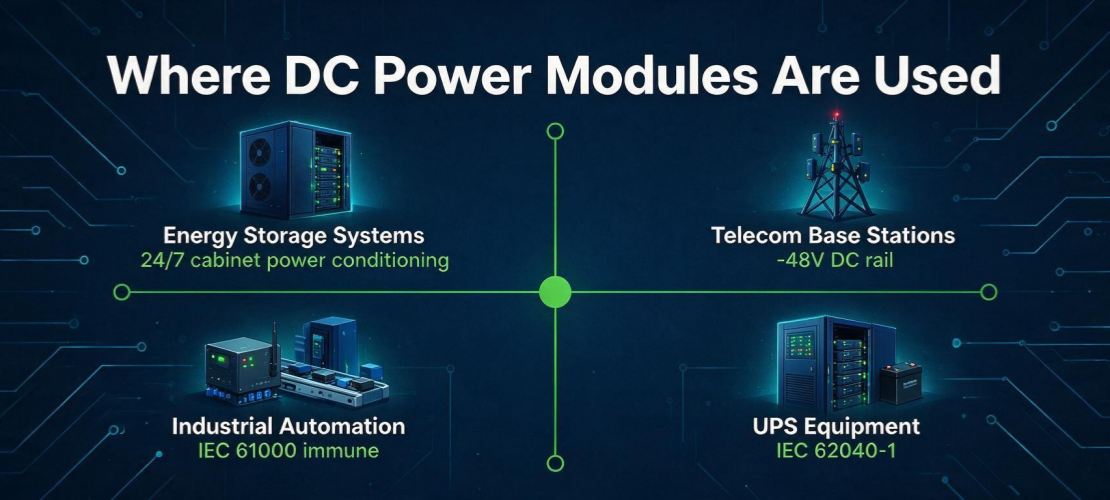 Schematic diagram of DC power supply module application scenarios
Three topics get buyers into the deepest trouble, and each gets its own article in this series.
High-frequency conversion is what makes 98%+ efficiency and low output ripple possible in a compact rack-mount unit, but switching topology and filter design involve real tradeoffs. We unpack them in High-Frequency DC Conversion and Low Ripple.
The modular structure exists so multiple units parallel into one system and grow with the project. Current sharing, wiring and redundancy rules are not automatic, though. Modular DC Power Parallel Expansion covers how to configure it without one module carrying the whole cabinet.
The intelligent protection suite, including OVP/OCP/SCP/OTP plus reverse polarity, surge and insulation monitoring, determines how a module behaves under fault rather than on a bench. DC Power Protection: OVP, OCP, SCP, OTP Explained walks through what each function should and should not be expected to do.
Four mistakes account for most of the problems we see.
Buying on peak efficiency alone. A 98.6% figure measured at the sweet spot tells you little about performance at 15% load on a cold morning. Ask for the full efficiency curve and look at where your system actually runs.
Ignoring the voltage windows. A battery specified at 800 V nominal still swings from roughly 600 V discharged to over 870 V at charge top, depending on chemistry and configuration. If your DC power module does not cover that full swing with usable current, part of the battery's capacity becomes unusable. Confirm both sides cover the extremes.
Treating parallel capacity as plug-and-play. Dropping a second module into a rack does not guarantee equal current sharing. Bus impedance, cable length, unit tolerances and configuration all play a role, which is why the dedicated parallel-expansion article exists.
Mounting an IP20 module outdoors or skipping derating. IP20 is an indoor cabinet rating. Outdoor duty needs a properly sealed cabinet, and high-temperature or high-altitude sites need deliberate derating from day one rather than a retrofit after nuisance trips.
The safety standards referenced above, including IEC 62368-1 for ICT and audio-video equipment safety, are useful language to put in your specification: asking which standards a module was designed against quickly separates serious suppliers from catalogue resellers.
If your cabinet voltage, battery chemistry or site conditions do not line up cleanly with the tables above, do not guess. Contact a GreenMore engineer with your one-line diagram and site conditions, and we will help you size the GM-LDC30 or GM-LDC60 for the load it will actually carry.
Please Read On, Stay Posted, Subscribe, And We Welcome You To Tell Us What You Think. BIPV solar tiles & energy storage — updates for global partners.




Copyright @ 2026 GreenMore All Rights Reserved.  Network Supported
Sitemap / Blog / Xml / Privacy Policy


