Why Double-Glass Frameless Solar Tiles Outlast Traditional Modules by a Decade
Sep 10, 2026
L
Luke
Product Manager, GreenMore · Photovoltaic building materials
GreenMore's double-glass frameless photovoltaic tiles use two layers of tempered glass encapsulating solar cells in a frameless structure, delivering a 25-year power warranty with annual degradation as low as 0.3–0.4%. Each tile measures 720 × 500 mm and installs via a hook-and-lap system that integrates directly with the roof — no separate racking step required.
That's the short version. Here's why the engineering matters.
The Backsheet Problem Nobody Talks About
Most conventional solar modules use a glass front and a polymer backsheet — typically EVA or Tedlar. It's a design that works well for ground-mounted utility projects, where you can swap out a degraded panel without much fuss. But a roof-integrated BIPV tile is different. It is the roof. Replacing one means disturbing the waterproofing layer, the flashing, and potentially the surrounding tiles.
Polymer backsheets allow water vapour permeation at rates of 1–4 g/m²/day, depending on material quality and ambient temperature. Over 15 or 20 years, that slow moisture ingress triggers the three most common field failure modes: Potential Induced Degradation (PID), encapsulant delamination, and corrosion of cell interconnects.
Glass is essentially impermeable. The water vapour transmission rate through a glass-glass module is 100 to 1,000 times lower than through a polymer backsheet. This single material swap eliminates the primary degradation pathway that shortens module life in real-world conditions.
According to a study published in the Oxford Academic Clean Energy journal, double-glass bifacial modules in hot-arid climates maintained a performance ratio of 91%, compared with 81% for single-glass polycrystalline panels under identical conditions. The degradation gap — 0.3–0.4% per year for glass-glass versus 0.5–0.7% for glass-backsheet — compounds into a 5–8% difference in cumulative energy production over 25 years.
What 25 Years Actually Looks Like
Here is a side-by-side comparison of expected power retention for the two architectures:
Parameter
Double-Glass (Glass-Glass)
Standard (Glass-Backsheet)
Year 1 degradation (LID)
1–1.5%
2–3%
Annual degradation (Year 2+)
0.3–0.4%/year
0.5–0.7%/year
Power retention at Year 25
88–91%
80–84%
Expected physical lifespan
25–30+ years
20–25 years
Product warranty
10 years (tile) / 25-year linear power
12–15 years
Moisture barrier
Near-zero permeability
1–4 g/m²/day
GreenMore's tiled type photovoltaic tiles are engineered with this long-term performance in mind. The double-glass frameless design means there is no aluminium frame to corrode and no polymer layer to yellow or crack. Power output is guaranteed to remain above 80% at the 25-year mark, under the 25-year linear power warranty.
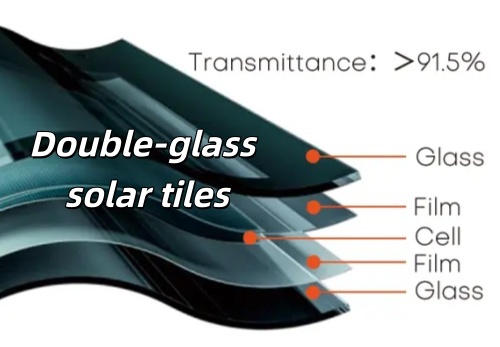
Comparison of technical parameters between double-glass and single-glass solar tile structures
Large-Format Tiles: Fewer Pieces, Fewer Failure Points
A standard concrete roof tile measures roughly 300 mm × 300 mm. GreenMore's tiles at 720 × 500 mm cover more than four times that area per unit. The practical effect goes beyond faster installation.
Fewer tiles means fewer joints, fewer waterproofing interfaces, and fewer electrical connections across the same roof area. Each joint is a potential water ingress point and a potential weak link in the electrical string. By reducing the total count, the system improves both structural reliability and electrical continuity.
The hook-and-lap mounting system is designed so that each tile locks into place mechanically, then secures at the overlap. On a typical residential roof, this approach reduces installation time compared to smaller-format BIPV tiles or traditional rack-and-panel systems that require separate roofing and solar steps.
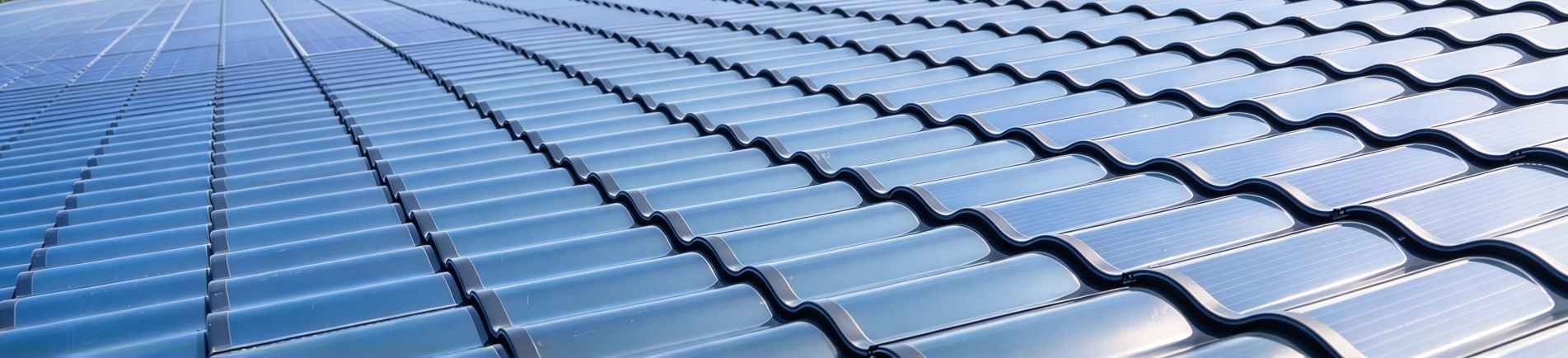
Real-life example of a pitched roof photovoltaic system with skylights
Self-Cleaning Performance in the Field
The tempered glass surface on both sides of the tile provides more than just mechanical protection. Glass maintains optical clarity over decades without yellowing, unlike polymer surfaces that degrade under UV exposure.
The smooth glass surface also allows rain to wash away dust, pollen, and particulate matter with minimal residue buildup. For residential installations at typical roof pitches (15°–35°), this self-cleaning effect keeps soiling losses low — usually under 2–3% annually in most climates. Agricultural or coastal sites may benefit from a semi-annual rinse, but the glass surface does not accumulate the stubborn mineral deposits that etch into degraded polymer coatings.
Two Technology Lines for Different Project Needs
GreenMore has been working in photovoltaics since 2017, bringing years of experience to the BIPV roofing market. The company operates two technology lines for its tiled products:
Thin-film (CIGS, since 2019): Approximately 100–105 W/㎡ output, well-suited for projects where aesthetics and uniform appearance take priority.
BC back-contact (added 2025): Up to 24.1% module efficiency, maximising energy output per square metre of roof area.
Both technology lines share the same double-glass frameless structure. The choice between them depends on project priorities — roof orientation, available area, local electricity costs, and energy targets.
For projects with specific dimensional or performance requirements, GreenMore offers customisation services to tailor tile specifications to the building's design and the owner's energy goals.
The Bottom Line on Durability
A solar roof tile that needs replacing at year 15 is a roofing problem, not just a solar problem. The double-glass frameless design eliminates the primary failure mechanisms that plague traditional backsheet modules — moisture ingress, UV degradation, and thermal cycling stress on asymmetric materials. Combined with the large-format installation approach and the mechanical stability of tempered glass on both faces, the result is a roofing system that is built to last as long as the building it covers.
GreenMore's tiled type photovoltaic tiles are certified to EN 14782 and carry CE marking. For specifiers and contractors evaluating long-term roofing and energy solutions, the full solar tiles product range demonstrates how double-glass construction is applied across the product line, backed by a decade of field deployment experience.
Work With GreenMore
GreenMore is a photovoltaic tile manufacturer. Our three-curve solar tiles, photovoltaic bricks, and photovoltaic curtain walls are produced in-house, in CIGS thin-film and back-contact technologies, with the inverter and battery supplied as supporting components of the complete system.
If you are planning a BIPV project or need a reliable manufacturing partner, you can reach us through our contact page or email export@gmsolarkit.com.
L
Luke · Product Manager, GreenMore
Luke manages GreenMore's photovoltaic building-material range, from the CIGS thin-film triple-arch tile to the newer back-contact line. In the solar industry since 2017, he focuses on designs that are genuinely buildable, with honest specs and warranty terms that match the products actually shipped.





 Network Supported


