Battery Backup vs Diesel Generator: Where Each One Wins
Nov 18, 2025
A diesel generator and a battery solve the same problem in opposite ways. The generator makes electricity on the spot from fuel it has to store, and it can keep doing that for as long as the fuel lasts. The battery gives back electricity that was put into it earlier, and when it is empty it stops. Everything else on this page follows from that one difference.
The Short Answer
If your outages are measured in hours, a battery is the better backup. It comes on by itself, makes no noise, needs no fuel delivered, and if it is charged from a rooftop array it costs nothing to run. If your outages are measured in days, a generator still has no real competitor, because there is no practical way to store a week of electricity in a wall box.
Most homes and most small businesses are in the first group. Grid interruptions in Europe, North America and most of urban Asia run from a few minutes to a few hours; the multi-day events are rare enough that most owners are paying for something they will use once a decade. When both risks exist, running a battery for the short cuts and a generator for the long ones usually costs less than sizing either one to do the whole job.
The numbers below explain where that line sits.
Aspect
Diesel generator
Battery storage
Noise at 7 m
65 – 75 dB(A)
30 – 40 dB(A) at 1 m
On-site emissions
CO2, NOx, CO, particulates
None
Start time
10 – 30 seconds
0 – 20 milliseconds
Fuel
About 0.33 litres per kWh
None
Running cost per kWh
0.40 – 0.50 USD
0.065 – 0.08 USD
Routine service
150 – 400 USD a year
Near zero
Runtime per event
Until the fuel runs out
2 – 4 hours per 10 kWh
Design life
8,000 – 15,000 running hours
6,000 cycles, 10 – 15 years
What a Diesel Generator Really Costs
The purchase price is the smallest part of the bill. A small residential set in the 8 to 20 kW class typically runs 3,000 to 8,000 USD depending on brand and whether it is air-cooled or liquid-cooled, and the installation adds another 800 to 2,000 USD once you include the automatic transfer switch, a concrete pad, exhaust routing and a fuel line.
Then the running costs start:
Fuel. A small diesel set converts roughly 30% of the energy in the fuel into electricity, which works out to about 0.33 litres per kWh delivered. At 1.20 to 1.50 USD per litre that is 0.40 to 0.50 USD for every kWh you use.
Servicing. Oil, oil filter, fuel filter and an annual inspection run 150 to 400 USD a year for a small set, whether you ran it or not. Most manufacturers also specify a load test, which is the visit that catches a failed transfer switch before the next outage does.
Fuel ageing. Diesel degrades. Stored fuel needs a stabiliser and should be turned over every 12 to 24 months, which means either burning it in a test or paying to have it polished and replaced.
Noise and permissions. A residential set sits at 65 to 75 dB(A) at 7 metres. In dense neighbourhoods that is enough to bring a complaint, and in some municipalities it is enough to require a permit or a sound enclosure that costs more than the generator.
None of this makes a generator a bad purchase. It makes it a purchase with an operating budget attached, and that budget is what most buyers forget to compare against.
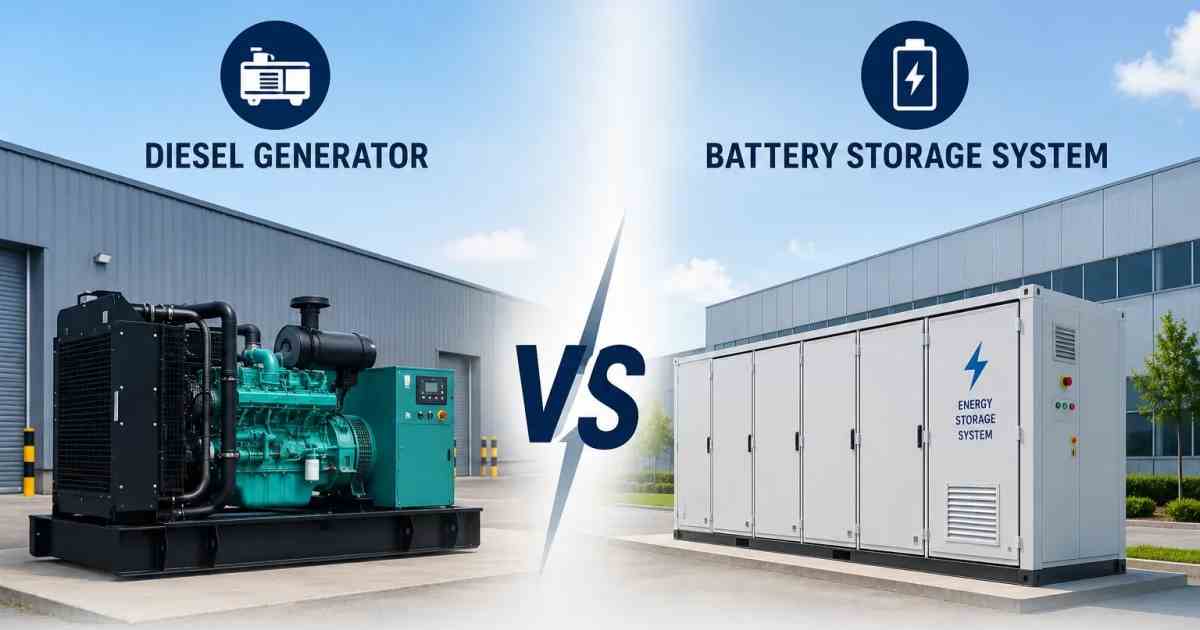
The same outage, two supply chains. Fuel has to be brought to the site; stored energy does not.
What a Battery System Really Costs
A 10 kWh lithium iron phosphate system, installed, lands somewhere between 3,000 and 4,500 USD in most markets in 2026, including the inverter or hybrid unit, the mounting and the electrical work. There is no fuel line, no pad, no exhaust and no annual service contract.
The cost that matters is the one spread across its life. A pack rated at 6,000 cycles to 80% of original capacity, discharged to 90% each time, will deliver roughly 54,000 kWh before it is done. Spread the purchase price across that and the energy costs about 0.065 to 0.08 USD per kWh. That figure is the one to hold next to the 0.40 to 0.50 USD per kWh of diesel.
Two caveats. First, cycle life is not the only limit; a pack that sits mostly full also ages on the calendar, and 10 to 15 years is a realistic service life whatever the cycle counter says. Second, the per-kWh figure assumes you actually use the cycles. A battery bought for backup alone and used 20 hours a year never earns that number back on energy alone; it earns it on noise, on automatic operation and on not having to maintain an engine.
Noise: The Number That Decides Most Arguments
Sound is where the comparison stops being abstract. A small diesel generator produces 65 to 75 dB(A) at 7 metres, which is roughly the level of a vacuum cleaner running in the next room, and it produces it continuously for as long as it runs. At night, in a garden, that is the difference between a backup and an event the whole street knows about.
A lithium system with no active cooling is effectively silent; the only sound is a relay click at transfer. Units with fans sit around 30 to 40 dB(A) at one metre, which is quieter than a refrigerator and drops below the background level of a residential street within a few metres.
This is the argument that sells storage in dense housing, in hospitality, in clinics and in any building where the backup runs while people are trying to sleep or work. It is also the argument that is hardest to retrofit: you cannot quieten a generator without an enclosure that costs a meaningful fraction of the set itself.
Fuel and Maintenance, Priced per kWh
Putting the two systems on the same axis makes the difference visible. The table below uses a 3 kW average backup load, which covers refrigeration, lighting, internet and a few small appliances in a typical home.
Cost item
Diesel generator, 8 kW
Battery system, 10 kWh
Equipment
3,000 – 8,000 USD
3,000 – 4,500 USD
Installation, transfer switch, pad, exhaust
800 – 2,000 USD
800 – 1,500 USD
Servicing over 10 years
1,500 – 4,000 USD
0 – 500 USD
Fuel or energy, 40 hours of outage a year
520 – 800 USD
0 if solar charged
Fuel or energy, 150 hours of outage a year
1,950 – 3,000 USD
0 if solar charged
Cost per kWh delivered
0.40 – 0.50 USD
0.065 – 0.08 USD
Refuelling during an outage
Required
Not possible
The figures are typical published ranges for small residential equipment, not measurements from our own test bench, and local prices move them by 30% either way. The relationship between them does not move: diesel is cheap to buy and expensive to run, storage is the reverse.
How Fast Backup Actually Starts
Transfer time is quoted carelessly in most brochures, and the difference between the categories is large enough to matter for what you can keep running.
System type
Transfer time
What it protects
Online double-conversion UPS
0 ms
Servers, medical equipment, anything that cannot tolerate a gap
Hybrid inverter with a backup port
10 – 20 ms
Whole-home essentials; electronics ride through without rebooting
Diesel generator with automatic transfer switch
10 – 30 s
Everything, once the engine is up to speed
Our all-in-one units are specified at 0 ms transfer, because the inverter is already supplying the load and the grid is simply one of its inputs. A hybrid inverter with a backup port typically transfers in 10 to 20 ms, which is fast enough that computers and routers stay up. A generator, by contrast, has to start, stabilise and only then accept load, so anything without a UPS in front of it will blink.
If your reason for buying backup is a freezer, a sump pump or a home office, the difference between 20 milliseconds and 20 seconds is the difference between not noticing and losing a day.
Runtime Is Where the Generator Still Wins
One honest limitation. A 10 kWh battery running a 3 kW load gives you about three hours at 90% depth of discharge. A generator with 100 litres of fuel gives you roughly 100 hours at the same load. No amount of battery marketing changes that arithmetic.
What changes it is how you count. A battery sized for backup is not used once and thrown away; a 150-hour outage year is 50 full cycles, and a 6,000-cycle pack absorbs that for well over a decade. The limitation is per event, not per lifetime. A battery cannot carry you through a five-day regional failure, but it can carry you through the fifty short ones that happen in between, and it will do it without anyone going outside to start it.
Solar Changes the Arithmetic
A battery charged from the grid is a convenience. A battery charged from a rooftop array is a small power station that also happens to work during an outage. Once the array is on the roof, the marginal cost of the stored energy is close to zero, and a multi-day outage becomes survivable in daylight even if the pack cannot cover the nights.
This is the configuration we see most often in weak-grid regions, where the grid is present but unreliable rather than absent. The battery covers the daily cuts, the array refills it, and the generator — if there is one — stays off for months at a time. We wrote about the sizing side of that in why weak-grid regions are adopting storage faster than stable ones.
The upstream emissions of a battery depend entirely on what charged it. Charged from a coal-heavy grid it displaces diesel exhaust at the point of use but not much at the smokestack; charged from solar it is close to zero on both ends. The US Energy Information Administration publishes the grid carbon intensity behind that statement, and it varies by a factor of ten between regions.
Running Both Together
The hybrid setup is not a compromise; for some sites it is the correct design. The battery takes every short interruption automatically, which is the vast majority of events. The generator stays connected but idle, and only starts when the outage passes a set duration or the pack drops below a threshold.
The savings come from hours, not from capacity. A generator that runs 20 hours a year instead of 150 needs less fuel, fewer services and far less attention, and the battery absorbs the wear that short cycling puts on an engine. If you already own a generator, adding storage is usually cheaper than replacing the generator with a larger one.
The controls matter more than the hardware here. The battery has to be able to command the generator to start, and the generator has to be able to feed the battery charger without fighting the inverter. That is a commissioning detail, and it is worth asking about before you sign.
A hybrid setup: the battery takes the short cuts, the generator waits for the long ones.
What We Build
Our residential line covers both shapes of the problem. The wall-mounted 5.12 kWh unit handles essentials in a flat where floor space is the constraint, and the stacked series scales from 5.12 to 25.6 kWh on the same 51.2 V platform when the load list grows. Both run LFP cells rated at 6,000 cycles to 80%, carry IP54 enclosures and hold CE, IEC 62619 and UN38.3 certification.
Where the whole house has to stay up, the 6 kW all-in-one pairs a 51.2 V, 20.48 kWh pack with the inverter and the transfer logic in one cabinet, and switches at 0 ms. For commercial sites, the liquid-cooled outdoor cabinets run from 215 to 372 kWh and are built to sit next to the load rather than in a plant room.
Sizing is the part that decides whether any of this works. If you are still working out how much backup you need, start with the load-list method rather than with a product. And if you are comparing platforms, the 48 V versus 51.2 V question decides your inverter options before it decides anything else.
Frequently Asked Questions
Is a battery backup really silent?
A unit without active cooling is silent apart from a relay click when it transfers. Units with fans measure around 30 to 40 dB(A) at one metre, which is below the background noise of a residential street at a few metres. There is no engine, so there is no continuous sound source.
How long can a battery run during an outage?
Divide usable capacity by your average load. A 10 kWh pack at 90% depth of discharge gives about three hours at 3 kW, or about nine hours at 1 kW. Solar charging extends that during daylight; nothing extends it at night except a larger pack.
Does battery backup produce emissions?
Nothing is emitted where the battery sits. The emissions belong to whatever charged it, so a pack charged from rooftop solar carries almost none and a pack charged from a coal-heavy grid carries the grid average. EIA publishes the grid figures if you want the regional number.
Should I keep my diesel generator?
Keep it if your outages regularly run past a day, if you are in a region where the grid can be down for a week, or if you already own a set that is in good condition. Run it on a schedule, keep the fuel treated, and let the battery take everything short. Replacing a working generator with a larger battery rarely pays.
Can a battery and a generator share the same transfer switch?
They can, but the sequencing has to be designed rather than assumed. The usual arrangement is a battery inverter on the critical-load panel and the generator on the upstream side, with the inverter holding the load while the generator starts and synchronises. Ask for the single-line diagram before installation; if nobody can produce one, the design is not finished.
What size battery replaces a 10 kW generator?
There is no direct conversion, because a generator is rated for continuous output and a battery is rated for stored energy. What you match is the load and the duration: list the circuits you want to keep running, add up their running watts, decide how many hours you need, and multiply. A 3 kW essential load for four hours needs about 12 kWh of usable capacity. Our capacity guide walks through the calculation, and the safety overview covers what the certification marks actually test.
P
Peter Lu
Energy Storage Product Manager, GreenMore
Works with homeowners and installers on backup sizing, comparing battery storage with generators on outage length, load profile and running cost. He handles the residential and commercial storage lines at GreenMore.
Updated on November 16, 2026





 Network Supported


