How much does a 20 kWh solar battery cost?
Jun 13, 2025
Three quotes for one house
Three quotes landed for the same house last month. All three said 20 kWh on the front page.
The first was $1,800. The second was €12,400. The third was €22,000.
The $1,800 quote was a pack on a pallet from Shenzhen, no inverter, no electrician, no grid paperwork. The €12,400 quote was a branded system on the wall, commissioned and notified to the network operator. The €22,000 quote was the same capacity from a premium brand with whole-home backup.
None of them lied about the capacity. The gap is not in the cells.
What the number on the box means
A 20 kWh battery holds 20 kWh. It does not hand you 20 kWh.
LFP packs are usually rated for 90 to 95 percent depth of discharge in daily cycling, NMC around 80 to 90. A 20 kWh LFP system leaves roughly 19 kWh you can draw. Quotes almost never say which figure they divided by, and on a 20 kWh system the two readings differ by about $1,000.
Power is a separate number. A 20 kWh pack behind a 5 kW inverter will not start a 7 kW heat pump with the sun down, however full it is. Capacity is how long you can run. Power is what you can switch on at once. Both are on the datasheet, usually a page apart.
Where a 20 kWh quote actually goes
A typical €16,000 turnkey quote, itemised the way the installer sees it:
Line
Amount
Share
LFP cells and modules
€2,600
16%
BMS, harness, fuses
€550
3%
Hybrid inverter, 5 kW
€1,250
8%
Enclosure and bracket
€650
4%
Cable and protective devices
€480
3%
Consumer unit modification
€600
4%
Installation labour, two people
€1,300
8%
Commissioning and notification
€470
3%
Certification
€250
2%
Freight
€350
2%
Brand margin
€2,400
15%
Installer margin
€5,100
32%
The cells are 16 percent of the invoice. The other 84 percent is the work of turning a pack into something an electrician will sign off and a network operator will accept.
One line moves more than the rest between 10 kWh and 20 kWh, and it is not the battery. A 20 kWh system delivering 5 to 8 kW sometimes needs its own way into the board and sometimes a new board; older Dutch and British boards often need both, at €300 to €800 and £250 to £1,400. So 20 kWh installation runs closer to twice the 10 kWh figure than to 1.4 times it.
Five prices for one battery
The same 20 kWh, priced at each stage it passes through:
Layer
20 kWh
Per kWh
What the layer adds
Cell pack, ex-works China
$1,600–1,800
$80–90
Cells, BMS, enclosure
Branded system on the wall
€11,500–15,000
€575–750
Power stage, certification, software
Turnkey in the Netherlands
€14,500–18,000
€725–900
Labour, board work, notification
Turnkey in the United States
$16,000–22,000
$800–1,100
Permits, inspection, backup panel
Premium all-in-one
€19,000–25,000
€950–1,250
Whole-home backup, warranty
The top bar and the bottom bar describe the same 20 kWh, 15 times apart.
A power stage. A test-house file with a certificate number. A person on site who signs the commissioning sheet. A name on a ten-year warranty that still answers the phone in year eight.
The bottom row is where brand pricing lives. The Sonnen Eco 20 lists near €20,000 in the Netherlands; a Huawei LUNA2000 of the same capacity is €11,500. The difference is software and what the warranty says about year ten.
What 20 kWh costs where you live
2026 published ranges, from the factory gate to five installed markets:
Market
Turnkey price
Per kWh
Before or after subsidy
Australia
A$14,172–15,172
A$709–759
After STC, A$18,600 before
United Kingdom
£14,000–17,000
£700–850
VAT zero
United States
$16,000–22,000
$800–1,100
Pre-ITC
Netherlands
€14,500–18,000
€725–900
No subsidy
Sweden
SEK 132,600 median
SEK 6,600
Pre-ROT
China, ex-works
$1,600–1,800
$80–90
Pack only
Do not rank these against each other. A British figure carries no VAT until April 2027; a Swedish one carries 25 percent. The Australian numbers already have the federal rebate taken out; the American ones do not. The only fair comparison is two quotes for the same house in the same country.
Sweden is worth its own note. Twenty-seven published prices in November 2026 ran from SEK 101,000 to SEK 177,000 for 20 kWh, median SEK 132,600. One model, the Emaldo Power Store at 20.48 kWh, came in at SEK 91,000 from one installer and SEK 70,810 from another. Same box, 28 percent apart.
Where the price per kWh bottoms out
Australian prices for the battery alone, installed, after the federal rebate, from the Solar Choice battery price index:
Usable capacity
Installed after STC
Per kWh
10 kWh
A$7,384
A$738
20 kWh
A$14,172
A$709
30 kWh
A$20,689
A$690
40 kWh
A$27,911
A$698
50 kWh
A$35,534
A$711
The curve bottoms out at 30 kWh and turns back up. That is the rebate schedule, not a manufacturing quirk: past 28 kWh the scheme pays 15 percent of the certificate rate.
Sweden runs the pattern cleaner, because there is no capacity taper. The cheapest 20 kWh system there has four times the capacity of the cheapest 5 kWh system and costs 1.63 times as much, which drops the unit price 59 percent.
The saving is real. It is also why people buy 20 kWh when 10 would have done the job.
How far 20 kWh goes after dark
A 20 kWh LFP system gives about 19 kWh usable. A night actually draws:
Household
Annual use
Night load
Capacity left idle
Netherlands, average home
2,430 kWh
4.0 kWh
15.0 kWh
Europe, 4 people, heat pump
6,500 kWh
9.8 kWh
9.2 kWh
Europe, plus an EV
9,000 kWh
13.6 kWh
5.4 kWh
Australia, typical home
7,300 kWh
10.0 kWh
9.0 kWh
Australia, house with pool
10,200 kWh
15.4 kWh
3.6 kWh
The Dutch row is the one to sit with. The average household there uses 2,430 kWh a year and needs about 4 kWh overnight; a 20 kWh battery leaves 15 kWh doing nothing until morning. Sellers there quote a threshold of 6,000 to 8,500 kWh a year before 20 kWh makes sense, three times the national average.
Winter makes it worse. A Dutch or British roof yields about 0.8 kWh per installed kWp per day in December. Filling 20 kWh would take 25 kWp, and no terraced house has 25 kWp. From November to February the battery charges off-peak or it sits empty. That is the season, not the product.
So in northern Europe a 20 kWh system is an off-peak arbitrage and backup asset in winter and a solar store in summer. In Australia it is a solar store year round, and it only earns its keep with a pool, an EV or a large all-electric house.
One cabinet or a stack
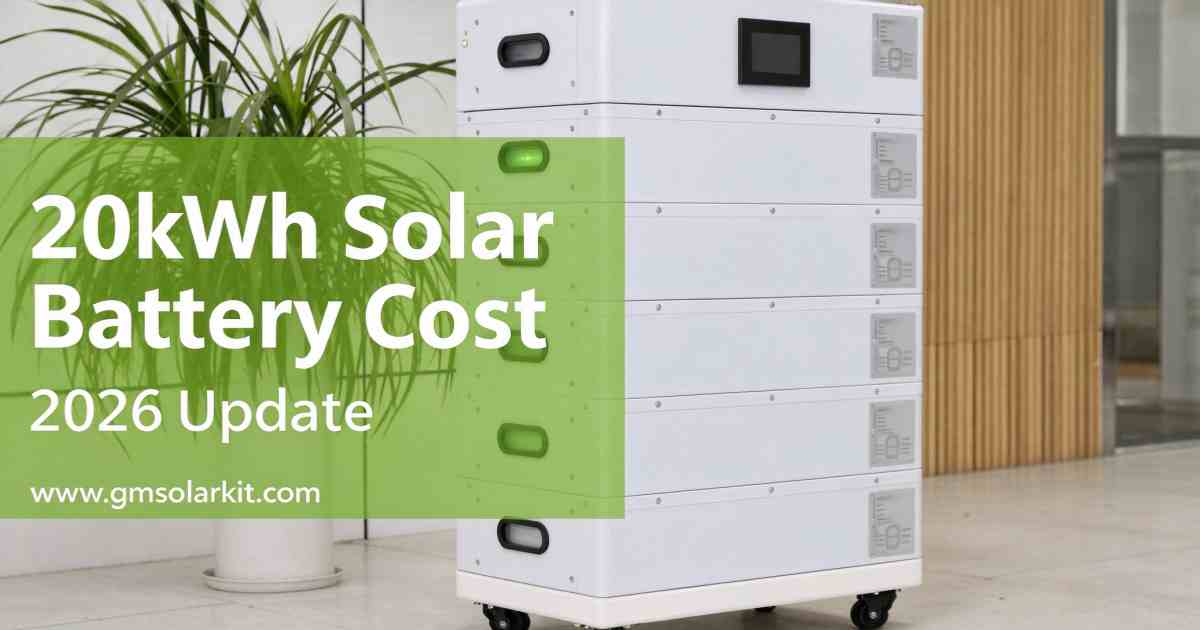
20 kWh is not a standard box. It is a number that gets assembled.
Eight 2.56 kWh stackable modules reach 20.48 kWh. Four 5.12 kWh wall units in parallel reach 20.48 kWh. Both are sold as "20 kWh", and both undercut a single 5 kWh unit, because the inverter and the site visit are shared across more energy.
The trade between them is real. One integrated cabinet has one BMS, one warranty contact, a cleaner wall and a single commissioning sheet. A parallel stack has four points of failure, but you can buy two now and two later, and a dead module comes off the wall without a crane.
GreenMore builds both: a stackable box from 2.56 to 25.6 kWh, and a wall unit that parallels to 40.96 kWh at eight. A 20 kWh job is eight of the first or four of the second, and the gap between those routes is usually narrower than between two brands of the same shape.
How subsidies move the number
Four programmes, and what each does to a 20 kWh system:
Market
Mechanism
Value on 20 kWh
Ends or steps down
Australia
STC, 119 certificates
A$4,400
Falls to 5.7 on 1 Jan 2027
United Kingdom
VAT zero rate
£700–850
31 March 2027, then 5%
United States
30% federal credit
$4,800–6,600
Steps down from 2033
Netherlands
Net metering removed
€1,200–1,800 a year
1 January 2027
The Australian sum, done by hand. Under the current rules the first 14 kWh of usable capacity earns 6.8 certificates per kWh, 14 to 28 kWh earns 60 percent of that, 28 to 50 kWh earns 15 percent. A 20 kWh system claims (14 × 6.8) + (6 × 6.8 × 0.60) = 119 certificates, about A$4,400 at A$37 each.
The British zero rate has a condition that catches people: it applies where the same contractor supplies and installs the battery. Buy the pack yourself and hire an electrician separately, and the hardware is standard-rated at 20 percent while the labour stays zero-rated. On a £15,000 job with £8,000 of hardware, that mistake adds £1,600.
The American 30 percent arrives through the federal residential clean energy credit: $16,000 to $22,000 becomes $11,200 to $15,400, for anyone with the tax liability to use it. State programmes sit on top.
The Dutch change works the other way. Net metering disappears on 1 January 2027, which turns a battery from optional into the thing that keeps self-consumed solar valuable. Sellers there now model €1,200 to €1,800 a year from storage alone, putting a €16,000 system at 9 to 13 years.
Reading three quotes side by side
Six things to line up before you compare the totals.
Nominal or usable capacity, and which one the per-kWh figure was divided by
Inverter included or excluded, and whether it is hybrid or AC-coupled
Board work inside the price or billed extra
Who files the grid notification and who pays
Warranty on product and on installation, as separate numbers
Whether the quote covers backup circuits, and how many
Most comparisons go wrong at the divider. Divide by usable capacity, not the number in the product name, and make sure both quotes include the inverter and the installation in the figure you divide. A quote that looks 20 percent cheaper usually moved one of those items outside the line.
Frequently Asked Questions
Is 20 kWh too big for an average house?
In most of Europe, yes. The average Dutch household uses 2,430 kWh a year and needs about 4 kWh overnight, so a 20 kWh system leaves 15 kWh idle every night. It fits a house with a heat pump, an EV or both, or an all-electric home above 6,000 kWh a year; in Australia, a pool or a large all-electric house. Below that, a 10 kWh system delivers most of the same bill reduction for less capital.
How much does a 20 kWh battery cost per kWh?
$80 to $90 per kWh buys the pack ex-works. €575 to €1,250 per kWh buys a branded system on the wall. €725 to €900 buys it installed in the Netherlands; $800 to $1,100 in the United States. All four describe the same 20 kWh, and the difference is labour, certification and margin rather than storage.
Do I need a three-phase connection for 20 kWh?
Not for the capacity, usually for the power. A 20 kWh system delivering 5 to 8 kW will run on single phase in many countries, but refilling 20 kWh inside a short off-peak window on one phase takes longer than most tariffs allow. Installers in the Netherlands and Germany quote three-phase above 10 kWh for that reason. Check what your supply is before you compare quotes, because an upgrade takes weeks.
Is 20 kWh cheaper as one unit or as stacked modules?
Modules usually win on hardware cost per kWh. Integrated cabinets win on labour and paperwork. Four parallel 5 kWh units share one inverter and one site visit; an integrated cabinet needs one commissioning sheet and one warranty call. Which one lands cheaper depends on how much board work your house needs, and that is a site question rather than a product question.
Does the price include installation?
Only if the quote says turnkey. A pack price excludes the inverter, the board work and the grid notification, and on a 20 kWh job those three lines run 20 to 30 percent of the installed cost. Board work alone reaches four figures in an older house.
How much does a 20 kWh battery save per year?
In the Netherlands, €1,200 to €1,800 once net metering ends. In the UK, £850 to £1,500 for a large home with an EV. In Australia, A$900 to A$1,400 for a typical household, more with a pool. Those figures assume daily cycling, which a 20 kWh unit in a house needing 10 kWh overnight will not do. The payback worked through on a real tariff is in our guide to whether home storage pays.
If you are sizing a system for a specific house, send the twelve-month consumption figure, the peak load and a photo of the consumer unit. That is enough to say whether 20 kWh is the right number or an expensive one. Start with the stackable home battery range, the wall-mounted 5.12 kWh unit, or browse the full home energy storage line. For a quote on a particular configuration, use the contact page.
PL
Peter Lu
Energy Storage Product Manager
Peter covers residential and commercial storage at GreenMore, from cell selection through to grid connection. He has spent eight years on LFP system design for European and Australian installers.
Updated on November 17, 2026





 Network Supported


