What is the role of energy storage inverter?
Sep 24, 2024
P
Peter Lu
Energy Storage Product Manager, GreenMore
An energy storage inverter — often called a power conversion system, or PCS — is the device that sits between a battery and the building or grid. It does more than convert DC to AC. It decides when the battery charges from solar or from the grid, when it discharges to run the loads, and whether the home can keep running when the grid drops. Every performance and safety claim in a storage brochure depends on how this device actually behaves.
Bidirectional DC/AC conversion
When the sun is producing more than the home is using, the inverter converts the DC from the solar array and battery to AC for the appliances. When solar stops and the battery is called on to discharge, the same inverter converts the battery's DC back to AC. In grid-tied systems the inverter also converts AC from the grid to DC to charge the battery, typically at night under a time-of-use tariff. The conversion is not loss-free; round-trip efficiency depends on the topology, switching frequency and operating point, and should be read from the datasheet rather than a headline "peak efficiency" figure.
Grid connection and power control
The inverter is the point of interconnection with the grid, so it must match the local grid code: voltage and frequency windows, power factor, fault ride-through and anti-islanding. Modern units also provide active and reactive power control, which lets the battery support voltage regulation and, where allowed, participate in frequency services or demand-response programs. Peak shaving works the same way — the inverter clips the household draw from the grid by discharging the battery during the highest-load window. Whether any of these functions are actually available depends on the inverter's firmware and the local utility rules; the capability list on a spec sheet is not a guarantee that your installer or utility has enabled it.
Off-grid operation and backup
When the grid fails, the inverter disconnects and must form a stable AC waveform for the home to keep running. This requires a grid-forming capability, not just a grid-following one. The switchover time — often quoted as a single number — depends on how the system is wired, whether a separate automatic transfer switch is used and which loads are on the backed-up circuit. For sensitive loads, verify the actual architecture rather than relying on a "millisecond" claim. In off-grid systems the inverter runs the whole house and must handle large inductive loads such as pumps and compressors starting, which is why sizing is normally done with a power margin over the connected peak load.
Battery communication and safety
The inverter reads the battery's state of charge, voltage, current and temperature through CAN, RS485 or a vendor-specific protocol, then enforces charge limits and triggers alarms or shutdown if the battery reports a fault. This is the first line of defense against overcharge and over-discharge, and why inverter-battery compatibility matters: two devices can each be well-made and still not talk to each other properly. Where the PCS includes an isolation transformer, it also provides galvanic separation between the DC and AC sides, which is often preferred for commercial and outdoor installations.
Schematic diagram of integrated photovoltaic, energy storage and charging architecture
Residential vs commercial PCS
Attribute
Residential hybrid inverter
Commercial/utility PCS
Typical power
3 to 15 kW per phase
50 kW to several MW
DC voltage range
Often 48 to 60 V class for low-voltage batteries
500 to 1500 V for high-voltage packs
Topology
Transformerless for efficiency and weight
Often with isolation transformer
Installation
Indoor or sheltered outdoor
Outdoor, sometimes containerized
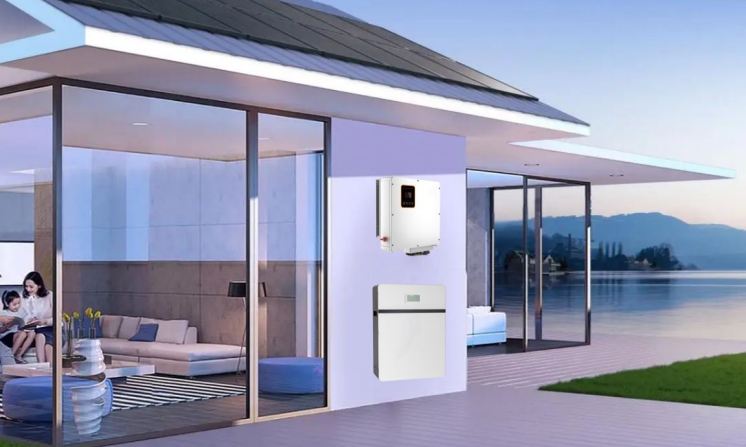
GreenMore supplies both types: the three-phase hybrid inverter for residential and small commercial systems, and larger PCS units with isolation transformer (50 to 250 kW) and MW-class PCS for utility and industrial systems. The right choice depends on battery voltage, grid code and whether isolation is required.
What to check when choosing
Power margin. The rated output should exceed the expected peak load, not just the average, especially where inductive loads start together.
Efficiency at your operating point. Look for European or CEC weighted efficiency rather than a single peak figure, and check the curve at partial load.
Battery compatibility. Confirm the inverter speaks the same protocol as the battery and that the voltage range overlaps; do not assume a CAN port means it will work.
Grid-code approval. Where the local utility requires a specific type-test or approval, confirm the inverter has it before ordering.
Standby and no-load losses. These run all day; a unit that idles at high consumption erodes savings silently.
If you want to check which inverter fits a specific project, use the contact page and share the battery voltage, grid code and peak load.
FAQ
Is an energy storage inverter the same as a solar inverter?
Not necessarily. A pure solar inverter only converts DC from panels to AC. A storage inverter must also convert AC to DC to charge the battery, manage bidirectional power flow and handle grid-tied and off-grid modes. A hybrid inverter combines both functions in one device.
What is the difference between a PCS and a hybrid inverter?
PCS is the broader term used for commercial and utility-scale bidirectional converters, often with an isolation transformer and MW-class power. Hybrid inverter usually refers to the smaller residential unit that also handles solar input. The underlying function — bidirectional DC/AC conversion with grid and battery control — is the same.
Does the inverter affect battery life?
Yes, indirectly. If the inverter misreads the battery state, charges beyond the manufacturer's limits or fails to stop on a fault, it can stress the cells. Using a matched inverter and battery from the same ecosystem reduces this risk.
Can the inverter run critical loads during an outage?
Yes, if it has off-grid capability and the critical loads are wired to the backed-up output. The duration depends on the battery capacity and the load size, not on the inverter alone.
P
Written by Peter Lu — Energy Storage Product Manager, GreenMore
Peter works with distributors, installers and system integrators to size residential and commercial storage around real load profiles. He focuses on LiFePO4 systems that match the inverter, grid rules and backup needs of each destination market.





 Network Supported

