CIGS or BC on a Curved Tile: Why TOPCon Stays Flat
Mar 25, 2026
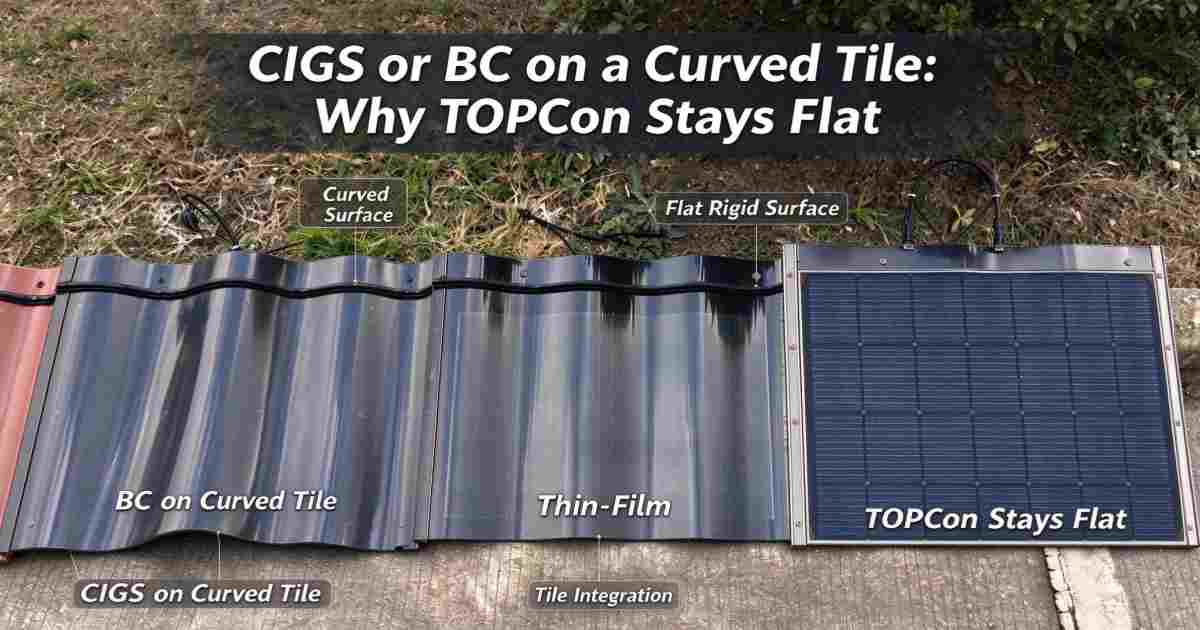
Why is the flat tile offered in TOPCon while the three-curve tile is not? It is the first technical question on most curved-roof enquiries, and the honest answer has nothing to do with which cell is better. TOPCon is the strongest mainstream cell technology on the market right now. It simply does not survive the shape.
A three-curve tile makes specific demands of a cell, and those demands are what push TOPCon out of the curved range and leave CIGS and back-contact as the two answers. The product-level comparison between the CIGS and BC tiles is covered separately in the three-curve tile range; this piece is about the cell decision underneath it.
One Factory, Three Cell Technologies
Our range uses three cell technologies, and they sit in three different products:
CIGS thin-film on the three-curve tile, 25 to 32 W per tile.
Back-contact crystalline on the newer three-curve tile, 37, 42 and 50 W per tile.
PERC and TOPCon on the flat tile, 75 to 100 W per tile.
The flat tile is the biggest and the cheapest per watt. The curved tiles are smaller, more expensive per watt, and the only ones that work on a roof profile with a compound curve. That split is not a marketing decision. It follows from four constraints that a curved tile imposes and a flat one does not.
What a Three-Curve Tile Asks of a Cell
Start with the geometry. A three-curve tile covers 0.294 m² of roof, measures 720 × 500 mm, sits in a 32 mm interlocking body, and goes down at 3.4 pieces per square metre with an 85 mm head lap. The laminate has to live inside that body without changing the profile, because the profile is what keeps the roof waterproof.
Then add the service conditions. The tile carries a 5400 Pa front load, has to survive being walked on during installation, and the HW32L body is tested against 25 mm hail at 23 m/s. It works between −40 and +85 °C. Laid, it weighs about 21.5 kg per square metre, which is the number a retrofit carpenter cares about.
Finally, the appearance. The colour has to run evenly across a whole roof plane, not vary from pallet to pallet, because a roof is viewed as one surface.
Those constraints rule out more cell technologies than buyers expect.
Why TOPCon Stops at the Flat Tile
Cutting a wafer cell down to tile size
TOPCon is built as a full-square wafer with passivation layers on both faces. The passivation is what gives it its efficiency, and it stops at the edge of the wafer. Cut that wafer into strips and every cut face is unpassivated silicon, which is a recombination site.
On a full-size module the cut edges are a small fraction of the total area, so the loss stays modest. On a tile the cell is a fraction of a wafer, and the perimeter-to-area ratio climbs steeply as the cell shrinks. The efficiency advantage TOPCon holds at wafer scale narrows once you have cut it into pieces small enough to fit inside a 32 mm tile body, and the yield loss from cutting adds to the cost at the same time.
Bending the glass
A TOPCon laminate is rigid. The three-curve profile is a compound curve, which means the glass itself would have to be formed, and the cells inside it still cannot bend. Formed glass is possible, but it is a low-yield process, and a rigid cell on a curved glass carries concentrated stress at the apex of the curve during a 5400 Pa load test.
CIGS sits on a flexible substrate and is laminated into the curve rather than forced into it. That is the whole reason thin-film exists in this product category. Our back-contact tile takes a third route: a shaped rigid laminate specified for gentle curves only, which is why we do not offer it for tight or compound profiles.
Bypass granularity on an interlocked roof
A tiled roof is lapped in both directions, and shade does not fall in neat rectangles on it. A chimney, a ridge line or a dormer shades part of one tile and the top of the next. Small cells in series need bypass diodes at a fine enough granularity that one shaded tile does not drag a whole string down.
More bypass means more diodes and more junction boxes inside a 32 mm body, which is already carrying an interlocking profile and a cable route. Higher current density per cell makes the mismatch cost of partial shade worse, not better. This is one of the reasons the curved products are specified with per-tile connectors and short strings rather than long runs.
Where TOPCon does win, and where we use it
Set the tile geometry aside and TOPCon is the best value cell on the market. A flat tile has no compound curve, so it takes standard glass and a standard lamination line, and it comes out at 75, 80, 95 or 100 W per tile, roughly 150 to 200 W per square metre, at 10.5 kg for a 1424 × 440 mm piece. Nothing in the curved range gets close on cost per watt.
That is why the flat tile keeps TOPCon and the curved tile does not. It is not that one technology is superior. It is that the flat format lets TOPCon be used as designed, at full wafer size, on flat glass.
The same factory, three cell routes, three different tile formats.
Why CIGS Fits a Compound Curve
CIGS is a thin-film absorber deposited on a flexible substrate. There is no wafer to cut, so there is no cut edge to lose, and the laminate can follow the tile profile through lamination rather than being bent afterwards.
The trade is power density. A CIGS three-curve tile delivers 25 to 32 W, and between 77 and 105 W per square metre depending on colour: the black-jade finish reaches 100 to 105, brick red sits at 87 to 92, and the blue-wave and smoke-grey finishes come in at 77 to 82. Custom colours land between 82 and 98. Weight is 6.6 kg per tile, 21.5 kg per square metre laid.
In exchange you get three things that matter on real roofs. It conforms to curves that a rigid laminate cannot follow. It keeps producing in diffuse light, which is why it holds up in coastal and northern climates. And its colour is a property of the film rather than a coating, so it stays uniform across a plane and does not fade at the same rate as a surface treatment.
The failure mode to know about is delamination at the encapsulant edge, which is a manufacturing and installation quality issue rather than an inherent flaw; we wrote about it in CIGS edge delamination.
Why Back-Contact Still Earns Its Place on a Curved Roof
Back-contact moves all the metallisation to the rear of the cell, which removes the front busbars and the shading they cause. On the same 720 × 500 mm footprint as the CIGS tile, the BC tile delivers 37, 42 or 50 W, with module efficiency of 24.1% on the 50 W version and 23.9% on the other two.
Fifty watts against twenty-five is roughly double the output from the same roof area, and on a project where every square metre of roof is already committed, that difference decides the array size. The tile weighs 6.5 kg, carries the same 5400 Pa front load, and comes in grey, green, red and black.
The limitation is mechanical. The laminate is rigid, so the BC tile is specified for gentle curves and standard curved profiles with stable structural support, not for tight or compound curves. If the roof profile came from an architect rather than a catalogue, CIGS is the safer answer.
The Three Routes Side by Side
Item
CIGS three-curve
BC three-curve
TOPCon flat
Cell route
CIGS thin-film on a flexible substrate
Back-contact crystalline
PERC / TOPCon crystalline
Power per tile
25 to 32 W
37 / 42 / 50 W
75 / 80 / 95 / 100 W
Power per roof area
77 to 105 W/m², by colour
About 170 W/m² at 50 W
Roughly 150 to 200 W/m²
Size and weight
720 × 500 × 32 mm, 6.6 kg
720 × 500 × 32 mm, 6.5 kg
1424 × 440 × 18 mm, 10.5 kg
Curve capability
Compound and tight curves
Gentle curves with stable support
Flat planes only
Front load
5400 Pa
5400 Pa
5400 Pa
Colour range
Black jade, brick red, blue wave, smoke grey, custom
Grey, green, red, black
Standard module finishes
Warranty
25-year linear power
10-year product, 25-year power
25-year linear power
Best fit
Architectural profiles, light structures, retrofit, diffuse light
Premium black roofs where output per square metre decides
Flat roofs, terraces, cost-driven projects
Reading Those Numbers Correctly
Efficiency and watts per square metre are not the same figure
The BC datasheet quotes 24.1% module efficiency. The same 50 W tile over 0.294 m² of roof works out to about 170 W per square metre, which is 17%. Both numbers are correct and they are not measuring the same area: efficiency is calculated on the illuminated cell area, watts per square metre is calculated on the roof area the tile actually covers, including the lap that disappears under the course above.
Anyone comparing a tile against a framed module needs to use the same basis. A framed module quotes efficiency over its full aperture and covers no lap, so the two figures are not directly comparable. Use W per square metre of finished roof to size an array, and efficiency only to compare one cell against another.
What the warranty actually says
The back-contact curved tile carries a 10-year product warranty covering materials and workmanship, plus a 25-year power warranty. The CIGS tile and the flat PERC/TOPCon tile are covered by a 25-year linear power warranty. Ask for both documents rather than the headline figure, because a power warranty without a product warranty leaves you owning a working module on a failed roof.
How We Specify It on a Project
Four questions, in this order, decide the tile:
Is the profile flat? Then TOPCon, and the argument is over.
Is the curve compound, or is the roof structure light? Then CIGS, because the laminate has to conform and 21.5 kg/m² is a number old timber can carry.
Is the curve gentle and is output per square metre the deciding factor? Then back-contact, at up to 50 W per tile.
Does the client need a specific colour across a large plane? Then CIGS, where the colour comes from the film rather than a surface finish.
The two curved families are on the site as the 32 W triple-arch hantile and the back-contact curved tile. If the roof is being built rather than re-covered, the sequence in how to install solar tiles applies to both.
The lap is what makes the roof watertight, and it is also what takes roof area away from the array.
Frequently Asked Questions
Why is TOPCon not offered on the three-curve tile?
Because the cell has to be cut small enough to fit a 32 mm tile body, and every cut face loses the edge passivation that makes TOPCon efficient. On top of that, a rigid laminate cannot follow a compound curve without formed glass and concentrated stress at the apex. The efficiency advantage it holds at wafer scale does not survive those two constraints.
Is CIGS less efficient than crystalline?
Yes, on a per-square-metre basis, and we do not pretend otherwise. The CIGS three-curve tile delivers 77 to 105 W per square metre against roughly 170 for the back-contact tile. What it buys in return is the ability to follow a compound curve, lower weight per square metre, and better output in diffuse light.
Can I mix CIGS and BC tiles on one roof?
Physically yes, since both share the 720 × 500 mm footprint and the same interlocking profile, and mixing is sometimes the right answer on a roof with one tight curved section and one long gentle plane. Electrically they need separate strings, because the current and voltage characteristics differ. Do not put them on the same MPPT input.
Which one lasts longer?
Both carry a 25-year power warranty, and the back-contact tile adds a 10-year product warranty on top of it. The practical difference is the failure mode rather than the lifespan. Thin-film failures tend to appear at the laminate edge and show up as moisture ingress. Crystalline failures tend to appear as microcracks from handling and thermal cycling. Both are installation-quality problems more often than product problems.
Does the flat TOPCon tile work on a low-slope roof?
It works as a roof covering at the slopes the profile is designed for, but it generates best at the tilt the array is designed around. On a low-slope roof the output per square metre falls and the economics change. That is an array design question, not a tile question.
What certifications should I ask for on a curved tile?
EN 14782 for the metal roofing element, EN 1090-1 for the structural component, and IEC 61215 and IEC 61730 for the electrical side, plus ISO 9001 and ISO 14001 for the factory. What those certificates actually prove, and what they do not, is set out in EN 14782 and IEC 61215.
L
Luke
Product Manager, BIPV Solar Tiles
Works across the CIGS and back-contact tile lines, mostly on projects where the roof profile was drawn before anyone asked whether a cell could follow it.
Updated on November 16, 2026





 Network Supported


