What's the best home battery?
Mar 26, 2025
There is no single "best" home battery for every house. The right one is the unit that matches your daily usage, the loads you want to keep running in an outage, and your local electricity tariffs. The models worth shortlisting do share a few things: lithium iron phosphate (LiFePO4) cells, a clearly stated usable capacity and power rating, a solid warranty, and the certifications required in your market. What separates them is not the biggest number on the brochure — it is how those numbers hold up under comparison.
This guide walks through the comparisons that actually change the answer, including the one metric most buyers never calculate and the efficiency figures that make two identically rated batteries perform differently on the same wall.
Start with the chemistry
Why LiFePO4 became the default
Most new home batteries use LiFePO4 cells, and for good reason. Compared with the older NCM and NCA chemistries used in some electric vehicles and early home batteries, LiFePO4 is more thermally stable and less prone to thermal runaway, tolerates more charge cycles, and generally lasts longer. That combination is why it has become the default choice for stationary home storage.
What chemistry does not solve
LiFePO4 is not immune to damage if misused. Overcharging, charging below freezing, sustained heat and deep discharge during storage can all shorten its life, and none of those protections come from the cell chemistry. They come from the battery management system and from how the system is installed and set. Chemistry narrows the field; it does not pick the winner. For the operating limits in practice, see how to use home solar batteries correctly.
The numbers that actually separate products
Datasheets mix several different kinds of number. The table below is the shortlist worth comparing side by side, with the range you should expect to see.
Specification
What to compare
What to expect
Usable capacity
Usable kWh, not nominal capacity
Measured usable energy can land up to 19% below the datasheet figure. That is what a German lab found testing 26 residential systems
Power rating
Continuous kW, plus surge capability
Around 0.5C is common: 5 kW from a 10 kWh pack. Air conditioners and pumps pull several times their running current at startup
Round-trip efficiency
AC-to-AC for the whole system, not cell-level DC
85–92% for a residential LiFePO4 system. Cell-level figures of 95%+ leave out the inverter, BMS and thermal losses
Cycle life and warranty
Cycles at a stated depth of discharge, alongside years and any throughput guarantee
6,000 cycles at 80% DoD is a typical LiFePO4 figure. A cycle count without a stated DoD is not comparable
Backup capability
Critical-loads panel or whole-home backup
Whole-home backup needs grid-forming hardware and the right wiring, not just a bigger battery
Certification
The listing your market actually requires, by name
UL 9540 for North America; IEC 62619 plus CE for the EU. A CE mark alone does not open a North American grid connection
Usable capacity is where the brochures stretch
The gap between nominal and usable capacity is the most common source of disappointment after installation. A pack sold as 10 kWh may hold back a reserve at the bottom and a headroom margin at the top, and the BMS may limit discharge further at temperature extremes. If the datasheet quotes 10 kWh and the measured usable figure is 8.1 kWh, you have bought 19% less than you thought, which is exactly the spread a laboratory test of 26 residential systems reported.
Ask for the usable figure in writing, and ask what depth of discharge it assumes. If you are working out what a given capacity means in practice, converting amp-hours to kilowatt-hours is the place to start.
Efficiency: the number that is rarely quoted honestly
Round-trip efficiency is the share of energy you get back after a full charge and discharge. Cell-level figures of 95% and above are common and technically true, but they describe the cells alone. Once you add the inverter, the BMS standby draw and thermal management, a residential system typically lands at 85–92% AC-to-AC.
Where the system sits matters too. DC-coupled architectures, where the battery shares a DC bus with the panels, commonly reach 93–96%. AC-coupled retrofits, where power passes through two inverters, usually sit around 85–90%. The DC advantage is real but conditional: it depends on a high battery voltage, so a low-voltage 51.2V pack does not automatically inherit it.
Cost per usable kilowatt-hour
Almost every buyer starts by comparing price per kilowatt-hour, and almost every buyer is misled by it. Dividing the purchase price by nominal capacity ignores three things at once: how much of that capacity you can actually use, how many cycles it will survive, and how much energy it loses in conversion. A cheaper battery can easily cost more per unit of delivered energy.
A worked comparison
Take two hypothetical 10 kWh units with the same headline capacity. Divide the price by usable capacity multiplied by rated cycles, and the ranking flips.
Battery A
Battery B
Purchase price
€3,200
€2,600
Nominal capacity
10 kWh
10 kWh
Usable capacity
9.0 kWh
8.0 kWh
Rated cycles
6,000
4,000
Cost per usable kWh per cycle
€0.059
€0.081
Annual cost at 300 cycles
€160
€195
Battery B is €600 cheaper to buy and 37% more expensive to own per unit of energy delivered. Over ten years at 300 cycles a year the gap runs to roughly €350 — enough to erase the discount and then some. The prices here are illustrative; run the same arithmetic with your own quotes and the ranking usually holds. Efficiency belongs in the same calculation, because every five percentage points of round-trip loss adds roughly 6% to the cost of each kilowatt-hour that reaches your house.
Match the system to your household
Capacity and form factor should follow how much electricity you use and which loads matter. A sensible starting point is covering the evening peak and a few essential backup circuits, rather than trying to run the whole house indefinitely.
Household
Suitable setup
Small to medium home
A compact wall-mounted battery paired with a suitably sized inverter, covering evening loads and essential backup
Large home or villa
A modular stacked system that expands module by module, with higher power for heating, pools and multiple large appliances
Frequent or long outages
A grid-forming battery sized for critical loads, with enough solar to recharge the next day
AC-coupled, DC-coupled or hybrid
The architecture decides how many conversion steps your energy takes, and therefore how much of it arrives. It is also the decision that most constrains what you can do later.
Architecture
Round-trip efficiency
Best for
Watch out for
AC-coupled
85–90%
Adding storage to an existing PV inverter you want to keep
Two inverters and more conversion steps; the loss is small per cycle but adds up over years
DC-coupled
93–96%
New builds where panels and battery are planned together
The efficiency gain depends on high battery voltage; power ceiling is fixed by the hybrid inverter
Hybrid
Either path
Households adding storage now and more panels or an EV charger later
More complex hardware; firmware quality varies more than the spec sheet suggests
Don't overlook the BMS and support
What a BMS should actually do
A battery management system monitors every cell's voltage and temperature, balances charge across cells, and disconnects the system if a limit is exceeded. It is the main thing protecting the cells day to day, so a well-designed BMS with readable monitoring is worth more than vague "smart" claims. Ask what it does at the extremes: does it taper charge current as the pack approaches freezing, does it protect against over-current and short circuit, and can your installer read its fault history without calling the factory?
If safety is the priority rather than feature count, the underlying standards are worth understanding. UL 9540, UL 9540A and IEC 62619 each test for something different, and the article on whether home energy storage batteries are safe breaks them down.
Support decides the real cost of a fault
Equally important is what happens after installation. Confirm the warranty terms in writing, who handles a faulty unit and where, and whether spare parts and technical support exist in your country. A battery that fails in month eighteen and takes four months to replace has cost you far more than the price difference with a better-supported product. A slightly cheaper unit with weak support is rarely cheaper over its life.
What to ask before you sign
A short list that separates a considered quote from a brochure with a price on it:
What is the usable capacity in kWh, and at what depth of discharge?
What is the continuous power rating, and what surge can it carry for how long?
What is the AC-to-AC round-trip efficiency for the complete system?
How many cycles at what DoD, and what does the warranty guarantee at the end of its term?
Which certification covers this exact model for my market, and can I see the certificate?
Which loads will be backed up, and what will not run during an outage?
Which inverter models and firmware versions are on the compatibility list?
Who services it locally, and what is the typical replacement lead time?
Work with GreenMore
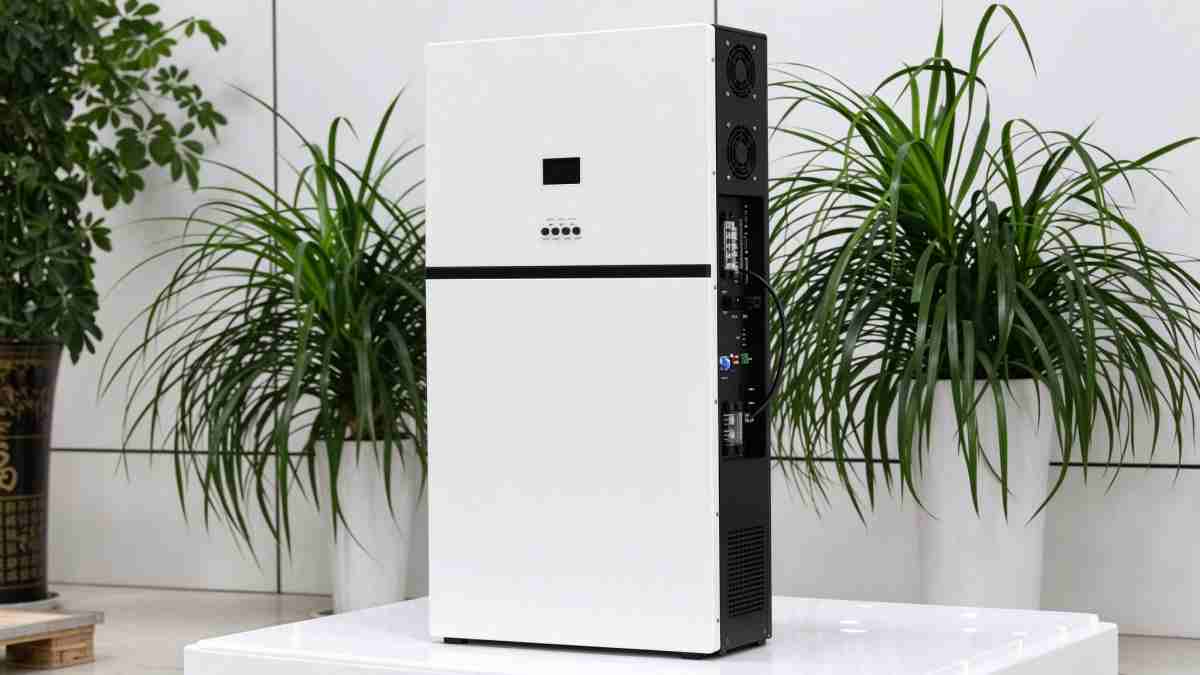
GreenMore builds home energy storage batteries with LiFePO4 cells and a BMS handling monitoring, balancing and protection, in wall-mounted and modular form factors with compatible inverters. Rather than a fixed package, we size the system against your actual usage and tariff plan and supply the documentation needed for installation in your market. The stacked series runs from 5.12 kWh to 20.48 kWh and is rated 6,000+ cycles at 80% depth of discharge, with a 3-year warranty.
Browse the home storage range, or send us a recent electricity bill through the contact page and we will size a system against it.
Wall-mounted and stacked formats cover the same chemistry at different capacities.
Frequently asked questions
How many kWh does a typical home need?
It varies with household size and usage. Many homes find that a battery covering the evening peak and a few essential backup circuits delivers the best value, rather than buying enough capacity to run everything. Your recent electricity bills give the most accurate figure. A household using 12 kWh a day rarely needs more than 10 kWh of storage to shift most of its evening load.
Is a bigger battery always better?
No. An oversized battery that rarely fills wastes money, while one that is too small runs out early. The power rating matters as well: a large-capacity battery with low continuous power may not start the appliances you care about.
Why is usable capacity lower than the rated capacity?
Most systems hold back a reserve at the bottom to avoid deep discharge and a margin at the top to avoid overcharging, and the BMS may restrict the range further at temperature extremes. That protects the cells and extends life, but it means the energy you can actually draw is less than the nominal figure. The difference is usually a few percent and occasionally much more. One laboratory study of 26 residential systems found usable energy up to 19% below the datasheet value.
Is AC-coupled or DC-coupled better?
DC-coupled is more efficient, typically 93–96% round trip against 85–90% for AC-coupled, because the energy takes fewer conversion steps. AC-coupled is the better choice when you already have a working PV inverter you do not want to replace. The efficiency gap only applies to energy that cycles through the battery, so if you mostly self-consume during the day the difference is smaller than the headline suggests.
Can a home battery power the house during an outage?
Only if it is installed with backup capability. Some systems back up selected critical circuits, while grid-forming whole-home systems can run more of the house. Runtime still depends on capacity and on solar to recharge.
How long does a home battery last?
LiFePO4 batteries are rated for several thousand cycles under the manufacturer's specified conditions. A common figure is 6,000 cycles at 80% depth of discharge, which at one cycle a day is roughly sixteen years before capacity falls to 80%. Usable life depends on cycling depth, temperature and settings, so compare the cycle-life figure together with the warranty years rather than looking at either alone.
Updated on November 12, 2026
P
Peter Lu
Energy Storage Product Manager, GreenMore
Peter helps homeowners and installers compare batteries by usable capacity, power, efficiency and warranty rather than headline numbers, and focuses on LiFePO4 systems that are correctly sized and properly supported.






 Network Supported


