How to buy a home energy storage system
Jul 24, 2024
P
Peter Lu
Energy Storage Product Manager, GreenMore
Buying a home energy storage system is less about picking a single "best" number and more about matching a small set of parameters to your loads, your grid tariff and your installation space. The right battery for a flat with a small solar roof and a 3-hour evening peak is a very different system from the right battery for a villa with electric heating and a long winter night. This guide walks through the parameters you actually need to compare and the claims that are worth ignoring.
Usable capacity (kWh) — the number that pays the bills
Nominal capacity is the battery's full rating. Usable capacity is what the manufacturer allows you to draw repeatedly without hurting cycle life, set by the recommended depth of discharge (DoD). Size from usable capacity, not nominal. A 10 kWh nominal battery with an 80% DoD gives you about 8 kWh of usable energy; a different battery at the same nominal size with a 90% DoD gives you about 9 kWh.
Start with your evening or backup load in kWh, then add modules until the usable capacity covers that load for the number of hours or days you want. A small efficient home with a short evening peak may be fine with 5 to 10 kWh of usable storage. A family home running heating or cooling through the evening typically lands in the 10 to 20 kWh range. Off-grid or multi-day autonomy requires more and often a generator as well.
Power rating (kW) — what the system can run at once
Capacity is how long you can run; power is how much you can run at the same moment. A battery with a 5 kW continuous output can support lighting, refrigeration and a small heat pump together, but not an electric oven, a clothes dryer and an air conditioner at the same time. Inverter-driven loads such as air conditioners and pumps draw extra current when starting, so the inverter and battery need headroom above the nameplate rating of those loads.
Cycle life and warranty
Cycle life is the number of full charge and discharge cycles the battery can complete before its capacity falls to a defined end-of-life point, commonly 80% or 70% of initial capacity. More cycles are better, but the number only matters when the test conditions match how you will actually use the battery — discharge rate, temperature and DoD all change the result. Read the cycle curve in the datasheet rather than a single headline number.
The warranty tells you what the manufacturer will stand behind in real use. For non-tile storage components GreenMore offers a 3-year warranty. Check what the warranty covers (capacity retention, parts, labor), how it is claimed and whether it requires installation by a certified partner.
Depth of discharge and round-trip efficiency
DoD and efficiency together decide how much energy reaches your appliances. Round-trip efficiency is the ratio of energy you get out to the energy you put in; the rest is lost as heat in the cells, the BMS and the inverter. A system with a higher DoD and a higher round-trip efficiency uses less solar or grid energy to deliver the same backup. Realistic figures for a well-designed LiFePO4 home system are in the high 80s to low 90s percent for round-trip efficiency; any number above that should be supported by a test report you can read.
Chemistry and form factor
LiFePO4 is the chemistry most often recommended for home storage because of its thermal stability and long cycle life. NMC and LFP both work; the choice is usually between safety margins, cycle life and cost. The form factor follows the use case: wall-mounted units save floor space and suit smaller capacities, stacked systems grow capacity in steps, and floor-standing cabinets are used where capacity and power are larger or where the unit lives in a garage or equipment room.
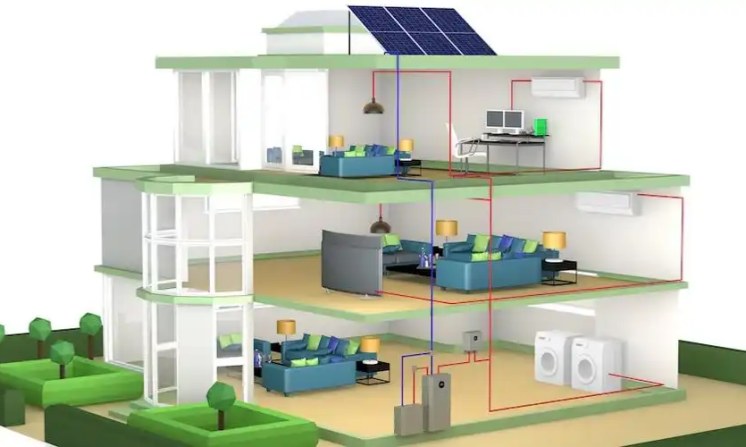
Integrated residential solar and energy storage energy management
Inverter compatibility
The battery and inverter must share a communication protocol and agree on voltage windows and charge limits. A CAN port on each device does not guarantee they will work together; the protocol version and the inverter's compatibility list matter. Where possible, use a matched battery-inverter pair from one ecosystem. If you are mixing brands, confirm in writing that your specific inverter model is listed as compatible with your specific battery model and firmware version.
Certification and protection
A certificate is only useful if you can see it and it matches the product. Common references for residential storage are IEC 62619 (cell and battery safety), IEC 63056 (stationary storage system safety), UN 38.3 and MSDS for transport, and CE for the EU market. In North America UL 9540 / 9540A is the typical system-level fire safety reference. Ask for the documents and check the model number on the certificate matches the product being quoted.
The ingress protection (IP) rating is model-specific. Indoor wall-mounted and stacked systems are designed for sheltered environments; outdoor cabinets carry a higher IP rating. Do not assume every home battery is equally rated for outdoors — check the datasheet for the model you are buying.
Installation and site requirements
The best battery in the wrong place will underperform or fail early. A clean, dry, well-ventilated space within the stated temperature and humidity range is the minimum. Allow the manufacturer's clearance distances for airflow and for future modules if the system is stackable. Use a qualified installer, confirm correct grounding and breaker sizing, and keep the installation certificate — some insurers and utilities ask for it.
A short checklist before you sign
Usable capacity covers your target evening or backup load.
Continuous power and surge rating cover your peak loads and any inductive starts.
Cycle curve and warranty terms match how you will actually use the battery.
Battery and inverter are listed as compatible at the model and firmware level.
Certificates are available and the model number matches the product being quoted.
Installation location meets the temperature, humidity, clearance and ventilation requirements.
Expansion path is clear if you expect to add capacity later, and the maximum stack size is stated in writing.
If you want to check a specific configuration against your load profile, see the home energy storage system product page and the home energy storage category page. For project questions, use the contact page.
FAQ
Should I size by nominal or usable capacity?
Always by usable capacity. Nominal capacity does not reflect the DoD limit or the losses in the inverter and battery. Two systems with the same nominal size can deliver meaningfully different energy to your appliances.
Is a longer warranty always better?
A longer warranty is useful only if the coverage is clear and the claim process is realistic. A 10-year warranty that excludes most real failure modes is less useful than a 3-year warranty that covers capacity retention and parts with a clear claim path. Read the terms.
Can I mix brands of battery and inverter?
Sometimes, but only if the inverter's compatibility list explicitly includes your battery model and firmware. A CAN or RS485 port on each device does not mean they will communicate. Mismatched pairs are a common source of faults and reduced cycle life.
Do I need a separate backup circuit?
You do not need one, but it is often the sensible choice. A dedicated backup circuit keeps the essential loads on the battery and leaves non-essential loads on the grid, which lets a smaller battery cover what matters for longer. Discuss the split with your installer before wiring.
P
Written by Peter Lu — Energy Storage Product Manager, GreenMore
Peter works with distributors, installers and system integrators to size residential and commercial storage around real load profiles. He focuses on LiFePO4 systems that match the inverter, grid rules and backup needs of each destination market.






 Network Supported

