GreenMore Israel Home Solar Roof Project Successfully Completed
Sep 27, 2026
L
Luke
Product Manager, GreenMore · BIPV solar tiles, facades & storage
Israel has some of the best rooftop solar conditions in the region — more than 3,000 hours of sunshine a year and peak sun hours around 5.3 to 6.0 depending on the location. Homeowners here increasingly want that resource used without putting an industrial-looking array on a house they have spent money on designing. This short project note covers a residential roof we completed with our curved photovoltaic tiles and a home battery, including what was fitted and how the system behaves in the local climate.
Project Background
Israel’s national policy aims for 30% of electricity to come from renewable sources by 2030, most of it solar, and households are encouraged to generate on their own roofs. The homeowner had two practical concerns that come up often in this market: conventional panels sit visibly above the roofline and change how the house looks, and in a dusty, hot climate panels can lose output to soiling and high operating temperatures. The goal was therefore a roof that generated its own power, stored some for evening use and still looked like a normal finished roof.
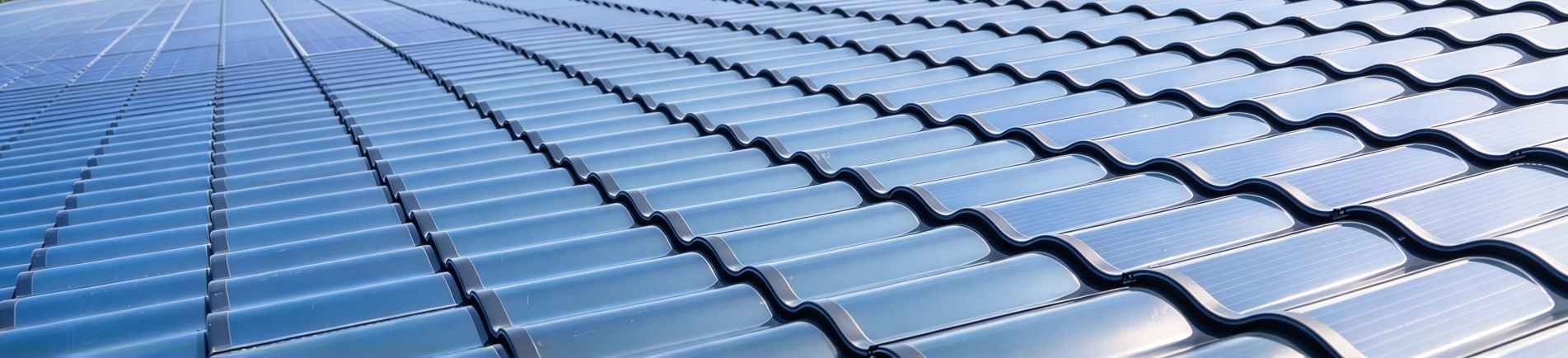
Photos of the Israeli Tri-Curve Solar Tile Project
What We Installed
Triple-arch photovoltaic tiles
The roof uses our triple-arch solar tiles, which follow the curve of traditional clay tiling rather than sitting on a rack. They are built from laminated toughened glass, rated for 5400 Pa static load and Class A fire performance, and operate across −40 °C to +85 °C, which suits both the hot inland summers and coastal humidity. A few design points matter for this climate:
The curved profile sheds rain and, because dust does not settle as flatly on a smooth curved surface, normal rainfall helps keep the glass cleaner between washes.
The tiles are laid with an air gap behind them, so heat can escape rather than being trapped against the roof, helping the cells run closer to their rated temperature.
Colors are matched to the building so the finished roof reads as tiling rather than equipment.
Home battery and hybrid inverter
Household demand in Israel tends to peak in the late afternoon and evening, after midday generation has passed its peak. We therefore paired the tiles with a stackable home battery from our energy storage range and a hybrid inverter with MPPT tracking. The combination covers three functions: daytime self-consumption, storing midday surplus for the evening, and backup for selected loads during an outage on an island-capable setup. Capacity is chosen per household; a 10–15 kWh battery is a common fit for a home of this size, and stackable units can be extended later if the family’s use grows.
System Layout and Expected Output
The pitched roof offered roughly 140 m² of usable area. Fully tiled at the curved product’s density of around 103 W/m², that corresponds to about 14 kW and on the order of 420 tiles; in practice the exact count is adjusted around hips, edges and any areas kept clear. On a clear day at local peak sun hours, a system of this size would typically produce in the region of 60 kWh — well above a single household’s daily use, leaving surplus for charging the battery or exporting. We present these as indicative figures from the local solar resource rather than guaranteed meter readings; the real number moves with shading, orientation, soiling and the season. You can see the full tile family in our solar tile category and read more in what is a triple-arch hantile.
What the Homeowner Told Us
The feedback that matters most to us is the simple kind: the roof looks like a normal finished roof from the street, the house uses more of its own solar in the evening thanks to the battery, and the owner no longer treats a short grid interruption as a problem for the lights, refrigerator and internet. We do not attribute invented revenue or percentage figures to customers; the value is easier self-consumption, some backup and lower exposure to tariff rises.
About GreenMore
GreenMore is a photovoltaic tile factory. Our solar tiles, PV bricks and curtain walls are made in our own production facility, and we configure the matching inverter and battery around them so a homeowner or project partner sources a compatible system from one team. We are a focused, growing manufacturer rather than a mass producer, which lets us tailor colors and profiles and give each project direct support. On warranty, the photovoltaic tiles carry a 25-year power output warranty, while the inverter, battery and other non-tile components carry a 3-year warranty; the two are specified separately.
Frequently Asked Questions
Do solar roof tiles suit the Israeli climate?
Yes. High irradiance suits generation, the laminated glass handles heat and UV, and the curved surface and rear air gap help with dust and temperature. Occasional washing in the dry season is still advisable.
Is a battery necessary with the tiles?
No. The tiles work grid-tied on their own. A battery mainly helps use midday generation in the evening and provides backup during outages, so it depends on the household’s routine and whether export terms are attractive.
Can the system keep running during a power cut?
With an island-capable hybrid inverter and battery, selected critical loads can keep running and the system isolates from the grid for safety. It backs up the circuits you choose rather than necessarily the whole house.
Do you supply the tiles and storage together?
Yes. As the tile manufacturer we supply the roof and configure a compatible inverter and battery for the local grid, so the parts are matched and supported through one contact.
Planning a solar roof in Israel?
Send us your roof area and pitch, orientation, target capacity and whether you want a battery. Use the contact page or email export@gmsolarkit.com, or browse more of our work at www.gmsolarkit.com, and we will recommend a layout and configuration.
L
Written by Luke — Product Manager, GreenMore
Luke manages GreenMore's BIPV tile and storage product line. He has worked on photovoltaic systems since 2017 and supports residential and commercial projects across the Middle East with honest sizing and configuration.






 Network Supported


