GreenMore Israel 14.4 kWp Solar Roof Project
Sep 09, 2025
Israel has some of the best rooftop solar conditions in the region, with more than 3,000 hours of sunshine a year and peak sun hours of roughly 5.3 to 6.0 depending on location. Households there increasingly want that resource used without putting an industrial-looking array on a house they have spent money designing.
This is a field note on one residential roof we completed with our curved photovoltaic tiles and a home battery: what was specified, how it was built, what it produces across a year, and what the numbers look like under the Israeli tariff. Where we estimate rather than meter, we say so.
One thing to be clear about up front: this is not the same project as the 30 kW installation elsewhere on this site. Different house, different roof, different specification. The capacity here is 14.4 kWp.
The Brief
The owner had two concerns that come up in almost every inquiry from this market. Conventional panels sit visibly above the roofline and change how the house looks. And in a hot, dusty climate, panels lose output to soiling and heat, so the array a homeowner pays for is rarely the one the datasheet describes.
The requirement was a roof that generates, stores some for the evening, and still reads as a finished roof.
Item
Specification
Market
Israel
Roof
Pitched, tiled, roughly 140 m² of usable area
Installed capacity
14.4 kWp
Tiles
About 420 triple-arch photovoltaic tiles at 103 W/m²
Battery
Stackable lithium iron phosphate, 10 to 15 kWh
Inverter
Hybrid, grid-tied, with MPPT tracking
Grid connection
Single point, net metering with export under the fixed tariff
Status
Completed 2025
Capacity follows from the roof rather than from a target number. At around 103 W/m², 140 m² of usable area gives 14.4 kWp, and 14.4 kWp at 34 W per tile gives roughly 420 pieces. The final count shifts around hips, edges and access strips.
Why Tiles and Not Panels
This is the decision that shapes everything downstream, and it is not only about appearance.
Consideration
Racked panels
Photovoltaic tiles
Roofline
Raised above the tile plane, visible from the street
Flush with the roof surface
Roof function
Sits on top of the existing covering
Is the covering
Wind loading
Lifted edges and gaps increase uplift
Continuous surface, fewer edges to catch wind
Heat
Air circulates behind the array but the panel itself runs hot
Air gap behind each tile lets heat escape through the roof build-up
Maintenance
Cleaning needs access to a raised plane
Cleaned like a glass roof
Rework at end of life
Panels removed, roof covering still there
Roof and generation replaced together
Appearance and roof function
A racked array is an addition to a roof. A tiled roof is the roof. For a house where the owner has already paid for design, that difference usually decides it, and it is why BIPV exists as a category rather than a finish.
Wind, heat and dust
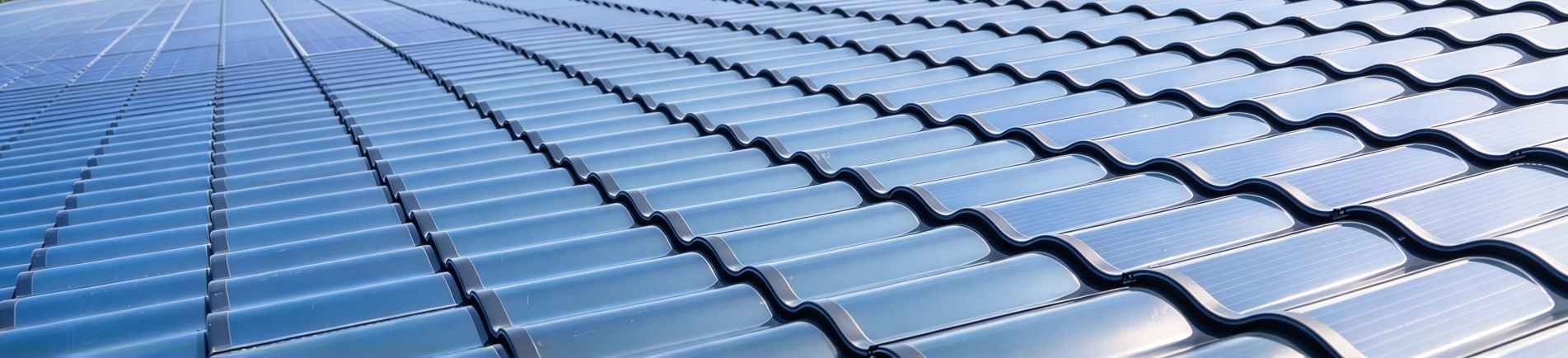
Three physical arguments support the tile approach here. The curved profile sheds rain, and dust does not settle as flatly on a smooth curved surface, so rainfall does some of the cleaning. An air gap behind each tile lets heat escape rather than trapping it against the deck, keeping cells closer to rated temperature. And a continuous surface presents fewer lifted edges for wind than a racked array.
Where panels still win
On a large flat industrial roof, or where budget is the binding constraint and the roof is never seen, conventional panels cost less per watt and remain rational. Tiles make sense where the roof is visible, where the covering needs replacing anyway, and where the owner wants one decision instead of two.
What Went on the Roof
Triple-arch photovoltaic tiles
The roof uses our triple-arch solar tiles, which follow the curve of traditional clay tiling rather than sitting on a rack. They are laminated toughened glass, rated for 5400 Pa static load and Class C fire performance, and operate from −40 °C to +85 °C, which covers inland summer heat and coastal humidity. Colors match the building so the finished roof reads as tiling.
Battery and hybrid inverter
Household demand in Israel peaks in the late afternoon and evening, after generation has passed its peak. The tiles are therefore paired with a stackable lithium iron phosphate battery and a hybrid inverter with MPPT tracking. The combination covers daytime self-consumption, storage of midday surplus for the evening, and backup for selected circuits during an outage where the inverter supports island mode.
Capacity is chosen per household rather than by rule. For a home of this size, 10 to 15 kWh is the common range, and stackable units can be added later if consumption grows.
Grid connection
Export in Israel runs under a fixed tariff rather than spot prices, and the rate depends on size. Systems up to 15 kW qualify for NIS 0.48 per kWh exported, on connection requests filed before the end of 2026, held for the contract term. Above 15 kW the rate falls to NIS 0.2844 to 0.3731. At 14.4 kWp this roof sits inside the smaller band, which matters before anyone adds capacity.
How the Roof Was Built
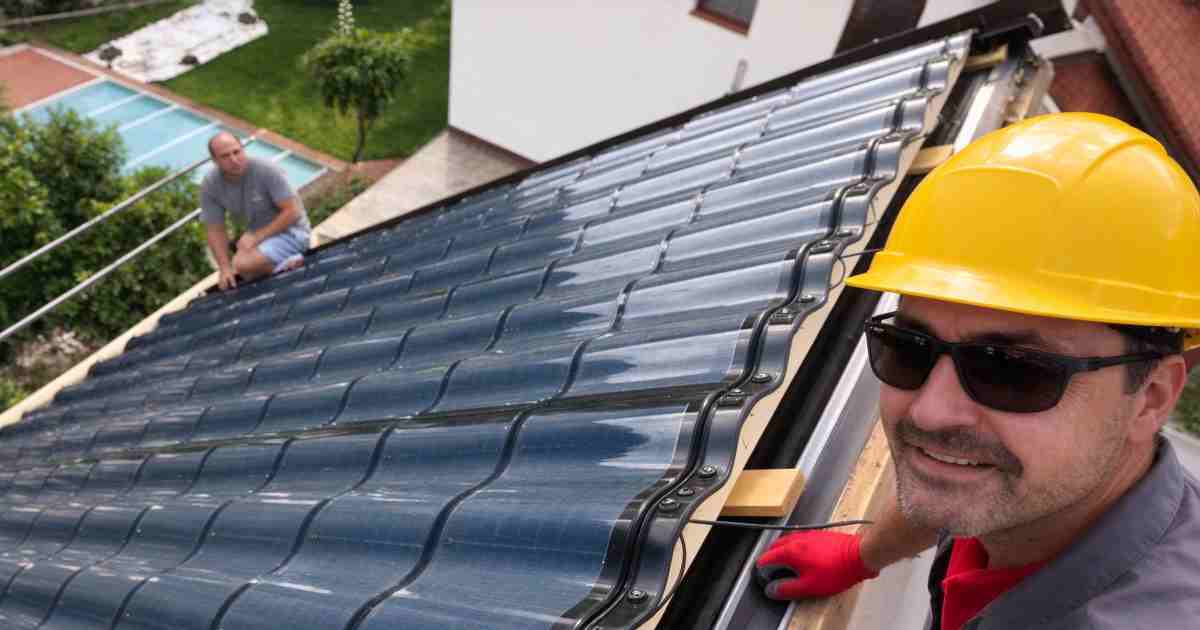
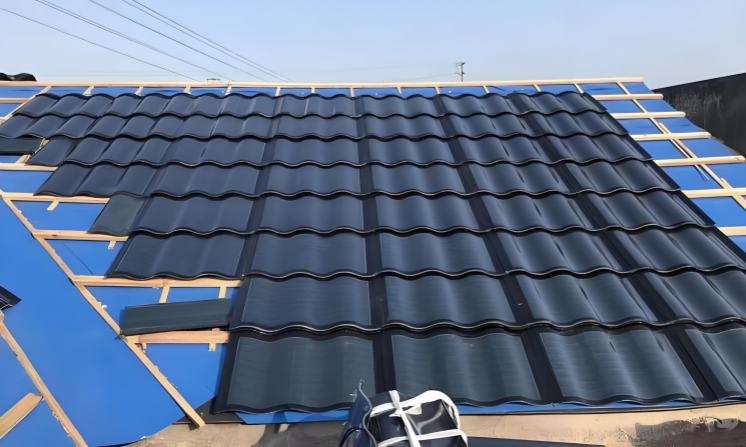
The only photographs we have from this project are from the installation, not from completion. We would rather show the build than stage a shot.
Installation stage on the Israeli roof: batten grid fixed, tile courses going down.
The roof was stripped to the deck and rebuilt in the sequence a tiled roof normally follows, with the electrical work folded in:
Battens and counter-battens fixed to create the ventilated gap and the fixing plane for each course.
Underlay and flashing detailed at valleys, hips and the wall junction before any tile went down.
Tiles laid course by course, with the string wiring run behind the tile plane and connectors kept clear of standing water paths.
Inverter and battery installed indoors, on a wall with the clearance the datasheet requires.
Commissioning, insulation resistance test, and the connection application filed with the local utility.
What decides whether a tiled BIPV roof stays watertight is not the tile but the flashing at penetrations and transitions, which is why it happens before the array.
What the Roof Produces
Generation estimate
At the local solar resource, a 14.4 kWp roof of this type produces on the order of 60 kWh on a clear day in the shoulder seasons, and around 22,000 kWh across a year. Monthly output follows the sun rather than the load, which is the whole reason a battery is in the specification.
Month
Estimated output, kWh
Share of annual
December to February
3,400
15%
March to May
5,900
27%
June to August
7,310
33%
September to November
5,390
25%
Year
22,000
100%
These are modelled figures from the local resource and the installed capacity, not meter readings. Shading, orientation, soiling between washes and the season all move the real number, and a roof with more hips and edges than the design assumed will sit below the model.
Self-consumption and export
A household of this size uses perhaps 7,000 to 8,000 kWh a year, most of it in the evening. That means a 22,000 kWh roof exports the majority of what it makes, and the battery's job is to move the evening peak off the grid rather than to store the whole day.
Destination
Estimated annual, kWh
What it displaces or earns
Direct daytime self-consumption
3,700
Retail tariff avoided
Charged into the battery, then used at night
4,200
Retail tariff avoided
Exported to the grid
14,100
Fixed export tariff
Total
22,000
The battery is deliberately sized below the daily surplus. Storing 14 kWh of midday output to cover a 14 kWh evening would mean a much larger battery, and in a market with a fixed export tariff the economics do not support it. The useful comparison is the spread between the retail tariff and the export tariff, multiplied by the energy the battery can shift each day.
Estimated monthly output and where it goes. The battery covers the evening; the surplus exports.
The Economics in Israel
Israel is an unusually clear market to model because both sides of the meter are fixed by regulation rather than by a market price that moves hourly.
Parameter
Value
Note
Residential tariff, from 1 July 2026
63.52 agorot/kWh including VAT
Uniform household rate
Export tariff, systems up to 15 kW
NIS 0.48/kWh
Connection requests filed before 31 December 2026
System management charge
About NIS 0.09/kWh consumed
Applies to self-consumed output as well
Proposed rate from 2027
Around NIS 0.35/kWh
Draft, not final
The rates are set by the Public Utilities Authority – Electricity, which publishes the tariff book and the connection rules; anyone modelling a project here should read the current edition rather than a figure from a blog post, this one included.
What it earns
The annual value splits into two streams. Self-consumed output, around 7,900 kWh, avoids the retail tariff but carries the management charge, so it is worth about NIS 4,310 a year net. Exported output, around 14,100 kWh at NIS 0.48, is worth about NIS 6,770. Together, close to NIS 11,100 a year, or roughly USD 3,300.
What it cost
We do not publish project prices, and a single figure would mislead because the roof, the battery and the inverter move independently. In this market a roof of this kind lands in these ranges, and the incremental cost matters more than the gross:
Photovoltaic tiles including installation, roughly USD 1.0 to 1.5 per watt, which already replaces the cost of a conventional tiled covering.
Battery, roughly USD 600 to 800 per kWh installed.
Hybrid inverter, roughly USD 100 to 150 per kW.
On those ranges payback lands at eight to eleven years, with the tariff fixed for the contract term and the tiles warranted for 25 years on output. Anyone quoting three years on a roof like this is ignoring the management charge or counting the retail tariff against exported energy.
The 2027 change
The Ministry of Energy and Infrastructure has consulted on cutting the export rate for systems installed from 2027 to around NIS 0.35, with existing contracts honoured. If adopted, the case for a battery gets stronger, because self-consumption stops competing with a generous export rate and starts competing with the retail tariff alone.
What Changed for the Owner
The feedback that matters is the simple kind. The roof looks like a normal finished roof from the street. The house uses more of its own solar in the evening because of the battery. And a short grid interruption is no longer a problem for the lights, the refrigerator and the internet.
We do not attribute invented revenue or percentage savings to customers, and this note contains none. The value is easier self-consumption, some backup, and less exposure to a tariff that has risen every year recently.
About GreenMore
GreenMore is a photovoltaic tile factory. Our solar tiles, PV bricks and curtain walls are made in our own facility, and we configure the matching inverter and battery around them so a homeowner or project partner sources a compatible system from one team.
We are a focused, growing manufacturer rather than a mass producer, which lets us tailor colors and profiles and support each project directly. On warranty, the tiles carry 25 years on power output, while the inverter, battery and other non-tile components carry 3 years. The two should be read separately.
Frequently Asked Questions
Do solar roof tiles suit the Israeli climate?
Yes. High irradiance suits generation, the laminated glass handles heat and UV, and the curved surface and rear air gap help with dust and temperature. Washing in the dry season is still advisable, and soiling is the most common reason a roof underperforms its model.
Is a battery necessary with the tiles?
No. The tiles work grid-tied on their own. A battery mainly helps use midday generation in the evening and provides backup during outages, so whether it pays depends on the household's routine and on the export tariff it faces.
Can the system keep running during a power cut?
With an island-capable hybrid inverter and battery, selected critical loads keep running and the system isolates from the grid for safety. It backs up the circuits you choose rather than necessarily the whole house, and the changeover takes a moment.
What fire rating do the tiles carry?
Class C. We state it plainly because it is the rating the product holds, and it is the figure a specifier should check against the roof's requirements.
Do you supply the tiles and storage together?
Yes. As the tile manufacturer we supply the roof and configure a compatible inverter and battery for the local grid, so the parts are matched and supported through one contact.
Is this the same project as your 30 kW Israeli installation?
No. That is a different house with a different roof and a different specification. This one is 14.4 kWp with a 10 to 15 kWh battery; the other is 30 kW with 30 kWh of storage. We keep them separate because the design logic behind each is different.
L
Luke, Product Manager
GreenMore · BIPV solar tiles, facades and storage
Luke manages the BIPV tile line at GreenMore and works on residential and commercial roof projects across the Middle East, Europe and Africa. He writes about what actually happens on site, including the parts that go wrong.
Updated on November 17, 2026





 Network Supported


