48V or 51.2V: What the Number on the Label Actually Means
Dec 25, 2025
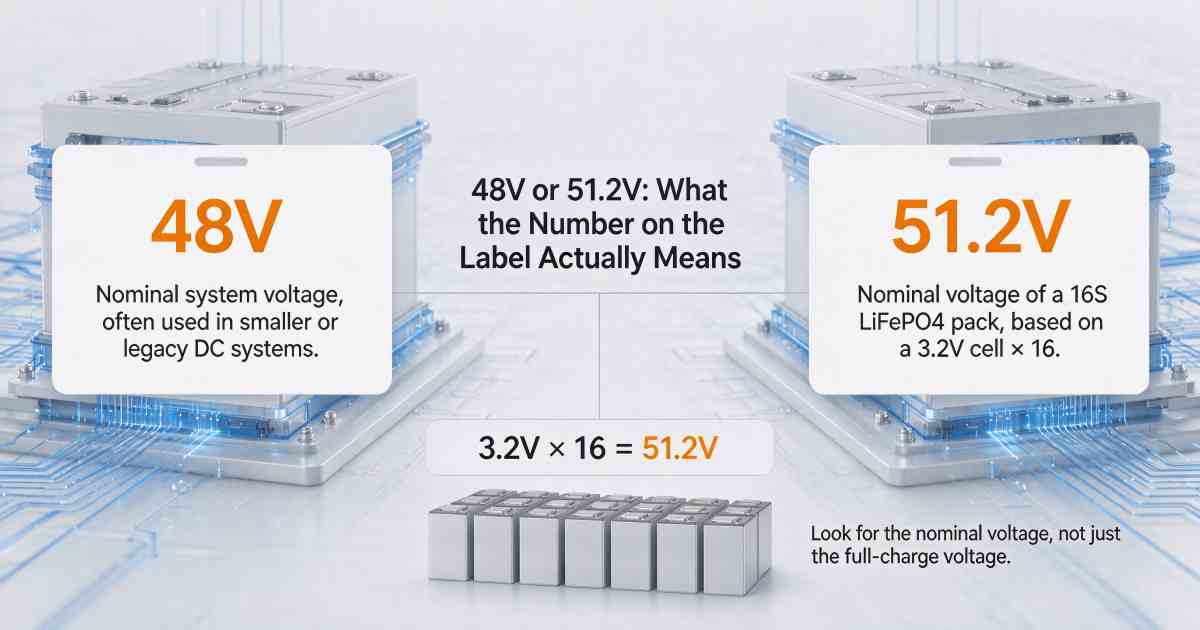
A buyer comparing quotations will see 48V on one and 51.2V on the next, and reasonably assume they are different products. They are not. Both describe a pack built from sixteen lithium iron phosphate cells in series, and the only difference is whether the number came from a marketing tradition or from arithmetic.
The distinction matters anyway, because the label decides which inverter will talk to the battery, what the charger is allowed to push into it, and at what point the whole approach stops scaling. Here is what each number actually means, and where the low-voltage platform runs out of room.
The Short Answer
A LiFePO4 cell sits at 3.2 V nominal. Sixteen of them in series give 16 × 3.2 = 51.2 V. That is the whole calculation. The 48V on the box is a system class name inherited from lead-acid, and it has survived because the equipment ecosystem was built around it.
What the label says
What it actually is
48V battery
A sixteen-cell LFP pack. 48V is the class name, not the measured voltage.
51.2V battery
The same pack, named by its arithmetic instead of its class.
48V inverter
An inverter with a DC input window of roughly 40 to 60 V, which is exactly the range a 51.2V pack sweeps through.
48V 100Ah = 4.8 kWh
Wrong on a 16S pack. 51.2 × 100 = 5.12 kWh. The 4.8 figure comes from using the label as the voltage.
That last row is where the confusion costs money. Suppliers who quote capacity from the label understate the pack by about 6%, and buyers who check the arithmetic think they are being short-changed when they are not. Always ask which nominal voltage the kilowatt-hour figure was calculated at. Our own pages list 51.2 V for this reason, and the capacity tables follow from it.
Where the 48V Label Comes From
A flooded lead-acid battery is 2.0 V per cell. Twenty-four cells in series give 48 V nominal, and that number became the standard for telecom, marine and off-grid equipment long before lithium was an option. Chargers were built to push those strings to 57.6 V for absorption and 60 V or more for an equalise cycle, and inverters were built to accept the resulting window.
When LFP arrived, nobody wanted to redesign the inverters. Four LFP cells replace six lead-acid cells in roughly the same space, so a string that lands in the same voltage window needs sixteen LFP cells rather than twenty-four lead-acid ones. 16 × 3.2 V is 51.2 V, which sits comfortably inside a window originally drawn for 48 V lead-acid. The name stuck because the equipment did.
This is not a quirk of one factory. Almost every low-voltage hybrid inverter sold today is specified against the same 40 to 60 V window, and almost every LFP pack built for it is 16S. The naming is inconsistent; the engineering is not.
Why 16S and Not 15S
Fifteen cells would give 15 × 3.2 = 48.0 V, which matches the label exactly and looks like the tidier answer. It is not the one the market chose, and the reason sits at the top of the charge curve rather than in the middle of it.
A 15S pack tops out at 15 × 3.65 = 54.75 V at the absolute ceiling. Most 48 V chargers run their absorption stage between 56.0 and 57.6 V, because that is what a lead-acid string needed. A 15S pack cannot reach that band, so the charger either finishes early or sits in absorption chasing a voltage the battery will never accept. A 16S pack reaches 58.4 V at the ceiling and holds 56.0 to 56.8 V through absorption without difficulty.
Fifteen-cell packs exist and some are sold as 48V, but they are a minority format with fewer BMS options and fewer inverter profiles that recognise them. If a quotation does not state the series count, ask. It is the single number that tells you whether the pack was designed for the charger or adapted to it.
The Window You Actually Work With
The nominal figure is a midpoint, not an operating voltage. A 51.2V pack spends its life between roughly 48 V and 54 V, and the ends of the range are where inverters misbehave.
Point on the curve
Per cell
16S pack
15S pack
What it decides
Charge ceiling
3.65 V
58.4 V
54.75 V
Inverter over-voltage trip
Absorption
3.50 to 3.55 V
56.0 to 56.8 V
52.5 to 53.3 V
How full the pack actually gets
Nominal
3.20 V
51.2 V
48.0 V
The number on the datasheet
Most of the discharge
3.00 to 3.30 V
48.0 to 52.8 V
45.0 to 49.5 V
Where the pack spends its working life
Inverter low cut-off
2.65 V
42.4 V
39.8 V
Where an outage turns into a shutdown
BMS cut-off
2.50 V
40.0 V
37.5 V
The last line of defence
The gap between the last two rows is where most low-voltage installations go wrong. A 16S pack reaches 42.4 V with roughly a tenth of its energy left, but the inverter stops asking for power at that point. The BMS cut-off at 40 V never gets used in normal operation, which is correct, but it also means the usable capacity is smaller than the datasheet suggests unless the inverter's cut-off is set properly.
Temperature moves the whole table. A cold LFP pack sits lower at the same state of charge, so a pack at 0 °C will hit an inverter cut-off earlier than the same pack at 25 °C. Systems installed in unheated outbuildings need a cut-off set with that in mind, and it is one of the reasons we keep recommending a sheltered position for the battery rather than the coldest corner of a plant room.
A 16S pack spends most of its discharge in a narrow band around 51 V. The steep ends of the curve are where inverters trip. Typical curve, not a measured test result.
Current Is Where the Difference Shows Up
The 6% gap between 48.0 and 51.2 becomes real once you divide power by voltage. A 5 kW load draws 97.7 A from a 51.2V pack and 104.2 A from a 48.0V pack. Six and a half amps, on the same cable, all day. That is the entire practical consequence of the naming difference, and it is small enough that nobody should choose a battery on it.
Load at 51.2 V
DC current
Typical cable, runs under 3 m
Typical DC breaker
3 kW
58.6 A
16 mm² copper
80 A
5 kW
97.7 A
35 mm² copper
125 A
8 kW
156.2 A
50 mm² copper
200 A
10 kW
195.3 A
70 mm² copper
250 A
These are the sizes that turn up most often at this voltage class in the market, not a substitute for a cable calculation. Run length, ambient temperature, conduit grouping and local code all move the number, and the installer who signs off on the system should do the calculation rather than copy a table from a supplier's website. The Wiring Unlimited handbook walks through voltage drop and conductor sizing for DC systems if you want to do it properly.
At 5 kW the pack delivers close to 100 A, so cable and breaker are sized on current rather than on the kilowatt figure in the brochure.
Where 48V Stops Being the Right Answer
The low-voltage platform is comfortable up to about 10 kW. Above that, current becomes the design problem rather than the battery. A 15 kW load at 51.2 V draws 293 A, which needs 120 mm² cable, a 400 A breaker and terminations most residential installers would rather not handle. Low-voltage hybrid inverters above 12 kW are also thin on the ground, so the equipment choice narrows at exactly the point where the installation is getting more expensive.
High-voltage systems solve it by moving the same power at 200 to 800 V. Current drops by a factor of four to sixteen, cable and breaker sizes fall with it, and the cost difference on a 30 kW installation usually pays for the more expensive battery within the first project. The trade-off is that a high-voltage pack needs a matching high-voltage inverter or PCS, and the two cannot be mixed and matched the way 48 V equipment can.
Our own position is that 10 kW is the crossover. Below it, 51.2 V is simpler, cheaper and easier to service. Above it, we quote high-voltage stacks and cabinet systems, and we would rather say that plainly than sell a 15 kW low-voltage system that works but is awkward to install and hard to expand.
Replacing a Lead-Acid Bank
This is the case where the 48V label earns its keep and where it also does the most damage. A 24-cell lead-acid bank and a 16S LFP pack occupy the same nominal class, but they are not interchangeable without changing settings.
Three settings have to change before the swap is safe:
Absorption voltage drops from 57.6 V to about 56.4 V.
Temperature compensation must be switched off, because a lead-acid charger raises voltage in the cold and an LFP pack must not be overcharged for the same reason.
The equalise cycle has to be disabled entirely, since a 60 V equalise charge will trip the BMS into protection every time it runs.
An inverter with a lithium charge profile handles all three. An older inverter without one can still work if it allows user-defined voltages, but somebody has to enter them and check them. If the inverter cannot be set, the battery should not be connected to it, and this is where a cheap replacement turns into an expensive experiment. The failure modes of lithium packs are well understood, and almost every case we see in the field traces back to charge settings rather than cells.
What We Build on This Platform
Everything in our household range is 16S at 51.2 V. The Green Energy Series runs from 5.12 kWh to 25.6 kWh in wall-mounted and stacked formats, with CAN and RS485 for inverter communication and 6000 cycles to 80% capacity. The Super Energy Series extends the same platform to 40 kWh for sites that need more capacity without moving to high voltage.
For off-grid work the 6 kW all-in-one system puts the inverter and a 20.48 kWh pack in one enclosure, which takes the cable and breaker question off the table at that size. The stacked battery covers the case where capacity has to grow after the fact, and the hardware differences on weak grids explain why the inverter choice matters more than the pack on those sites.
Above 10 kW we switch to high-voltage stacks and to the liquid-cooled outdoor cabinets for commercial sites. The cabinet and the battery inside it are designed together, which is the advantage high voltage buys: fewer assumptions left to the installer.
Frequently Asked Questions
Are 48V and 51.2V the same battery?
Yes. Both describe a sixteen-cell LiFePO4 pack. 48V is the system class name inherited from lead-acid equipment, and 51.2V is the calculated nominal voltage from sixteen cells at 3.2 V each.
Will a 51.2V battery work with my 48V inverter?
It will if the inverter's DC window covers roughly 40 to 60 V and it has a lithium charge profile or user-defined voltages. Check the maximum DC input voltage on the datasheet against the pack's 58.4 V charge ceiling, and confirm the low cut-off can be set above the BMS protection point.
What is the full charge voltage of a 51.2V battery?
58.4 V at the absolute ceiling of 3.65 V per cell, though most systems absorb at 56.0 to 56.8 V and never reach the ceiling. Charging to the lower figure costs a fraction of a percent of capacity and adds cycles, which is why we set it that way by default.
How many kWh is a 51.2V 100Ah battery?
5.12 kWh. Multiply 51.2 by 100 and divide by 1000. If a quotation gives you 4.8 kWh for the same pack, they have used 48 as the voltage. The same calculation for a 200Ah pack gives 10.24 kWh.
Can I replace a 48V lead-acid bank with LiFePO4?
Only if the charger can be set to lithium voltages. Absorption drops to about 56.4 V, temperature compensation must be off, and the equalise cycle must be disabled. An inverter that cannot do those three things should not be connected to a lithium pack.
At what size should I move to high voltage?
Around 10 kW. Below that, 51.2 V keeps cable and breaker sizes reasonable and the inverter choice wide. Above it, the current at low voltage gets large enough that installation cost and equipment availability both start to favour a high-voltage system.
PL
Peter Lu
Energy Storage Product Manager
Peter works with installers on low-voltage and high-voltage storage projects, checking inverter windows, charge profiles and expansion plans before a battery is specified.
Updated on November 16, 2026






 Network Supported


