What size solar system do I need for my home?
Sep 27, 2026
L
Luke
Product Manager, GreenMore · BIPV solar tiles & roof systems
Almost every homeowner planning solar hits the same question first: how big a system do I actually need? Buy too small and the bills barely move. Buy too large and money sits on the roof as generation you cannot use. The good news is that sizing is not a mystery — it follows from two numbers you can find yourself: how much electricity your home uses each day, and how much sun your location gets. This guide walks through the calculation, shows worked examples and explains how a battery changes the answer.
Step 1: Find Your Daily Electricity Use
Start with kilowatt-hours (kWh), not the number of panels. There are two straightforward ways to get your average daily figure.
Use your electricity bill
Most utilities show monthly or annual usage in kWh. Take a full year if you can, because heating and cooling vary with the seasons, then divide to get a daily average:
Daily use (kWh) = annual use (kWh) ÷ 365or monthly use (kWh) ÷ 30
Example: a home using 3,650 kWh a year uses about 10 kWh a day.
Add up your appliances
If no bill is available, list each appliance’s power in watts, multiply by its daily running hours and add them up. Remember that fridges and air conditioners cycle on and off, so use their average running time rather than 24 hours at full power. The figures below are illustrative.
Appliance
Power (W)
Typical hours/day
Daily energy (Wh)
Refrigerator
150
8 (cycling)
1,200
Air conditioner
1,500
3
4,500
Lighting
100
6
600
TV and electronics
150
4
600
Washing / kitchen (combined)
—
—
3,100
Total
—
—
~10,000 Wh = 10 kWh
Step 2: Check Your Peak Sun Hours
A solar array is rated by its output under a standard test intensity of 1,000 W/m². The number of hours your location effectively reaches that level is called the peak sun hours (PSH) — it is not the same as total daylight hours. A 1 kW array in a location with 4 peak sun hours produces roughly 4 kWh on an average day. Typical values run from about 3 hours in cloudy northern regions to 5–6 hours in sunnier ones. Use a reliable local solar-resource figure for the exact number rather than a national average.
Step 3: Calculate the Array Size
A simple “kWh ÷ sun hours” gives a theoretical size, but real systems lose some energy to temperature, wiring, inverter efficiency, dust and slight shading. A performance ratio around 0.8 is a reasonable planning figure, so we add it to the formula:
Required array (kW) = daily use (kWh) ÷ peak sun hours ÷ performance ratio (0.8)
Example: a home using 10 kWh a day in a 4 peak-sun-hour location:
10 ÷ 4 ÷ 0.8 = 3.125 kW → a roughly 3 kW system, often sized slightly larger at 3.5–4 kW for headroom.
Two more worked examples: a 30 kWh/day home with 5 peak sun hours needs about 7.5 kW, and a 20 kWh/day home with 4.5 peak sun hours needs about 5.6 kW. These are offset targets, not guarantees — actual output varies day to day.
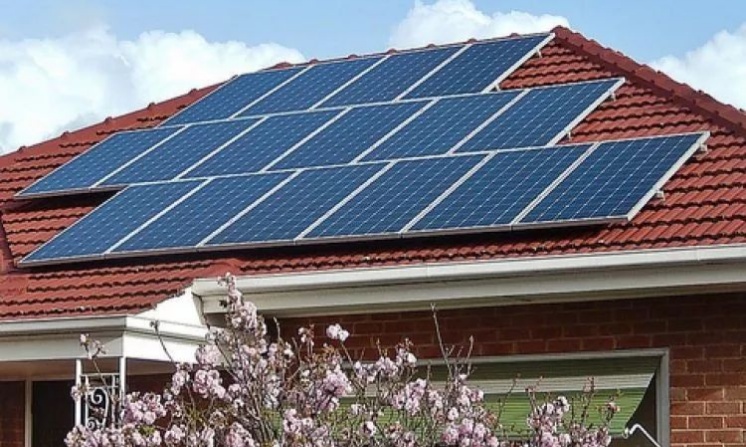
GreenMore residential pitched roof solar system real scene
Step 4: Check the Roof Fits
The calculated kilowatts have to physically fit a suitable roof. As a rough planning figure, modern panels need about 5–7 m² per installed kilowatt, so a 3 kW system needs roughly 16–22 m² and a 7.5 kW system about 38–53 m². South-facing planes are usually best; east and west also work; north-facing planes are generally not worth it. Shading from trees or chimneys should be avoided on the main array. The background to how these systems are put together is in our BIPV system explainer.
If you prefer a tiled roof finish rather than conventional panels, our solar tiles form the weather surface and generate at the same time. Flat photovoltaic tiles run at around 200 W per square metre, while the curved three-arch tiles are around 103 W per square metre because of their traditional profile — so a tile roof needs more area than a high-density panel array for the same capacity, but gives a completely integrated look.
Step 5: Decide on a Battery
A grid-tied system does not require a battery: it uses solar as it is generated and exports the surplus. A battery is worth considering where evening use is high, export is poorly paid or you want backup. Size it from how much evening or backup energy you want to store — not from the whole day’s generation. As a rough guide:
3 kW array — a 5–10 kWh battery usually covers evening use.
5–6 kW array — a 10–15 kWh battery is a common match.
Larger homes — stacked batteries can be added in modules as demand grows.
Because you cannot fully drain a lithium battery, the usable capacity is lower than the nameplate. A battery offering 5 kWh of usable energy, for example, needs roughly 5.6 kWh of nominal capacity at 90% depth of discharge. For genuine off-grid or long-outage backup, size from the daily load times the number of autonomous days, divided by round-trip efficiency and depth of discharge; a 30 kWh/day home wanting three days of cover needs around 111 kWh of installed battery, which is a significant system rather than a typical grid-tied home. How this all fits together is covered in our article on solar with energy storage, and the hardware options are in our home battery range.
Other Factors to Get Right
Local grid rules and incentives — export limits, feed-in tariffs and approval requirements change the economics and sometimes the maximum size you can connect.
Future load — if you plan to add an electric vehicle, heat pump or air conditioning, allow extra capacity now rather than retrofitting later.
Inverter type — choose a hybrid inverter from the start if a battery is likely, since it handles DC and battery connection in one unit.
System compatibility — the panels, inverter and battery should be designed and warranted to operate together.
For larger homes and light-commercial loads we also supply complete pre-configured kits, including a 15 kW solar system, and the broader options sit in our solar systems section. One warranty point worth knowing: the photovoltaic tiles carry a 25-year power warranty, while the battery, inverter and other non-tile components carry a 3-year warranty — the two are separate.
Frequently Asked Questions
How many solar panels do I need for a typical home?
It depends on usage and sun, but a home using 10 kWh/day in a 4 peak-sun-hour location needs roughly a 3 kW array — about 8–10 panels at 350–400 W each. Always size from your own bill rather than a rule of thumb.
Is it better to oversize a solar system?
A little headroom (10–20%) makes sense for cloudy spells and future appliances, but far oversizing a grid-tied home can waste money on generation you export cheaply. Pair extra panels with a battery if you want to keep that energy.
What size battery do I need to go off-grid?
Off-grid systems are sized to carry your full load through the longest expected stretch of poor weather, which usually means a much larger battery and array than a grid-tied home. Tell us your daily load, location and required backup days and we will model it rather than guessing.
Can I add a battery later?
Usually, yes, but it is cheaper and cleaner to install a battery-ready hybrid inverter at the start. Adding storage to an older string inverter sometimes means a second inverter or replacing the original.
Send us your numbers for a sized proposal
Share your annual or monthly kWh use, roof area and orientation, country and whether you want backup storage, and we will recommend an array size, a layout and an indicative quote. Reach us through the contact page or email export@gmsolarkit.com.
L
Written by Luke — Product Manager, GreenMore
Luke manages GreenMore's solar product line and helps overseas partners correctly size panels, solar tiles and batteries for homes and light-commercial buildings. He has worked on photovoltaic systems since 2017 and would rather a system be honestly sized than over-promised.






 Network Supported

