Energy Storage Battery vs Power Battery: How They Differ
May 04, 2025
"Energy storage battery" and "power battery" are both lithium batteries, engineered for different jobs. A power battery pushes energy out fast enough to move a vehicle. An energy storage battery charges and discharges steadily, every day, for years, in a fixed location. Those two jobs lead to different choices of chemistry, cell format, C-rate, thermal management, certification and enclosure. Using one in place of the other means paying for capability you will never use, or losing capability you cannot do without.
What each battery is built to do
A power battery delivers high power for acceleration and absorbs energy under regenerative braking. It is sized around the weight, range and performance targets of a vehicle, and has to keep working across a wide outdoor temperature range while being moved, vibrated and occasionally abused.
An energy storage battery stores energy when it is cheap or available and releases it when the building needs it, thousands of times, in a controlled environment with maintenance access. Weight and volume matter far less than cycle life, safety and total cost of ownership. A power battery is designed around kW, a storage battery around kWh.
Attribute
Energy storage battery
Power battery (EV)
Typical chemistry
Mostly LiFePO4; some NMC where space is tight
Mostly NMC or NCA; LFP growing in entry models
Cell format
Large prismatic cells in rack or cabinet modules
Cylindrical or prismatic, densely packed
Continuous C-rate
Often 0.2C to 1C
Often 1C to 3C, with peaks well above that
Cycle life target
Several thousand cycles at moderate depth of discharge
Hundreds to low thousands of deep cycles
Thermal management
Air cooling on small home units, liquid on commercial cabinets
Liquid cooling almost universal
Certification
IEC 62619, IEC 63056, UN 38.3, UL 9540
UN 38.3, ECE R100, UL 2580
Enclosure
Wall, stacked or cabinet, indoor or outdoor
Built into the vehicle chassis
Design driver
Cost per kWh delivered over life
Power per kg and per litre
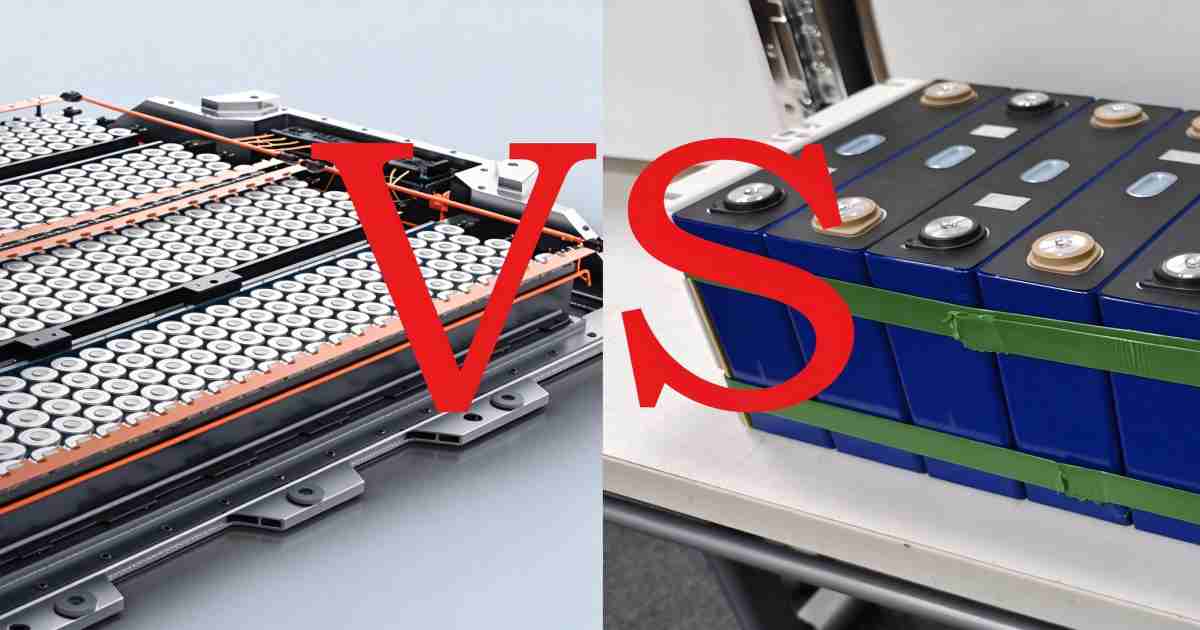
LiFePO4 modules for a stationary pack. Similar cells appear in vehicles; the system around them is what differs.
Energy density and power density pull opposite ways
Energy density is how much energy a battery holds for its weight or volume, in Wh/kg or Wh/L. Power density is how fast it can release that energy, in W/kg. A cell can be optimised for one or the other, and the physics does not let you max out both.
The mechanism is electrode thickness. A thick electrode packs more active material into the same footprint, raising energy density, but ions have a longer path to travel, which raises internal resistance and limits discharge rate. A thin electrode does the opposite. This is why an LFP storage cell is built thick and slow, while a vehicle cell is built thin and fast and pays for it in cost per kWh and cooling load.
Metric
Energy storage battery
Power battery (EV)
What it decides
Gravimetric energy density
Roughly 90 to 160 Wh/kg at cell level for LFP
Roughly 150 to 250 Wh/kg at cell level for NMC
How much energy a given weight holds
Volumetric energy density
Lower; larger cells, heavier packaging
Higher; cells packed tightly
How much energy fits in a space
Gravimetric power density
Roughly 100 to 300 W/kg
Roughly 300 to 1,000 W/kg
How fast energy moves in and out
Electrode design
Thicker coating, more active material
Thinner coating, shorter ion path
The trade between the two densities
Which constraint bites
Weight and volume rarely limit the design
Both are fixed by the vehicle
Where the engineering effort goes
C-rate: what the number means in practice
C-rate expresses current as a multiple of capacity. At 1C a battery delivers its full rated capacity in one hour; at 0.5C it takes two hours and the current is half as large. The number only becomes useful when you multiply it by the capacity you are buying.
A 10 kWh home battery at 0.5C continuous gives 5 kW. That covers a heat pump, an oven and the usual household loads together, but not a 7 kW EV charger at the same time. A 50 kWh commercial cabinet at 0.5C gives 25 kW from the same chemistry. Power packs run at 1C to 3C because the load demands it, and the cooling is sized for those peaks. A more common mistake is specifying a storage pack on capacity alone, then finding the continuous rating cannot carry the site. Our guide to the discharge rate of a lithium battery runs the calculation through.
C-rate
10 kWh pack
50 kWh pack
What that power covers
0.2C
2 kW
10 kW
Base loads: lighting, refrigeration, electronics
0.5C
5 kW
25 kW
Heat pump, oven and most household loads together
1C
10 kW
50 kW
Whole-home load with several large appliances at once
3C
30 kW
150 kW
Vehicle acceleration, not a household scenario
Cycle life depends on how it was tested
A cycle count on its own tells you very little. The same LFP cell can be quoted at 6,000 cycles or 1,800 depending on depth of discharge, temperature and the end-of-life threshold used. Comparing two datasheets without those conditions is comparing two different tests.
Depth of discharge matters most. Cycling between 20% and 100% state of charge is far gentler than cycling the full range, and the difference in energy delivered over life is often larger than the difference in cycle count. Temperature comes second: sustained operation above 35°C shortens life noticeably, which is why air-cooled home units need some ventilation rather than a sealed cupboard. The threshold comes third: 80% of initial capacity gives a shorter count than 70% for the same cell. If a warranty quotes cycles without those three conditions, ask for them. Our note on how long a 10 kWh battery lasts for a family works through the same arithmetic.
How it is quoted
Test conditions
Cycles
What it means in practice
Best case
25°C, 0.5C, 80% depth of discharge, 80% end of life
6,000
Roughly 16 years at one cycle a day
Typical
35°C, 1C, 90% depth of discharge, 80% end of life
3,500
Roughly 9 to 10 years at one cycle a day
Harsh
45°C, 1C, full depth of discharge, 70% end of life
1,800
Around 5 years, and most warranties exclude this duty
Thermal management follows the duty cycle
A power battery absorbs large, fast heat swings from acceleration and fast charging while sitting outdoors, for the life of the vehicle. Liquid cooling is close to universal in EV packs for that reason.
A stationary battery sees slower, more predictable cycles but may run for many hours at a time for a decade. Small home units use passive or fan-assisted air cooling, adequate at 0.2C to 0.5C. Commercial and utility cabinets use liquid cooling not because the C-rate is high, but because a large pack in a sealed cabinet needs cell temperatures held close together so one module does not age faster than its neighbours. Our overview of the outdoor energy storage cabinet and the container energy storage system covers how that scales.
Enclosure follows the same logic: a home unit is a wall-mounted pack or a stack of modules, and outdoor-rated versions are a packaging question as much as a thermal one.
Cost per kWh and cost per kW are different currencies
Storage is priced by energy, because the buyer pays for the ability to hold kilowatt-hours until needed. A vehicle pack is priced by power and by pack, because the buyer pays for acceleration, range and a finished assembly that fits a chassis. Comparing the two headline numbers directly is a category error.
The number that does compare across storage products is cost per kWh per cycle. A 10 kWh unit at €3,200 with 9 kWh usable and 6,000 cycles works out at about €0.059 per kilowatt-hour moved. A cheaper 10 kWh unit at €2,600 with 8 kWh usable and 4,000 cycles comes to €0.081. The cheaper battery costs 37% more per unit of energy delivered, which is the opposite of what the price tag suggests. Our home battery comparison applies the same arithmetic across a wider set of products.
Certification runs on two separate paths
The paths differ because the risks differ. A stationary battery is assessed for continuous operation in a building with people nearby for years. A vehicle battery is assessed for crash, vibration and abuse inside a moving chassis. The standards overlap on transport and on cell safety, and diverge almost everywhere else.
For stationary storage the core set is IEC 62619 for cell and battery safety, IEC 63056 for the safety of the stationary system, UN 38.3 for transport, and in North America UL 9540 with UL 9540A for system-level fire safety and cell-level thermal runaway. For vehicle packs it is UN 38.3, ECE R100 for the powertrain and its rechargeable energy storage system, and UL 2580 in North America, which covers abuse tolerance, BMS requirements and enclosure construction.
A certificate from one path does not transfer to the other. A pack certified to UL 2580 is not thereby approved for a building, and a storage product that cites only automotive standards is worth questioning. Our article on whether home energy storage batteries are safe covers what each test demonstrates.
Standard
Applies to
What it covers
IEC 62619
Storage cells and batteries
Safety of lithium cells and batteries for industrial applications
IEC 63056
Stationary storage systems
Safety requirements for lithium battery systems in electrical energy storage
UL 9540 and 9540A
Storage systems, North America
System-level fire safety, plus cell-level thermal runaway testing
UN 38.3
All lithium batteries in transport
Transport safety by air, sea and road
ECE R100
EV battery packs, EU and UN markets
Powertrain and REESS safety, including vibration and fire
UL 2580
EV battery packs, North America
Abuse tolerance, BMS requirements and enclosure construction
Second-life EV cells in stationary storage
An EV pack is usually retired at around 70% to 80% of original capacity, because range loss becomes unacceptable to the driver. It still holds a great deal of energy, and stationary storage does not care about weight. That has made second-life packs an obvious idea and a growing commercial category.
The economics can work. Repurposed modules often sell at a fraction of new cell cost, and a stationary installation does not need the power density the vehicle did. The problems sit elsewhere. Remaining life is hard to establish without the full operating history, which is usually held by the original manufacturer rather than the reseller. The BMS has to be replaced or remapped, because a vehicle BMS talks to a vehicle, not an inverter. And the assembly has to be re-certified as a stationary system, so the savings must survive that cost.
For a home installation the case is weak. Insurance, warranty and permitting assume a product with a traceable manufacturer, and a repurposed pack usually has none. For commercial and utility projects with an engineering team, second-life modules are reasonable provided the cells are traceable, the pack is rebuilt to a stationary standard, and someone is contractually responsible. Our BESS overview covers where that fits in a larger system.
Why swapping one for the other fails
A power battery in a stationary system means paying for high-rate capability the building will never use, with a cycle life and enclosure not designed for long daily cycling in a fixed place. A storage battery in a vehicle cannot deliver the surge the drivetrain needs, is too heavy, and fails automotive certification and vibration requirements. Both directions end in higher cost, shorter life or a safety gap.
This does not mean the cells inside cannot be similar. The same LFP chemistry appears in both markets, and some high-rate NMC packs end up in stationary storage. What differs is the engineered system around the cells: BMS logic, thermal design, enclosure, certification and integration. A cell is one input among several, and rarely the one that decides whether a pack suits a building or a vehicle. Asking a supplier which market the product was designed for, and which certificate it holds, gets a more useful answer than asking whether it can do both.
A vehicle pack: modules bonded to a cooling plate, with the high-voltage harness and service disconnects. The enclosure is built to survive a chassis, not a wall.
What to specify
If you are writing a specification, work from the load rather than from the capacity. Start with the peak power the site needs, add margin for motor startup, then choose a capacity that supplies that power at a sensible C-rate. A pack sized for average consumption trips the first time a pump starts.
For residential sizing, our guides to converting amp-hours to kilowatt-hours and choosing a home energy storage system go further. The home energy storage range and the commercial energy storage range show how the two product families differ in practice.
Decision
What to check
Why it matters
Peak load
Continuous C-rate multiplied by usable kWh, with about 30% margin
A pack sized for average load trips on motor startup
Daily energy
Usable kWh against evening and overnight consumption
Nominal capacity is not what you can draw
Cycle conditions
Depth of discharge, temperature and end-of-life threshold in writing
A cycle count without conditions is not comparable
Certification
The listing your market requires, by name
A certificate from the other path does not transfer
Enclosure
Indoor, outdoor, wall, stacked or cabinet
Retrofitting an enclosure is rarely economic
Support
Who handles warranty claims and holds spares locally
A fault without local support is a total loss
Frequently asked questions
Can I use an EV battery for home storage?
Technically it stores energy, but it is rarely the right choice. The enclosure, BMS, cooling and certification are designed for a vehicle, not a fixed installation. Repurposed EV cells can be used in stationary systems, but only when rebuilt into a pack that meets stationary storage standards and is matched to the inverter.
Why do most home storage systems use LiFePO4?
LiFePO4 offers high thermal stability and long cycle life at moderate cost, which matches the daily cycling profile of a home system. Energy density is less critical because the battery sits in a fixed location and weight is not a constraint.
Does a higher C-rate make a storage battery better?
Only if your loads need it. A higher C-rate costs more per kWh and generates more heat under sustained use. For most home evening self-consumption and backup, 0.2C to 0.5C continuous is usually enough. Match the C-rate to your actual peak load with margin, not to the highest number on a brochure.
Can the same cell be used in both applications?
Yes, the same chemistry can appear in both, but the pack engineering is different. Cell selection is one input. The BMS, thermal management, enclosure, certification and integration decide whether the final product is a power battery or an energy storage battery.
How can I tell from a datasheet whether a battery is storage-grade?
Look for three things: a continuous C-rate in the 0.2C to 1C range, a cycle life quoted with depth of discharge and end-of-life threshold, and a stationary storage certificate such as IEC 63056 or UL 9540. A datasheet that leads with peak C-rate and omits the cycle test conditions is written for a different buyer.
Are second-life EV batteries safe for home use?
The cells can be, but the assembly is the issue. A home installation needs a traceable manufacturer, a stationary certification and a warranty that survives a fault. Repurposed packs usually lack all three. For commercial projects with engineering support and rebuilt packs, second-life modules are workable.
P
Peter Lu
Energy Storage Product Manager
Peter works with distributors, installers and system integrators to size residential and commercial storage around real load profiles. He focuses on LiFePO4 systems that match the inverter, grid rules and backup needs of each destination market.
Updated on November 18, 2026






 Network Supported


