How do I add battery storage to my solar system?
Jun 11, 2025
P
Peter Lu
Energy Storage Product Manager, GreenMore
Adding battery storage to a solar system is possible in most cases, but the path depends on what inverter you have today. Some systems are battery-ready and accept a DC-coupled battery directly; others need a second inverter for an AC-coupled retrofit. The first job is to identify which situation you are in, then choose the battery type, capacity and operating mode that match your goals.
Why add a battery in the first place
A battery changes what you can do with the solar energy you generate. The typical reasons are:
Higher solar self-consumption. Store excess daytime generation instead of exporting it, and use it in the evening.
Time-of-use savings. Shift stored energy into peak tariff periods to reduce grid imports.
Backup power. Keep essential loads running during an outage — but only if the inverter and battery are configured for backup. A standard grid-tied battery system shuts down during an outage unless it has backup capability and an islanding relay.
Be clear about which of these is your main goal. Backup, in particular, has specific hardware requirements and cannot be assumed from "solar plus battery" alone.
The key question: what inverter do you have?
Your existing inverter determines how the battery connects. There are three common situations.
Existing setup
How a battery is added
Hybrid or battery-ready inverter (has a DC battery port or battery terminals)
DC-coupled battery connects directly to the inverter. This is the cleanest retrofit if the battery is on the inverter's compatibility list.
Standard grid-tied string inverter (no battery port)
AC-coupled retrofit: keep the existing inverter and add a battery storage inverter (often called a battery inverter or storage system) on the AC side. Alternatively, replace the inverter with a hybrid unit and fit a DC-coupled battery.
Microinverter or optimizer system
AC-coupled only. Each panel already converts DC to AC at the module level, so the battery connects through a separate AC battery system.
DC-coupled vs AC-coupled
The two coupling methods describe where the battery sits relative to the inverter. Both work, but they have different efficiency, cost and retrofit implications.
Attribute
DC-coupled
AC-coupled
Connection
Battery connects on the DC side, sharing one hybrid inverter with the solar array
Battery has its own inverter and connects on the AC side alongside the existing solar inverter
Efficiency
One DC-to-AC conversion for stored solar; slightly higher round-trip efficiency
Solar is converted to AC, then back to DC for storage, then to AC again; more conversion steps
Retrofit suitability
Best for new builds or when replacing the inverter
Best for retrofits where the existing inverter is young and working well
Cost
Single inverter; often lower total cost if you are starting fresh
Two inverters; but avoids replacing a working unit
If your existing inverter is near the end of its warranty or you already planned to replace it, moving to a hybrid inverter with DC-coupled storage is usually the tidier solution. If the inverter is relatively new and efficient, AC coupling preserves that investment.
Off-grid/grid-connected solar energy storage architecture principles
Choosing the battery form factor
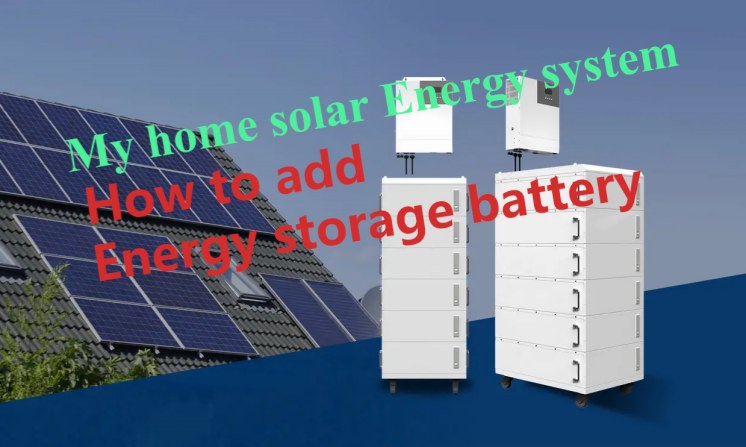
Stationary home batteries come in three common forms. The choice depends on available space, future expansion plans and how much of the system you want integrated.
Form factor
Best for
Wall-mounted battery
Limited floor space; garage or utility-room walls; fixed capacity
Stacked (modular) battery
Starting small and adding modules later; capacity growth without extra footprint
All-in-one system (battery + hybrid inverter integrated)
Simplest installation and commissioning; single supplier responsibility
Sizing the battery
Capacity should follow your load profile and goal, not the largest unit available.
For self-consumption: size usable capacity around the evening load that is not covered by solar — commonly 5 kWh to 15 kWh for a single-family home.
For backup: list critical loads and multiply wattage by required hours of autonomy, then divide by DoD and inverter efficiency.
Check power, not just energy. The battery and inverter must deliver enough continuous kW for simultaneous loads and enough peak kW for motor starting. A large kWh battery with a small inverter still cannot run the whole house at once.
LFP (LiFePO4) is the standard chemistry for stationary storage because of its cycle life and thermal stability. The exact cycle count depends on DoD and operating conditions, so compare cycle curves on the datasheet rather than relying on a single headline number.
Installation steps
Audit the existing system. Record inverter model, PV array size, system voltage, and confirm whether the inverter is battery-compatible. Gather interval electricity use if possible.
Confirm compatibility and permits. Verify the battery is on the inverter's approved list (for DC coupling) or that the two inverters are configured for AC coupling. Check local permits and grid interconnection rules.
Install and commission. Mount the battery, run DC or AC cabling with proper protection, and configure charge/discharge settings and backup transfer if applicable.
Set the operating mode and schedule. Self-consumption, time-of-use or backup priority — and review performance after the first few weeks against the expected savings.
Battery work involves high-voltage DC and grid-connected wiring; it should be carried out by a qualified installer who can also certify the installation for warranty and insurance purposes.
To explore options, start with the all-in-one energy storage system, the off-grid solar storage system, and the full lineup on the home energy storage category page. For help deciding between DC and AC coupling, use the contact page.
FAQ
Can I add a battery to any existing solar system?
Almost always, but not always in the same way. Hybrid inverters accept a DC-coupled battery; standard string inverters and microinverter systems need an AC-coupled battery system. In rare cases an inverter is so old or proprietary that replacing it with a hybrid unit is the most practical route.
Will my battery power the house during an outage?
Only if the system is designed for it. A grid-tied battery without backup certification and an islanding relay must shut down during an outage for safety. If backup is important, specify backup-capable hardware and decide which circuits are protected.
Is it better to replace my inverter or add an AC-coupled battery?
If the inverter is within its warranty and working well, AC coupling usually makes sense and avoids waste. If it is aging, inefficient, or out of warranty, replacing it with a hybrid inverter and a DC-coupled battery gives a cleaner, single-system solution.
How long can a battery run my home without solar or grid?
It depends on the battery capacity and which loads you keep on. A 10 kWh battery might run essential loads (fridge, lights, internet, communications) for roughly 8 to 12 hours; a 20 kWh battery roughly double that. These are rough estimates — the real number comes from your actual load wattage and the battery's DoD.
P
Written by Peter Lu — Energy Storage Product Manager, GreenMore
Peter works with distributors, installers and system integrators to size residential and commercial storage around real load profiles. He focuses on LiFePO4 systems that match the inverter, grid rules and backup needs of each destination market.






 Network Supported


