
Welcome to GreenMore
Welcome to GreenMore

Adding battery storage to a solar system is possible in most cases, but the path depends on what inverter you have today. Some systems are battery-ready and accept a DC-coupled battery directly; others need a second inverter for an AC-coupled retrofit. The first job is to identify which situation you are in, then choose the battery type, capacity and operating mode that match your goals.
A battery changes what you can do with the solar energy you generate. The typical reasons are:
Be clear about which of these is your main goal. Backup, in particular, has specific hardware requirements and cannot be assumed from "solar plus battery" alone.
Your existing inverter determines how the battery connects. There are three common situations.
| Existing setup | How a battery is added |
|---|---|
| Hybrid or battery-ready inverter (has a DC battery port or battery terminals) | DC-coupled battery connects directly to the inverter. This is the cleanest retrofit if the battery is on the inverter's compatibility list. |
| Standard grid-tied string inverter (no battery port) | AC-coupled retrofit: keep the existing inverter and add a battery storage inverter (often called a battery inverter or storage system) on the AC side. Alternatively, replace the inverter with a hybrid unit and fit a DC-coupled battery. |
| Microinverter or optimizer system | AC-coupled only. Each panel already converts DC to AC at the module level, so the battery connects through a separate AC battery system. |
The two coupling methods describe where the battery sits relative to the inverter. Both work, but they have different efficiency, cost and retrofit implications.
| Attribute | DC-coupled | AC-coupled |
|---|---|---|
| Connection | Battery connects on the DC side, sharing one hybrid inverter with the solar array | Battery has its own inverter and connects on the AC side alongside the existing solar inverter |
| Efficiency | One DC-to-AC conversion for stored solar; slightly higher round-trip efficiency | Solar is converted to AC, then back to DC for storage, then to AC again; more conversion steps |
| Retrofit suitability | Best for new builds or when replacing the inverter | Best for retrofits where the existing inverter is young and working well |
| Cost | Single inverter; often lower total cost if you are starting fresh | Two inverters; but avoids replacing a working unit |
If your existing inverter is near the end of its warranty or you already planned to replace it, moving to a hybrid inverter with DC-coupled storage is usually the tidier solution. If the inverter is relatively new and efficient, AC coupling preserves that investment.
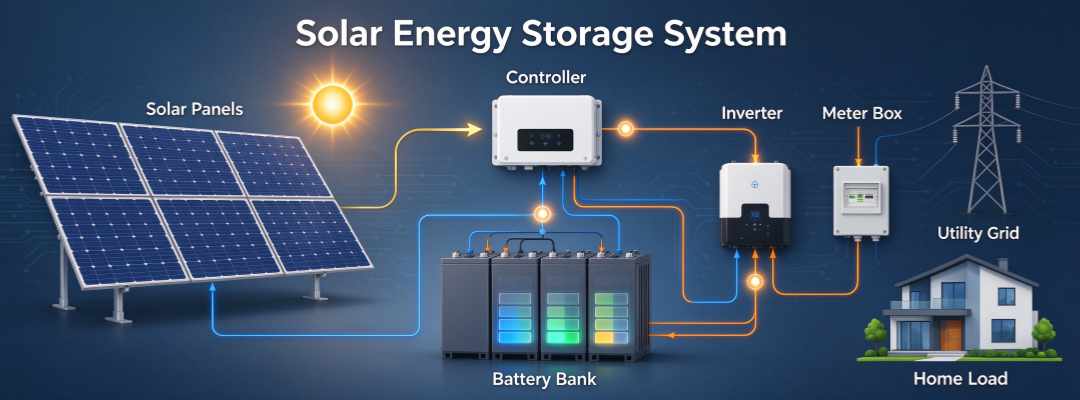
Off-grid/grid-connected solar energy storage architecture principles
Stationary home batteries come in three common forms. The choice depends on available space, future expansion plans and how much of the system you want integrated.
| Form factor | Best for |
|---|---|
| Wall-mounted battery | Limited floor space; garage or utility-room walls; fixed capacity |
| Stacked (modular) battery | Starting small and adding modules later; capacity growth without extra footprint |
| All-in-one system (battery + hybrid inverter integrated) | Simplest installation and commissioning; single supplier responsibility |
Capacity should follow your load profile and goal, not the largest unit available.
LFP (LiFePO4) is the standard chemistry for stationary storage because of its cycle life and thermal stability. The exact cycle count depends on DoD and operating conditions, so compare cycle curves on the datasheet rather than relying on a single headline number.
Battery work involves high-voltage DC and grid-connected wiring; it should be carried out by a qualified installer who can also certify the installation for warranty and insurance purposes.
To explore options, start with the all-in-one energy storage system, the off-grid solar storage system, and the full lineup on the home energy storage category page. For help deciding between DC and AC coupling, use the contact page.
Almost always, but not always in the same way. Hybrid inverters accept a DC-coupled battery; standard string inverters and microinverter systems need an AC-coupled battery system. In rare cases an inverter is so old or proprietary that replacing it with a hybrid unit is the most practical route.
Only if the system is designed for it. A grid-tied battery without backup certification and an islanding relay must shut down during an outage for safety. If backup is important, specify backup-capable hardware and decide which circuits are protected.
If the inverter is within its warranty and working well, AC coupling usually makes sense and avoids waste. If it is aging, inefficient, or out of warranty, replacing it with a hybrid inverter and a DC-coupled battery gives a cleaner, single-system solution.
It depends on the battery capacity and which loads you keep on. A 10 kWh battery might run essential loads (fridge, lights, internet, communications) for roughly 8 to 12 hours; a 20 kWh battery roughly double that. These are rough estimates — the real number comes from your actual load wattage and the battery's DoD.
Peter works with distributors, installers and system integrators to size residential and commercial storage around real load profiles. He focuses on LiFePO4 systems that match the inverter, grid rules and backup needs of each destination market.
Stay up to date with GreenMore. We share new BIPV solar tile releases, product and certification updates, and field notes from our projects — no fluff, just the things that matter to installers, distributors, and system integrators. If there's something you'd like to see covered, drop us a line — we read every reply.




Copyright @ 2026 GreenMore All Rights Reserved.  Network Supported
Sitemap / Blog / Xml / Privacy Policy


