Is it worth using energy storage batteries at home?
Jun 25, 2025
P
Peter Lu
Energy Storage Product Manager, GreenMore
Whether a home energy storage battery is worth it depends on three things: your electricity tariff structure, your solar generation profile (if you have panels), and how you value backup power. There is no single answer that applies to every household, but there is a clear way to work it out for your situation.
The three value streams of a home battery
A home battery can create value in up to three ways. Most installations capture one or two of them; capturing all three is possible but depends on the local tariff design and grid rules.
Value stream
How it works
Where it matters most
Solar self-consumption
Stores excess solar that would otherwise be exported at a low feed-in tariff, and uses it in the evening instead of importing from the grid
Markets with low or zero feed-in tariffs and high retail electricity prices
Time-of-use arbitrage
Charges from the grid during off-peak hours and discharges during peak hours, capturing the tariff spread
Markets with a wide peak-to-off-peak spread, with or without solar
Backup power
Keeps essential loads running during a grid outage
Areas with frequent or long outages; the value is insurance, not direct cash savings
The payback calculation is simplest for self-consumption and time-of-use arbitrage, because both produce a measurable kWh saving per year. Backup value is real but harder to quantify — it depends on how often outages happen, how long they last, and what you lose when the power goes out.
When a home battery usually pays for itself
A home battery is most likely to make financial sense when several of the following conditions are true:
High retail electricity price. The more you pay per kWh from the grid, the more each self-consumed or arbitrage kWh is worth.
Low or zero feed-in tariff. If exporting solar earns little or nothing, storing it for your own use becomes the better option.
Wide peak-to-off-peak spread. A spread of 2× or more between peak and off-peak tariffs makes time-of-use arbitrage attractive even without solar.
Frequent or long grid outages. If outages cost you money (spoiled food, lost work, damaged equipment) or create safety concerns, the backup value alone can justify the investment.
Available incentives. Some markets offer rebates, tax credits or favorable financing for home storage. These directly shorten the payback period.
When a home battery is harder to justify
Conversely, a home battery may not be the best use of capital when:
Electricity is cheap and stable. If your retail tariff is low and outages are rare, the annual savings from a battery may not cover the upfront cost within the product's useful life.
Feed-in tariffs are generous. If you are paid close to the retail rate for exported solar, the benefit of storing it yourself is smaller.
Your evening load is small. A battery sized for self-consumption needs enough evening load to discharge through. If most of your usage is during the day, the battery may sit idle.
You are renting or planning to move soon. The payback period is typically measured in years; a short remaining time at the property reduces the return.
How to estimate payback for your home
A simple framework for self-consumption payback:
Annual saving ≈ Self-consumed kWh per year × (Retail tariff − Feed-in tariff)Simple payback (years) ≈ Installed cost ÷ Annual saving
The self-consumed kWh per year depends on your solar array size, your daily load shape, the battery capacity, and local weather. A rough guide: in a typical single-family home with a 5 kW to 8 kW solar array and a 5 kWh to 10 kWh battery, self-consumption can rise from 30% (solar only) to 60% to 80% (solar plus battery), depending on how much of the evening load the battery can cover.
For time-of-use arbitrage without solar, the formula is similar but the "saved" kWh are charged at the off-peak rate and discharged at the peak rate. The annual saving is roughly the daily arbitrage kWh times the tariff spread, times the number of cycle days per year.
These are planning estimates. For a site-specific calculation you need your actual electricity bills, solar generation data (if applicable), and the battery's round-trip efficiency from the datasheet.
Residential Photovoltaic Storage Integration
Four questions to answer before buying
What is my main goal? Self-consumption, backup, time-of-use savings, or a combination. The answer drives the minimum size.
What is my evening or critical load? List the appliances you want to cover and their wattage. This sets the inverter power and the battery capacity.
What are my local tariffs? Retail rate, feed-in tariff, and peak/off-peak spread. Without these numbers you cannot estimate payback.
What incentives are available? Check national, regional and utility-level programs. These can change the economics significantly.
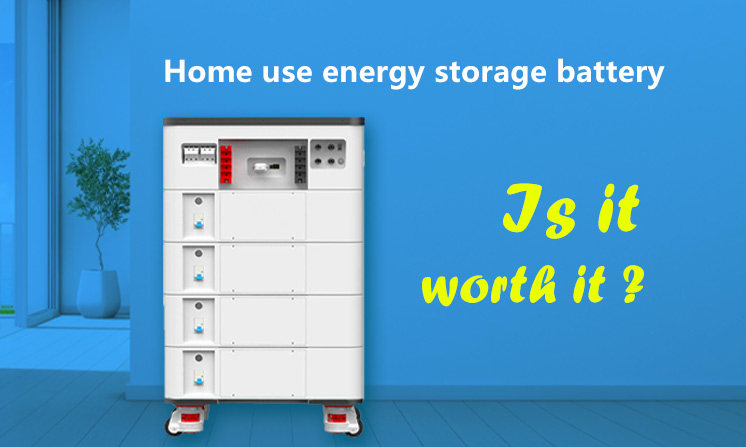
If you are sizing a system, see our residential range on the stacked energy storage battery page, the all-in-one system page, and the full lineup on the home energy storage category page. For project-specific questions, use the contact page.
FAQ
How long does it take for a home battery to pay for itself?
In markets with high retail tariffs and low feed-in rates, typical payback is 5 to 10 years. In markets with cheap electricity and generous feed-in tariffs, it can be longer than the battery's useful life. Run the numbers with your own bills before deciding.
Do I need solar panels to benefit from a home battery?
No. A battery without solar can charge from the grid during off-peak hours and discharge during peak hours or outages. The economics depend on the tariff spread and outage frequency, not on solar generation.
What size battery does a typical home need?
For evening self-consumption in a single-family home, 5 kWh to 10 kWh is a common range. For backup of essential loads, 5 kWh to 15 kWh depending on how many hours of autonomy you want. The right size comes from your actual load profile, not a generic recommendation.
How long will a home battery last?
A typical LFP home battery delivers several thousand cycles at moderate DoD before capacity drops below 80% of initial. In daily cycling that is roughly 10 to 15 years, but the actual service life depends on usage patterns, DoD, C-rate and operating temperature. Check the cycle curve on the datasheet for the DoD you plan to use.
P
Written by Peter Lu — Energy Storage Product Manager, GreenMore
Peter works with distributors, installers and system integrators to size residential and commercial storage around real load profiles. He focuses on LiFePO4 systems that match the inverter, grid rules and backup needs of each destination market.






 Network Supported


