
Welcome to GreenMore
Welcome to GreenMore

Installing a commercial or industrial (C&I) energy storage system is a capital project, not a plug-and-play purchase. The technical and commercial outcome depends largely on the preparation done before the first cabinet is delivered. This checklist covers the items that typically determine whether a project succeeds, gets delayed, or gets redesigned halfway through.
Start with the electricity bill. You need to understand not just the average price per kWh, but the full tariff structure:
A simple rule of thumb: if the peak-to-off-peak spread is small (for example, less than 2×), demand charge reduction or backup value may need to carry more of the business case. If the spread is large, arbitrage alone can be attractive.
A single monthly kWh number is not enough. You need interval data — ideally 15-minute or 30-minute readings over at least 12 months — to understand:
If interval data is not available, a qualified installer can install a temporary logger for a few weeks to capture the load shape. Do not skip this step — sizing without load data is the most common cause of underperformance.
The existing transformer sets a hard ceiling on how much power the site can draw from or export to the grid. Before specifying the storage system, confirm:
C&I energy storage cabinets are heavy, generate heat, and carry high-voltage DC. The installation site must meet several requirements:
| Item | What to check |
|---|---|
| Floor loading capacity | Cabinets can weigh several tons. Confirm the floor slab can support the distributed and point loads. |
| Clearances and access | Maintenance access around each cabinet, cable routing paths, and crane or forklift access for delivery. |
| Ventilation and cooling | Air-cooled cabinets need adequate airflow; liquid-cooled cabinets need a cooling water supply and drain. Check ambient temperature limits from the datasheet. |
| Fire separation | Distance from buildings, fire walls, sprinkler coverage, and fire detection systems as required by local fire codes. |
| IP rating and environment | Outdoor installations need cabinets rated for the local climate (rain, dust, temperature extremes). Indoor installations need adequate room conditions. |
| Electrical room compatibility | If installed inside, the electrical room must meet local codes for battery energy storage systems, which may differ from standard electrical room requirements. |
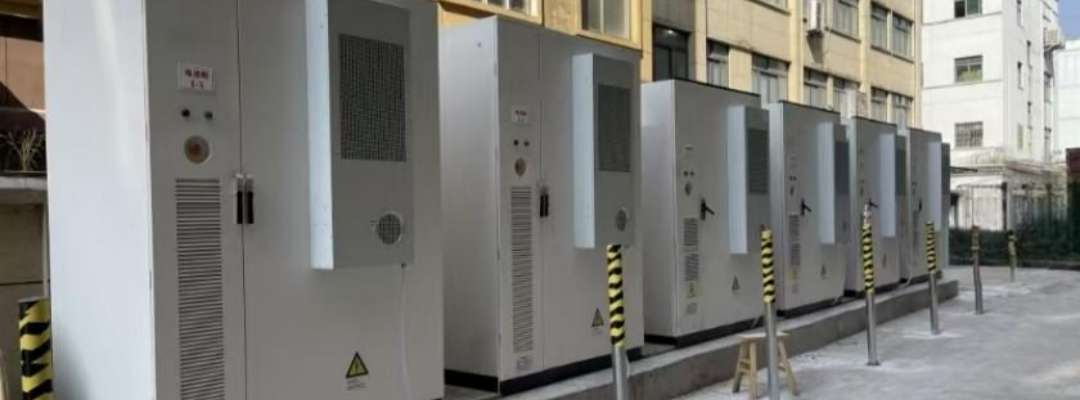
Outdoor integrated energy storage cabinet and parallel energy storage power station
Regulatory requirements vary by country and region, but typical items include:
Plan for operations before the system goes live:
If you are scoping a project, see our commercial range on the air-cooled cabinet energy storage system page and the full lineup on the commercial energy storage category page. For project-specific questions, use the contact page.
For a straightforward site with existing load data and a cooperative utility, 4 to 8 weeks is typical. Sites that need a transformer upgrade, fire code review, or complex interconnection study can take several months.
Not always. If the existing transformer has enough headroom to absorb the storage charge power without exceeding its rating, no upgrade is needed. The load profile and charge schedule determine this — it is one of the first things a qualified installer will check.
Sizing the system without interval load data. A system sized on a monthly kWh number often turns out to be too small to shave peaks or too large to cycle fully every day. Install a temporary logger if you do not have historical interval data.
Many C&I systems are designed with modularity in mind — additional cabinets can be added as load grows or as the business case improves. Confirm with the supplier whether the BMS, PCS and communication architecture support planned expansion before the initial purchase.
Peter works with distributors, installers and system integrators to size residential and commercial storage around real load profiles. He focuses on LiFePO4 systems that match the inverter, grid rules and backup needs of each destination market.
Stay up to date with GreenMore. We share new BIPV solar tile releases, product and certification updates, and field notes from our projects — no fluff, just the things that matter to installers, distributors, and system integrators. If there's something you'd like to see covered, drop us a line — we read every reply.




Copyright @ 2026 GreenMore All Rights Reserved.  Network Supported
Sitemap / Blog / Xml / Privacy Policy


