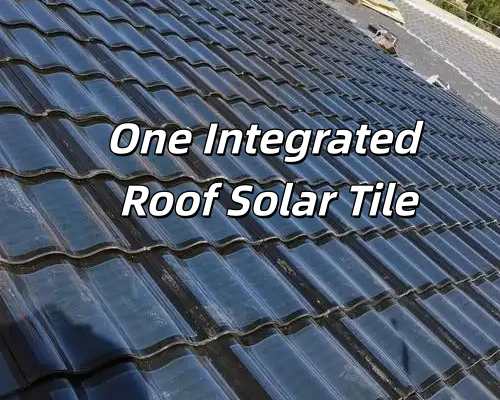
Large-area BIPV curved solar tile roof array for commercial buildings by GreenMore
Home

solar roof tiles

solar roof tiles

  • Netanya Solar Roof Tile Project: 407 Tiles, One Integrated Roof
    Netanya Solar Roof Tile Project: 407 Tiles, One Integrated Roof Oct 08, 2026
    L Luke Product Manager, GreenMore · Photovoltaic building materials Most solar roof projects start with the same question: can you generate power without turning the building into a power station? This case study walks through a real BIPV project in Netanya, Israel, where 407 curved solar tiles replaced an aging roof and started producing electricity in a single build — no racks, no drilling, no separate waterproofing layer. The numbers come from the system’s live monitoring, not lab estimates. I will share what worked, what was tricky, and why the owner chose curved tiles over flat panels even though flat panels promise more watts per unit. The existing roof before BIPV renewal. Faded and broken tiles on a four-aspect residential roof that had reached the end of its service life. Why the Owner Was Looking for an Alternative The house sits in Netanya, a coastal city north of Tel Aviv. The original roof tiles were faded and broken, and a renewal was due — a job that typically runs $20,000 to $30,000 in the region. At the same time, the owner wanted to start generating solar power. Three problems came up in early discussions: Rack-mounted panels would damage the roof. Conventional panels are drilled through the roof structure, raising leak risk and clashing with the building’s Mediterranean styling. Panels and tiles age on different clocks. Roof tiles fail long before the panels do. Renewing the roof later means removing the panels first — extra cost, extra work, and downtime. Looks and clean power rarely come together. Owners who care about curb appeal simply will not accept metal racks and exposed panels on a residential roof. The brief was clear: clean energy without giving up the roofline, the looks, or the waterproofing. That ruled out conventional panels from the start. Project Scope and Success Metrics Before any product was selected, we defined the boundaries of the job and the numbers that would count as success. Item Detail Total roof area About 140 m², with 126.4 m² of usable tiling Roof configuration Four aspects (N / E / W / S), gentle pitch around 8° Delivery model Turnkey — tiles, fittings, tier-1 inverter, battery storage, installation Contractor Single contractor, end to end. No separate purchasing for the owner. Success was defined by three measurable targets: 407 tiles — full tiling complete across all four aspects. 28,490 kWh per year — annual yield target met. Original roof untouched — complete roof renewal without demolition. All three had to be met together. Hitting the yield target with a damaged roof would not count. A perfect-looking roof with low output would not count either. The Solution: Triple-Arch Solar Tiles We selected GreenMore’s triple-arch solar tiles for this project. Three reasons drove the choice: The tile is the roof. No racks, no drilling. Tiles are laid just like ordinary roof tiles, course by course from the eaves up. Fitting tiles handle the ridge and eaves transitions. Curved profile suits Mediterranean styling. The three-arch shape reads as a traditional roof across all four aspects, rather than a grid of flat panels bolted on top. Integrated waterproofing. The solar tile itself becomes the new waterproof layer. Single-tile replacement is possible, and the ventilated rear keeps cells cool. System configuration 407 triple-arch tiles  ·  126.4 m² coverage  ·  tier-1 inverter  ·  battery storage  ·  on/off-grid ready We did consider flat tiles with optimizers. Flat tiles give more watts per unit, but the racked look and the separate waterproofing layer fell short of the brief. After evaluation, we held to the integrated curved-tile route. Looks and waterproofing were hard constraints; output was optimised within them. Construction in progress. Curved solar tiles being laid across the four-aspect roof, course by course from the eaves upward. Fixing battens and tile placement detail. The existing roof structure was left intact underneath the new solar tiles. Construction Timeline The build ran in six stages, delivered by a single crew from survey to commissioning: Stage What happened 1. Survey & design Roof measured, string layout set for four aspects 2. Materials on site Tiles, fittings, inverter, and battery delivered 3. Battens installed Fixing battens laid across the existing roof structure 4. Tiling, 4 aspects 407 tiles laid by slope, north through south 5. Flashing & trim Detail work at valleys, ridges, and junctions 6. Commissioning Inverter, battery, and grid connection tested The Hard Parts and How We Handled Them 1. Balancing output across four aspects A four-aspect roof means each face receives very different sunlight. The north face gets the least, the south face the most. If you wire them carelessly, the weakest face drags the whole string down. The fix was thoughtful string sizing — grouping tiles by aspect and wiring them so the weaker faces do not bottleneck the stronger ones. The gentle 8° pitch helps here too: at such a shallow angle, every aspect sees relatively even light throughout the day. Average daily yield settled at 74.8 kWh across all four faces. 2. Keeping the roof fully watertight No drilling, no racks. Fitting tiles handle the ridge and eaves transitions, and the solar tiles themselves become the new waterproof layer. The existing roof was left untouched underneath — no demolition, no exposure to weather during the build. The system meets EN 14782 requirements for self-supporting metal sheets used in roofing. 3. The curved-tile trade-off Flat tiles generate more watts per unit. That is a fact. But on this roof, the racked look and the separate waterproofing requirement did not meet the brief. The owner’s priorities were clear: roofline unity and waterproofing came first, output came second. Within those constraints, the curved-tile route delivered a stronger overall result. The completed BIPV roof. 407 triple-arch solar tiles covering all four aspects, with integrated waterproofing and a seamless roofline. Results: Before and After BEFORE Faded, broken tiles — $20–30k renewal due Zero self-generated solar Rack-mounted options would damage the roof AFTER 74.8 kWh average daily yield 28,490 kWh annual equivalent yield $4,826 annual bill savings Investment and payback Item Value Total investment $60,000 turnkey Nominal payback About 12 years (solar only) Actual payback About 6 years, net of the $20–30k roof renewal that would have been needed anyway The payback number changes dramatically once you count the roof renewal as a line the owner was going to pay regardless. Solar tiles replace that cost rather than adding to it. That is the real economics of a BIPV roof replacement. Live monitoring data from October 9, 2026. PV power (yellow) peaks past 11 kW at midday, battery (green) stores surplus and discharges in the evening to cover the household load (purple). What the Live Monitoring Shows These figures come from the system’s own monitoring app, recorded on a clear day in early October: Midday (12:41): 35.30 kWh generated so far that day. Battery at 98%, solar feeding 11.43 kW into the system. Power curve peak: 91.46 kWh total for the day — a clear day can top 90 kWh. Evening (20:03): 74.80 kWh total generation. Solar at zero, battery discharging at 3.61 kW to cover the 3.60 kW load. Grid draw: 7 W. Four aspects at about 8° pitch. The string sizing and the shallow angle close the gap between faces, so no single aspect becomes a bottleneck. The daily average of 74.8 kWh is what the system delivers consistently, not just on its best day. Triple-Arch Tiles vs Conventional Panels Dimension Conventional panels GreenMore triple-arch tiles Mounting Metal racks, drilled through the roof No racks — laid like ordinary tiles Roof impact Breaks the waterproof layer, leak risk The tile is the waterproof layer — full renewal Appearance Visible panels clash with the building Curved profile matches traditional tiles, seamless Upkeep Tiles and panels age apart; renewal means stripping panels Replace a single tile; ventilated rear cooling Overall payback Similar nominal payback, plus a separate roof-renewal bill About 6 years once renewal cost is counted Both options generate power. The difference is what else you get: waterproofing, a renewed roof, and a building that still looks like a house. The International Energy Agency’s Solar Energy Buildings programme (Task 66) notes that building-integrated PV is growing fastest in markets where appearance and building code compliance matter — exactly the conditions on this project. Three Things This Project Taught Us 1. Pick the strategy from the pitch On gentle multi-aspect roofs, full curved-tile coverage receives light evenly, for steadier output and higher efficiency. Pitch is the first variable to assess on projects like this. 2. Bring the renewal cost into the math Solar tiles replace a roof renewal that would have cost $20–30k. Once that line is counted, the real economics stand out. Comparing solar tiles to panels without counting the avoided renewal cost is not a fair comparison. 3. Ask first what the owner cares about most Where looks and waterproofing lead, choose curved tiles — then use turnkey delivery (materials, build, branded electrical) to lower the decision barrier. The owner should not have to coordinate three separate suppliers. One line: not just a generating roof, but a complete answer for looks, waterproofing, and returns. If your roof is due for renewal and you are considering solar, the two decisions do not have to be made separately. Request a roof assessment L Luke · Product Manager, GreenMore Luke has worked in the solar industry since 2017, focusing on BIPV product development and project delivery. He writes about real installations, real numbers, and the trade-offs that come up on actual roofs.

  • Transforming Commercial Buildings with Solar Roof Tiles and Storage Systems
    Transforming Commercial Buildings with Solar Roof Tiles and Storage Systems Sep 27, 2026
    L Luke Product Manager, GreenMore · BIPV solar tiles, facades & storage For businesses and property developers, energy is no longer just a line item on the operating budget. A commercial roof now has to do two things at once: protect the building and play a part in cost control, resilience and sustainability reporting. Solar roof tiles, paired with commercial storage, are one way to meet all three without putting an industrial-looking array on a building that is meant to look good. This guide looks honestly at what they offer a business, where they fit and how they compare with conventional panels. What Are Solar Roof Tiles? Solar roof tiles are photovoltaic roof coverings — sometimes called solar shingles — that generate electricity while acting as the finished weather surface. Instead of mounting framed panels above an existing roof, the tiles replace the roof covering itself and follow its lines. Our own range, made in our factory, includes the curved three-arch tile for traditional or premium profiles and flat photovoltaic tiles for simpler planes. They are particularly relevant for: Commercial and public buildings that want a clean, modern or architecturally considered roofline. Hospitality and cultural projects — hotels, resorts and visitor centres where appearance is part of the product. Property developers looking to differentiate a new scheme and reduce its running costs from day one. Comparison of BIPV (Building Integrated Photovoltaics) and BAPV (Building-integrated Photovoltaics Business Benefits Cost control and ROI On-site generation reduces the volume of grid electricity a business buys and insulates it against tariff rises. Combined with commercial energy storage, a site can store midday generation and use it during expensive peak periods rather than exporting it cheaply. The return depends on local tariffs, the load profile and any available incentives, so it should be modelled on the building’s real bills rather than promised as a fixed figure. Sustainability and compliance As carbon and building-energy rules tighten, on-site renewables give businesses a verifiable way to reduce scope 2 emissions, support ESG reporting and meet green-building requirements. Generation and self-consumption data from the monitoring system provides the evidence rather than a claim on a brochure. Resilience and energy independence Solar plus a battery configured for backup can keep critical loads running during grid outages — important for sites where interruption is costly, such as retail, cold storage, offices with data rooms or guest accommodation. It reduces, rather than removes, dependence on the grid; full independence requires a deliberately oversized off-grid system. Property value and lettability For developers, a building with integrated generation and lower running costs is easier to market to tenants and buyers who increasingly expect low-carbon infrastructure. Integrated tiles keep that benefit without changing the building’s silhouette. Solar Tiles vs. Conventional Panels for Business Neither option is universally better; they suit different buildings. You may also know our tiled product line as tiled-type photovoltaic tiles. Feature Solar roof tiles Conventional panels Design integration Replace the roof covering; clean, flush finish Mounted above the roof on rails; highly visible Cost per kW Higher, as it includes the roof surface Usually lower for generation alone Power density Curved profiles around 103 W/m²; flat tiles near 200 W/m² Highest; needs the least area per kW Best fit New builds and re-roofs where looks matter Large low-pitch commercial roofs and retrofits Value created Generation plus a finished, attractive roof Primarily energy cost savings How Storage Strengthens the Business Case Many commercial sites generate most at midday, when the building may be partly empty, and draw most power in the morning and evening. A battery re-times that energy and adds a few practical functions: Peak shaving — discharge stored energy to cut demand spikes and reduce both energy and demand charges. Self-consumption — use solar that would otherwise be exported for little return. Backup — support critical loads during outages where the system is island-capable. Control and reporting — an energy management platform coordinates generation, storage and load and supplies the data for reporting. Why Work With GreenMore GreenMore is a photovoltaic tile factory rather than a reseller. Our solar tiles, PV bricks and curtain walls are made in our own production facility, and we build the solar and storage systems around them, so a commercial customer sources compatible parts from one team instead of stitching separate suppliers together. We provide: Solar roof tiles for premium, integrated generation. Commercial and industrial storage for peak shaving and backup. Conventional rooftop and ground-mount systems where they suit the building better. Project-specific layouts and configuration for the destination grid. We are a focused, growing factory rather than a mass producer, which suits project work: we can tailor colors and profiles, stay flexible and give each project direct technical support. Two warranty points to be clear on: the photovoltaic tiles carry a 25-year power warranty, while the inverter, battery and other non-tile components carry a 3-year warranty. They are specified separately. You can see the breadth of our work in the BIPV solutions section. Frequently Asked Questions Are solar roof tiles suitable for a commercial building? Yes, especially for new builds or re-roofs where appearance matters, such as offices, hotels and public buildings. For very large, low-cost utility-style roofs, conventional panels often give more capacity for the money. Do commercial solar tiles work without a battery? Yes. They offset grid use during the day and export surplus like any grid-tied system. A battery mainly helps shift that energy to peak times and provide backup. How long does commercial solar storage take to pay back? It varies with demand charges, time-of-use tariffs, incentives and how often the battery cycles, so there is no single figure. We model it from the building’s interval-meter data and quote the assumptions openly. Can you supply the tiles, inverter and battery together? Yes. As the tile manufacturer we supply the integrated roof and configure the matching inverter and storage for your grid, so the system is electrically compatible and supported through one contact. Plan a commercial solar roof with us Send us the building type, roof area and pitch, country, typical monthly use and target capacity, plus whether you need storage for peak shaving or backup. We will come back with a product recommendation, layout and indicative quote. Reach us through the contact page or email export@gmsolarkit.com. L Written by Luke — Product Manager, GreenMore Luke manages GreenMore's BIPV and commercial storage product line. He has worked on photovoltaic systems since 2017 and helps businesses choose honestly between solar tiles, conventional panels and battery storage based on the building and the numbers.
  • Solar Roof Tiles Explained: Stylish Design Meets Sustainable Power
    Solar Roof Tiles Explained: Stylish Design Meets Sustainable Power Sep 27, 2026
    L Luke Product Manager, GreenMore · BIPV solar tiles, facades & storage Homeowners increasingly want clean energy without giving up how their house looks. Conventional panels do the job, but they are clearly an addition bolted on top of the roof. Solar roof tiles take a different route — the electricity generator becomes the roof covering itself. This article explains what they are, how they compare with panels, what they cost, and where a home battery does and does not help. What Are Solar Roof Tiles? Solar roof tiles — also called solar shingles — are photovoltaic units made to look and lay like a normal roof covering. Rather than fitting framed panels above an existing roof, the tiles replace the covering and follow its lines. At GreenMore we make two main families in our own factory: Curved three-arch tiles for traditional, clay-tile and premium profiles, such as our solar roof tiles. Flat photovoltaic tiles for cleaner, more modern planes. Each tile carries out three jobs at once: it finishes the roof, keeps the weather out and generates electricity. You can read more detail in our guide what is a triple-arch hantile. Why Homeowners Choose Them A roof that still looks like a roof The main reason is appearance. Tiles sit flush and follow the roof’s shape, so a heritage, traditional or carefully designed home keeps its character rather than carrying a visible rack of panels. Generation and weatherproofing in one layer Because the tiles replace the covering, you are not paying for a roof and then a second generation system on top of it. That single-layer logic is what makes the economics work, particularly on a new build or a roof that was going to be replaced anyway. Lower running costs The electricity generated is electricity you do not buy, and surplus can be exported under whatever scheme applies locally. The saving depends on your tariff, roof orientation and how much daytime generation you use in the house. Built for outdoor exposure Our tiles use laminated toughened glass and are rated for 5400 Pa static load, Class A fire performance and operation from −40 °C to +85 °C, so they handle wind, snow, hail and coastal humidity rather than being fragile indoor electronics. GreenMore Residential Wave-Shaped Building-Integrated Photovoltaic Roof Solar Tiles vs. Conventional Panels Both are mature, reliable technologies. The honest answer is that they suit different situations rather than one simply winning. Feature Solar roof tiles Conventional panels Appearance Flush, follows the roof; looks like tiling Framed modules on rails; clearly visible Power density Curved around 103 W/m²; flat near 200 W/m² Highest; least area per kW Cost Higher per kW, but includes the roof surface Lower for generation alone Best timing New builds and re-roofs Retrofits on a sound existing roof Role Roof covering and generator Generator only Do You Need a Home Battery? Solar tiles work fine on their own. During the day they power the house and export any surplus. A battery earns its place in two situations: when you are away during the day and most generation would otherwise be exported cheaply, and when you want backup during outages. It stores midday generation for the evening and, on an island-capable system, keeps key loads running if the grid fails. We explain the interaction in how solar roof tiles work with storage. A point worth making plainly: a grid-tied solar roof with a battery reduces your dependence on the grid, but it is not usually complete “energy independence.” Genuine off-grid living needs an oversized array, a larger battery bank and often a generator for long cloudy periods. You can compare options in our home battery range. What It Costs and How Long It Lasts Solar tiles cost more per kilowatt than conventional panels, but the fair comparison is against the combined cost of a new roof plus panels. On a building that needs re-roofing, the gap narrows considerably; on a sound existing roof where you only want generation, retrofit panels are usually the cheaper route. Our solar roof solutions are quoted per project against the roof area and the country. On warranties, the photovoltaic tiles carry a 25-year power output warranty, while the inverter, battery and other non-tile parts carry a 3-year warranty. These are separate figures and we never blur them into one number. Frequently Asked Questions Do solar roof tiles work on any roof? They work best on pitched roofs with good orientation and enough usable area. Because curved tiles produce less per square metre than large panels, a small or heavily shaded roof may not fit the capacity you want; we check this from your dimensions before recommending them. Can solar tiles be fitted to an existing roof? They are designed to replace the covering rather than sit over it, so retrofitting usually means re-roofing the relevant area. If your roof is still in good condition and you only want generation, conventional panels are generally the more economical choice. How much can a solar tile roof reduce bills? It depends on roof size, orientation, local sunlight and your daytime use, so there is no universal percentage. A realistic estimate is modelled from your actual bills and roof rather than promised up front. Do you supply the tiles and battery together? Yes. As the tile manufacturer we supply the roof and configure a compatible inverter and battery for your grid, so everything is matched and supported through one contact. See what fits your roof Send us your roof area and pitch, orientation, country and target capacity, and whether you want a battery. We will recommend tiles or panels based on the actual numbers. Use the contact page or email export@gmsolarkit.com. L Written by Luke — Product Manager, GreenMore Luke manages GreenMore's BIPV tile and home storage product line. He has worked on photovoltaic systems since 2017 and helps homeowners choose honestly between solar tiles, conventional panels and battery storage based on the roof and the real costs.

Subscribe To Our Newsletter

Stay up to date with GreenMore. We share new BIPV solar tile releases, product and certification updates, and field notes from our projects — no fluff, just the things that matter to installers, distributors, and system integrators. If there's something you'd like to see covered, drop us a line — we read every reply.

Copyright @ 2026 GreenMore All Rights Reserved. Network Supported

Sitemap / Blog / Xml / Privacy Policy

leave a message

leave a message
If you are interested in our products and want to know more details,please leave a message here,we will reply you as soon as we can.
submit

Home

Products

WhatsApp

contact