How Solar Roofing Tiles Integrate With BIPV Systems
May 19, 2026
A solar roof tile has to do two jobs at once. It is the finished roof surface, and it is a photovoltaic module. The roofing half gets the attention, because it is the part you can see. The electrical half decides whether the roof actually works: how the tiles connect to each other, how they are grouped into strings, what the inverter has to cope with, and what happens to the power once it is generated.
This article is about that second half. The roof build-up itself — layers, laps, ventilation, load and fire requirements — is covered in our article on integrated roofing design. Here the focus is the path from the tile to the meter.
First, the Tile Has to Be a Roof
One thing is worth stating before the wiring, because it changes how the whole system is designed. A conventional panel is added to a roof that is already finished and already watertight. A BIPV tile changes the order of work: it replaces part of the outer covering and becomes the weather line itself. There is no separate roof underneath doing the waterproofing.
Our solar roof tiles are therefore built as both a roofing material and a module: a toughened laminated glass face that carries load and takes hail, overlapping and interlocking edges that shed rain like any tiled roof, concealed fixings to battens rather than rails sitting over an old surface, and materials that stay stable under ultraviolet light for decades. A waterproof underlay below still provides the second line of defence, and the cavity behind the tiles lets heat and moisture escape.
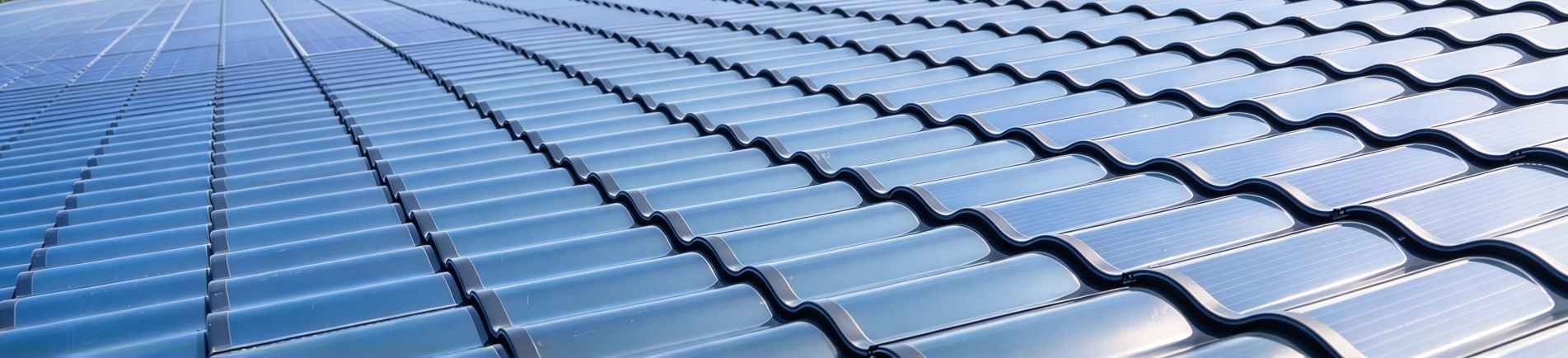
Solar tiles and ordinary tiles on the same pitch, finished as one surface.
That ordering matters for the electrician. The cabling, the junction points and the route to the inverter all have to be planned before the covering goes on, because once the tiles are laid there is no access from above. The practical sequence is set out in our guide to installing solar tiles on a roof.
How the Tiles Connect Electrically
The electrical architecture of a tile roof is the same in principle as any PV array. What differs is the granularity: instead of twenty or thirty large modules, you have hundreds of small ones, and that changes the connection detail and the string maths.
Tile-to-tile connections
Each tile carries factory-fitted weatherproof plugs and sockets, so neighbouring tiles connect directly on the roof. Factory-made connectors do two useful things: they keep polarity consistent, so a tile cannot be plugged in backwards, and they cut the amount of exposed field wiring, which is where most connection faults start. The joints sit under the lap of the course above, out of the water path.
The connector itself needs an ingress rating, and it is worth reading that number correctly. IP67 on a connector says nothing about the roof being watertight — that comes from the laps and the underlay. The two are separate systems that happen to share a surface.
Strings and combining
Tiles are wired in series into strings, and the string voltage has to land inside the inverter's operating window across the whole year, not just on a mild day. Module voltage rises as temperature falls, so the check runs both ways: the open-circuit voltage at the coldest expected morning must stay below the inverter's maximum input voltage, and the maximum-power voltage at the hottest roof temperature must stay above the start-up threshold. A roof surface runs considerably hotter than the air around it, so the hot-case figure should come from the roof temperature, not the weather forecast.
Strings are then combined, with fuses or isolation as the design requires, before the DC run to the inverter. On a tiled roof there is an extra constraint that panel arrays do not have: the number of tiles per string has to follow the roof geometry. You cannot put thirty tiles in series if the roof only offers twenty-four in that run, so strings are laid out to match the pitches and the roof is wired in the shapes it actually has.
The inverter
The inverter converts the array's direct current into alternating current that matches the grid and the building. A grid-tied unit exports surplus and imports when generation is short. A hybrid unit adds the DC connections and controls needed to charge and discharge a battery, which is the usual choice when storage is planned from the start rather than added later.
Sizing follows the array, but not slavishly. A tile roof rarely reaches its nameplate output, because of pitch, orientation, shading and the fact that whole-tile efficiency is calculated on the installed footprint. Slight undersizing of the inverter is normal and improves low-light behaviour; heavy undersizing clips the peak on clear days. On shaded or broken-up roofs, microinverters or optimizers work at the individual tile, which limits the effect of one shaded tile on the rest of its string. You can see the architectures we support in our solar inverter options, and the wider system context sits in our BIPV system guides.
Cabling goes in before the covering is closed. After that, every connection has to be reached from below or from the ridge.
The Safety Layer
A PV array is a live electrical installation on a roof, and it is live whenever there is light. The safety measures are not optional extras bolted on at the end; they belong in the design.
Earthing and bonding
A frameless glass–glass tile puts less metal on the roof, which reduces the earthing task but does not remove it. The array, the mounting metalwork and the inverter enclosure still need protective earthing and equipotential bonding, so that a fault cannot leave two nearby metal parts at different potentials.
Isolation and rapid shutdown
DC isolators have to be reachable and clearly labelled, and an increasing number of jurisdictions require rapid shutdown, which reduces the voltage in the array conductors close to the tiles when the system is shut down. That requirement shapes the choice of inverter and, sometimes, the choice of module-level electronics. It should be settled at design stage, because retrofitting shutdown to a finished tile roof is expensive.
Monitoring and fault finding
String-level monitoring tells you that something is down. Tile-level monitoring tells you which tile. On a roof with hundreds of small modules, that difference is the difference between a service visit with a ladder and a service visit with a ladder, a layout drawing and an afternoon of testing. If the roof is complex or partly shaded, tile-level visibility is worth the extra cost.
Adding Energy Storage
A tile roof generates most of its output around the middle of the day. A house or a commercial building usually wants the most energy in the evening. A battery closes that gap, and it is the part of the system most often sized badly.
Size from the load, not the array
The instinct is to match the battery to the array: a 6 kW roof gets a 6 kWh battery. That is not a sizing method. The battery is sized from what has to be kept running and for how long — the evening and overnight consumption, plus any circuits reserved for outages. A roof that generates more than the building uses will export the surplus whether or not a battery is fitted; a battery only helps if there is load to absorb the stored energy later.
Grid-tied, hybrid and off-grid
These three are often used loosely, so it is worth separating them. A grid-tied system has no battery and exports surplus; it stops generating when the grid fails, because the inverter has to protect the line workers. A hybrid system keeps a battery and can run selected circuits during an outage. A true off-grid system has no grid connection at all and has to be sized for the worst week of the year, not the average day, which usually means a larger array, more storage and often a generator.
Configuration
Storage
During a grid outage
Best suited to
Grid-tied
None
Shuts down
Lowest cost per watt, where the roof only has to generate
Hybrid
Battery
Selected circuits continue
Most homes and small commercial sites
Off-grid
Large battery
Full load, within design limits
Sites with no connection, sized for the worst week
Modular storage scales in steps, so capacity can follow the load rather than the array size.
Our home energy storage range and the home solar battery system cover the capacities we supply, and the inverter has to be matched to the battery's voltage window rather than chosen separately.
The Complete System, Working Together
Put together, an integrated solar-tile BIPV system is made of:
Photovoltaic tiles as the outer roof covering, with factory connectors.
Battens or rails, fixings and a waterproof underlay beneath the covering.
String wiring and protection, laid out to the roof geometry.
A grid-tied or hybrid inverter, sized to the array and the local temperature range.
A battery where storage is required, sized to the load.
Metering and energy management to decide where the power goes.
Earthing, surge protection and rapid shutdown for safety and for the fire service.
The result is a building that generates its own power, uses more of it on site and draws less from the grid. It is worth being precise about that last part: a grid-connected roof with a battery meaningfully reduces dependence, but genuine independence needs a larger array, storage sized for poor-weather stretches and, in most cases, a backup generator. The two should not be sold as the same thing.
Why Tiles Suit BIPV Projects
Tiles are chosen for BIPV work because they offer a combination that add-on panels cannot: one architectural surface instead of a covering plus an array, a durable glass outer skin, low routine maintenance, and compatibility with ordinary inverters and storage. They fit villas, commercial and industrial buildings and architectural projects, with the profile and the power density selected to suit the building rather than the other way round.
The trade-off is real. Tiles cost more per watt than standard panels, and curved profiles generate less per square metre, so a sound existing roof whose only goal is the cheapest possible generation is usually better served by conventional modules. Tiles earn their cost on new builds and re-roofs, where they replace a covering that had to be bought anyway, and on projects where appearance or planning conditions matter.
Frequently Asked Questions
How many tiles can go on one string?
There is no fixed number, because the limit comes from the inverter's voltage window and the local temperature range. The string is checked at the coldest expected morning, where open-circuit voltage is highest and must stay under the inverter maximum, and at the hottest roof temperature, where operating voltage is lowest and must stay above the start-up threshold. On a tiled roof there is a second limit: the string has to fit the run of tiles the roof actually provides, so the layout often sets the count before the maths does.
How are the tiles connected to the building's electrics?
Tiles plug into each other on the roof through factory-fitted connectors, are grouped into strings, and feed an inverter that converts DC into AC for the building and the grid. A hybrid inverter also manages a battery. Earthing, isolation, surge protection and, where required, rapid shutdown are part of the same design rather than add-ons.
Do I need a battery for a solar tile roof to work?
No. A grid-tied system works without one, exporting surplus during the day and importing when generation is low. A battery is added when you want to use more of your own generation in the evening, keep selected circuits running during an outage, or shift load away from peak tariffs on a commercial site.
Can a solar tile roof run off-grid?
It can, but it has to be designed as an off-grid system from the start. That means sizing the array for the worst stretch of weather rather than the average day, storage large enough to carry the load through it, and usually a generator as a backstop. A grid-tied roof with a battery is a different product: it reduces what you buy from the grid, but it is not independent of it.
How long do solar tiles last and what is the warranty?
The tiles carry a 25-year linear power warranty plus a 10-year product warranty covering materials and workmanship. Inverters, batteries and other non-tile components carry 3 years. We state the terms separately so they match the products actually supplied, and we do not claim a service life that no warranty backs.
Design a BIPV System With GreenMore
GreenMore is a photovoltaic tile manufacturer. Our solar tiles, photovoltaic bricks and photovoltaic curtain walls are produced in-house, and we supply the inverter and battery as the parts that complete the system. We work with distributors, installers and project owners from the first design stage, matching tile profile, roof structure, string layout, inverter and storage to the building and the local code.
Send us the building type, roof area, location and target output, and we will come back with a system that can be built and commissioned, not a generic datasheet. Reach us through our contact page or at export@gmsolarkit.com.
L
Luke
Product Manager, BIPV Solar Tiles
Luke manages GreenMore's photovoltaic building-material range, from the curved triple-arch tile to flat tiles and PV curtain walls. He has worked in the solar industry since 2017 and writes about the parts of a system that decide whether it can actually be installed and commissioned.
Updated on November 14, 2026






 Network Supported


