Sizing a Commercial Battery: kW First, Then kWh
Mar 27, 2026
Most battery sizing advice answers one question: how many kWh does a house need. A factory, a cold store or a shopping centre is a different problem. There the electricity bill has two halves, and a battery that fixes one half can leave the other exactly where it was. Getting the number right means sizing power and energy separately, then checking both against the hardware that actually exists.
A Commercial Bill Has Two Lines, Not One
The first line is energy: how many kWh you pulled, priced by time-of-use period. The second is demand: the highest average power you reached inside a billing window, usually 15 or 30 minutes, charged at a rate per kW. A third line often hides underneath, a ratchet clause that holds your billed demand at the highest figure of the last six or twelve months, so one bad afternoon in July sets the price for the rest of the year.
On many industrial tariffs the demand line is the expensive half, and it is the half a battery cuts most directly. This is why a 100 kW / 241 kWh cabinet can pay for itself on a site that consumes several megawatt-hours a day. It is not selling kWh. It is holding a ceiling on kW.
Home sizing collapses those two lines into one number because a house peaks at a few kilowatts and the spread between peak and base is small. If you are working on a house instead, the calculation is simpler and we cover it in sizing a home battery.
Read Twelve Months of Interval Data Before Choosing Anything
What to ask the utility or the meter owner for
Fifteen-minute interval data for twelve consecutive months, in kW rather than kWh where possible. Monthly totals are useless here; they average the peaks away.
The tariff sheet itself: demand window, ratchet clause, peak and valley periods, and the reactive power charge if there is one.
Transformer rating, existing spare capacity, and the protection settings at the point of connection.
Any export limit written into the interconnection agreement, which decides whether surplus can be pushed back to the grid.
What you are actually looking for
Sort the intervals by size and look at the top hundred. That cluster is the peak. Look at when it happens, how long it lasts, and how far it sits above the rest of the day. Then look at the base load, the floor the site never drops below, because no battery can shave below that floor and still keep the lights on.
Two figures come out of this exercise: the demand level you want to hold under, and the number of hours you must hold it for. Everything downstream depends on those two numbers and nothing else.
The shaded band is what the battery has to cover; the dashed line is the demand level you are buying.
Step One: Size the Power in kW
The battery has to cover the gap between the site load and your target demand for the entire window, not just at the instant of the peak. If the load sits 100 kW above target for four hours, a converter that can only hold 80 kW will let the demand register climb back up and the saving disappears.
Take a plant that peaks at 480 kW between 10:00 and 12:00, dips, then peaks again from 14:00 to 16:00. Set the target at 380 kW and you need 100 kW of continuous discharge across both windows, with enough overload headroom to follow the load rather than chase it. Our modular converters are rated for 110% long-term overload, which covers the wobble inside a window without uprating the hardware.
Do not forget the transformer
The converter adds to site load when it charges. A 100 kW charger sitting on a 630 kVA transformer that already carries 500 kW leaves very little room, and the charging schedule becomes a constraint rather than a setting. Either charge inside the valley period at reduced power, or accept a longer charge window. Both are workable; discovering the limit after commissioning is not. The site survey questions we ask before any C&I installation are set out in what to prepare before installing a C&I system.
Step Two: Size the Energy in kWh
Energy is the shaved power multiplied by the hours you hold it, then divided by the fraction of the pack you are willing to use and by the round-trip efficiency. Skip either divisor and the system comes up short on the first hot afternoon.
The C-rate sets a ceiling on duration
Our outdoor cabinets and containers run at a charge and discharge rate below 0.5C. That is a deliberate choice for cycle life, and it means a 100 kW unit with 241 kWh of storage holds full power for about 2.4 hours. If the site needs four hours, the answer is two units in parallel, not one unit asked to work harder. The relationship between C-rate and run time is the same one we explain in discharge rate of a lithium battery.
Depth of discharge and losses
LFP packs in commercial service are normally worked to about 90% usable capacity. Round-trip efficiency, converter losses plus auxiliary consumption, lands near 90% on a well-designed system. Multiply those two together and roughly four fifths of the nameplate figure reaches the meter. A 482 kWh pair therefore delivers about 390 kWh of useful work, and that is the number the payback calculation should use.
A worked example
Hold the 100 kW shave for four hours and you need 400 kWh at the meter. Divide by 0.9 for usable depth and again by 0.9 for round-trip efficiency, and the nameplate requirement is about 494 kWh. Two liquid-cooled cabinets at 241 kWh each, paralleled, give 482 kWh and 200 kW of discharge. That covers roughly 3.9 hours at 100 kW, close enough for a four-hour tariff window with a little load-following margin, and a third cabinet covers a longer window or a second shave period later in the day.
Step Three: Check What the Grid Connection Allows
A battery that is sized correctly on paper can still be refused at the point of connection. Three limits matter. The first is the transformer and switchgear rating, which caps the sum of load and charging power. The second is reverse power: many sites have a relay that trips if power flows back, and without an export agreement the battery must be set to never export. The third is the declared demand itself, because in some markets the figure you register with the utility is the figure you are billed against regardless of actual use.
Our converters hold a power factor above 0.99 and current distortion below 3% on linear load, which keeps the connection compliant without adding a filter. What they cannot do is change the size of the transformer you already have.
Step Four: Put a Number on the Return Before You Commit
Annual saving is roughly usable energy per cycle, multiplied by cycles per day, multiplied by the value of a displaced kWh, multiplied by operating days. On a 400 kWh usable system cycling once a day at a 0.12 USD per kWh spread over 330 working days, that is about 15,800 USD a year before degradation. Substitute your own tariff; the shape of the calculation matters more than the figure.
Degradation belongs inside the arithmetic
Our LFP cells are rated above 6,000 cycles to 80% capacity retention, with a design life beyond ten years. One cycle a day for ten years is 3,650 cycles, roughly half the rated life, so the fade inside a normal payback period is small. Two cycles a day changes that picture and should be priced in from the start.
Demand shaving and arbitrage are not the same revenue
Shaving is paid by avoided demand charges, which are stable and easy to forecast. Arbitrage is paid by the spread between valley and peak prices, which moves with the market and with your own load. A system sized purely for shaving will be smaller and will cycle less than one sized for arbitrage. Running both on the same hardware is normal, but the two revenue streams should be modelled separately before the capacity is fixed. We go through the arbitrage side in how businesses use cheap electricity.
Step Five: Match the Number to a Format
Once power and energy are fixed, the enclosure is a question of site conditions and delivery logistics rather than electrical design. The four formats we build cover most commercial and industrial cases.
Hardstanding, service clearance and cable entry decide the layout as much as the kWh figure does.
Format
Rated power and energy
Duration at rated power
Where it fits
Air-cooled outdoor cabinet
100 kW, 225 or 241 kWh
2.3 to 2.4 hours
Temperate sites with a clean, shaded yard and a single shave window
Liquid-cooled outdoor cabinet
100 or 200 kW, 241 to 418 kWh
2.1 to 2.4 hours
Hot, dusty or coastal sites, tight footprints, integrated fire suppression required
10-foot container
100 or 300 kW, 241 to 784 kWh
2.4 to 4.8 hours
Longer windows where a two-pack build beats paralleling cabinets on site
20-foot container
Set by the external converter, 3,762 kWh per unit
Two hours and up, depending on the converter
Large industrial loads and grid-side duty where the capacity is measured in megawatt-hours
The cabinet and container families are described in more detail in what an outdoor energy storage cabinet is and what a container energy storage system is. If the site needs an isolated supply, the converter itself is a separate selection and is covered in what a PCS does.
What Changes the Answer on a Real Site
Ambient temperature
Liquid-cooled cabinets are rated from −20 to +50 °C and containers from −20 to +55 °C. Air-cooled units lose usable capacity faster in a hot yard, and the loss is not linear: a week of 45 °C afternoons can turn a comfortable design margin into a system that stops shaving exactly when the site needs it most. If the site is in a hot climate, price the liquid-cooled option before assuming the cheaper cabinet will do.
Fire separation decides the footprint
Our containers and liquid-cooled cabinets carry an integrated perfluorohexanone fire suppression system, and local codes still set separation distances to buildings, boundaries and each other. On a congested industrial plot those distances often decide how much capacity fits, not the energy figure. Check the code before the layout is drawn, because moving a container afterwards is a civil works job.
Footprint and access
A liquid-cooled cabinet measures about 1,000 × 1,330 × 2,300 mm and weighs 2,200 to 3,500 kg depending on capacity. A 20-foot container is 6,056 × 2,438 × 2,896 mm and under 35 tonnes. Both need a hardstanding, a crane or forklift path, and service clearance at the front. Retrofits fail at this stage more often than at the electrical one.
A diesel generator already on site
If the site already runs a genset for outages, the battery can take over the short interruptions and leave the generator for long ones, which cuts fuel burn and run hours. The transfer scheme has to be designed for it, including seamless grid-to-off-grid switching where the load cannot tolerate a break. Decide this before the converter is specified, not after.
Room to grow
Cabinets parallel cleanly, so starting with one unit and adding a second later is practical as long as the transformer, the switchgear and the footprint were sized for the final build. Sites that expand in phases usually regret sizing the civil works to phase one.
Where the Roof Enters the Same Calculation
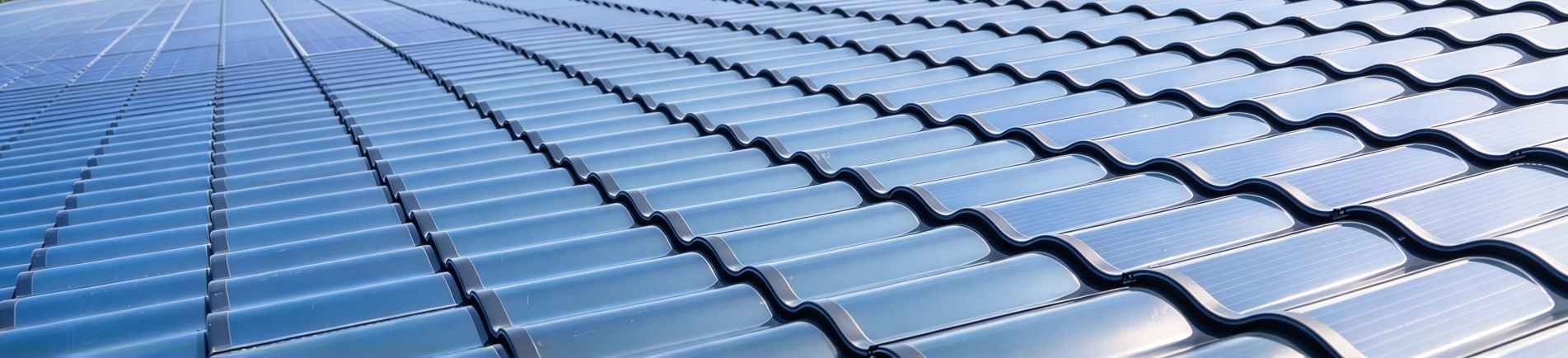
If the site also gets PV tiles, the arithmetic shifts. A kWh generated and used behind the meter avoids the full retail rate, which is usually more than the valley-to-peak spread the battery is chasing. That makes self-consumption the first revenue stream and arbitrage the second, and it changes the optimal capacity: a battery sized only for shaving will be too small to absorb a midday generation peak.
The interface questions between a tiled roof and a battery are covered in how solar roof tiles pair with storage, and the commercial case for a combined roof and battery project is set out in transforming commercial buildings with solar tiles and storage.
Frequently Asked Questions
Can I size a commercial battery from monthly bills alone?
Not reliably. Monthly bills give you energy and a billed demand figure, but not the shape of the peak or how long it lasts, and those two determine the energy requirement. Ask the utility for interval data first. If it is genuinely unavailable, a two-week temporary meter on the main incomer costs far less than an oversized cabinet.
What is the difference between kW and kWh in this context?
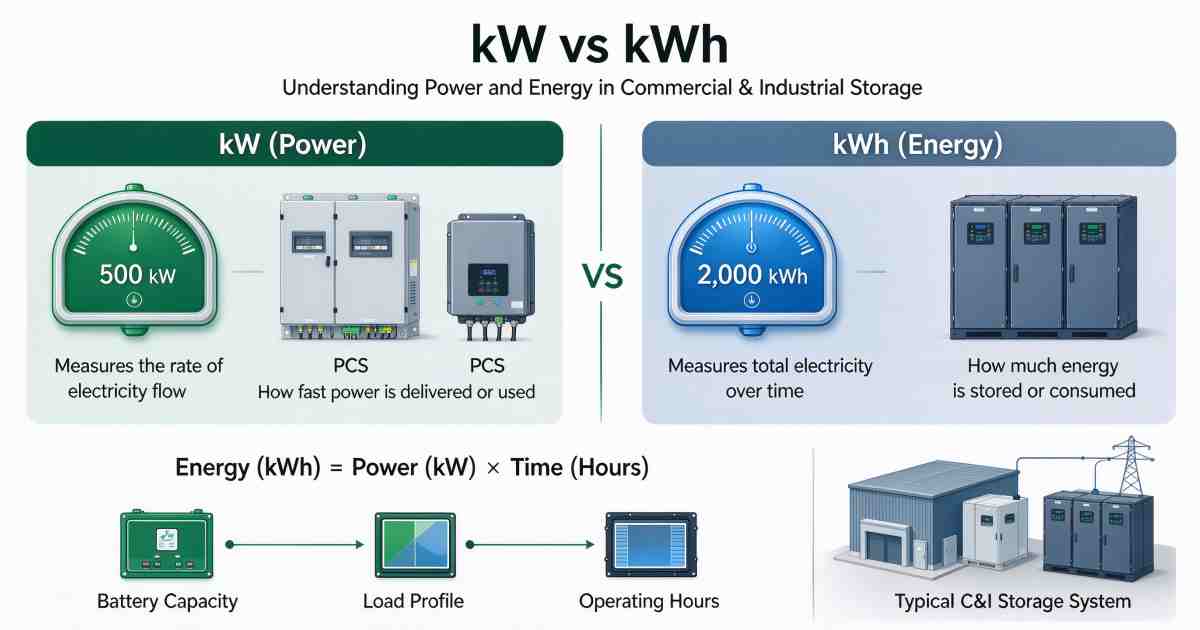
kW is how fast the battery can deliver, and it sets how much of the peak you can remove. kWh is how long it can keep delivering, and it sets how long the peak stays removed. A system with plenty of kWh but too little kW will not hold the ceiling; one with plenty of kW but too little kWh will drop the ceiling after an hour or two.
How long will a 241 kWh cabinet run a 100 kW load?
About 2.4 hours at rated power, less once you allow for usable depth of discharge and round-trip losses, which puts realistic delivery just under two hours. That is the figure to use when checking it against a tariff window.
Should I size for demand charges or for arbitrage?
Size for whichever is larger on your own data, then confirm the other still works with the same hardware. Where the demand charge is heavy, the battery will be power-rich and energy-light. Where the peak-to-valley spread is wide, it will be the other way round. Very few sites are balanced.
Can I add capacity later without replacing the first unit?
Yes. Cabinets and containers are designed for parallel expansion, and the added unit joins the existing EMS as additional capacity rather than as a separate plant. The constraint is physical and electrical headroom, so size the transformer, switchgear and hardstanding for the final build at the outset.
Do I need a new transformer to add a battery?
Usually not, but it depends on the charging power and the existing load. If the spare capacity is smaller than the converter rating, limit the charge rate in the EMS or shift charging into the valley period. Only when the site is already close to the transformer rating does a new or larger unit become unavoidable.
PL
Peter Lu
Energy Storage Product Manager
Works on C&I storage sizing and commissioning, mostly with factories and commercial sites in Europe and the Middle East.
Updated on November 16, 2026





 Network Supported


