What is Power Conversion System(PCS)?
Mar 12, 2025
P
Peter Lu
Energy Storage Product Manager, GreenMore
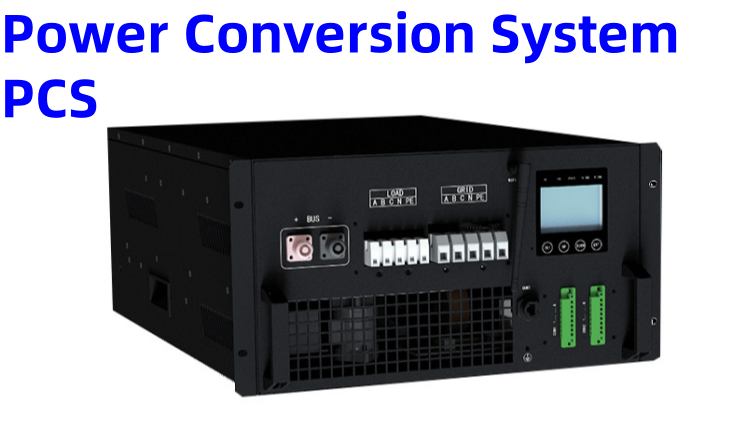
A Power Conversion System (PCS) is the bidirectional converter that sits between a battery and the grid or loads. Batteries work in DC, while the grid and most equipment work in AC, so the PCS converts in both directions: AC to DC to charge the battery, and DC back to AC when the stored energy is needed. Along with the battery and the BMS, it is one of the three core parts of any grid-scale storage system.
How a PCS works
At the hardware level, a PCS is built around power semiconductor modules (typically IGBTs) that switch rapidly to shape voltage and current, plus a digital controller and output filtering. The same bridge runs in two directions:
Charging (rectifier direction). Grid AC is converted to controlled DC at the battery's voltage, following a charge profile agreed with the BMS.
Discharging (inverter direction). Battery DC is converted to AC that matches grid voltage, frequency and phase, and feeds the site or grid.
The controller constantly coordinates with the BMS — which knows cell voltage, temperature and state of charge — and with the EMS, which decides when and how much to charge or discharge. Filters (commonly LCL type) remove switching harmonics so the output meets grid power-quality requirements.
Schematic diagram of grid-connected inverter operation
Core functions
A storage PCS does more than convert energy. It is the actuator for whatever the site or grid operator asks the system to do.
Function
What it means in practice
Bidirectional power flow
Charge and discharge through the same unit, with controlled ramp rates
Active and reactive power control
Independent control of real power (kW) and reactive power (kVAr) for voltage support and grid services
Grid-connected and off-grid operation
Grid-following mode when connected; grid-forming mode to establish voltage and frequency in a microgrid or outage, where supported
Fast response
Power output can change within milliseconds, which is why storage is used for frequency regulation and smoothing
Protection and anti-islanding
Over/under-voltage and frequency protection, overcurrent and anti-islanding tripping to protect personnel and equipment
PCS vs a solar inverter
The boxes look similar, but the operating logic is different.
Attribute
Solar (PV) inverter
Storage PCS
Power direction
One direction: panels to grid
Bidirectional: grid to battery and back
Control partner
Follows solar irradiation via MPPT
Follows BMS limits and EMS dispatch schedules
Off-grid capability
Generally none without storage
Can form a grid for backup or microgrid use, where designed for it
Hybrid inverters combine both roles in one residential unit — MPPT inputs for panels plus a DC battery connection. In commercial systems, the PCS is typically a dedicated three-phase unit sized in tens or hundreds of kW.
Topology: two-level vs three-level
The internal switching arrangement affects harmonics, losses and filtering size.
Two-level designs are simpler and lower cost, and are common in smaller units.
Three-level (NPC-type) designs produce a smoother waveform with lower harmonic content and switching losses, which allows higher power density and efficiency; the control and hardware are more complex.
Efficiency should be judged from the full curve, not only the peak. Most modern PCS reach high peak efficiency, but performance at the actual operating load — often partial load — matters more in daily operation.
Microgrid multi-scenario applications
Typical applications
C&I storage for peak-valley arbitrage and demand-charge management.
Renewables integration to smooth solar and wind output and limit ramp rates.
Microgrids and weak-grid sites, operating grid-forming with solar, storage and sometimes generators.
Frequency and voltage services where grid markets allow storage to participate.
How to select a PCS
Match power to the application. Rate the unit for continuous kW and expected peak/overload; motor starting and load steps need headroom.
Check the DC voltage window. It must cover the battery's full charge and discharge voltage range, including parallel strings and end-of-life conditions.
Review the efficiency curve and losses. Efficiency at your typical load matters more than the maximum figure.
Confirm imbalance and overload behavior. Three-phase sites with uneven single-phase loads need a stated unbalanced-load capability.
Verify protection, certification and grid code. Storage converters commonly ship with CE and IEC documentation, with destination-country grid-code requirements and safety certifications confirmed before order.
Plan integration and cooling. Communication protocols (such as Modbus or CAN) must match the BMS and EMS; indoor rack units and outdoor cabinets have different cooling and protection needs.
A PCS is usually supplied as part of a complete cabinet or container; see the full lineup on the commercial energy storage category page, and for the enclosures it is built into, read about outdoor energy storage cabinets and container energy storage systems. For help matching a PCS to a battery and site, use the contact page.
FAQ
Can I use an ordinary solar inverter instead of a PCS for storage?
Not for a DC battery. A standard PV inverter only converts DC from panels into AC and cannot charge a battery or follow BMS commands. A hybrid inverter is the residential exception; commercial storage uses a dedicated bidirectional PCS.
What is the difference between grid-following and grid-forming?
A grid-following converter synchronizes to an existing grid and injects a set amount of power; it cannot run alone. A grid-forming converter establishes its own stable voltage and frequency, allowing the system to run off-grid or start a dead microgrid (black start). Grid-forming capability must be specified in the PCS and controls.
How is PCS size chosen for a storage project?
From the required power and the duration of storage, which together define the C-rate. A 100 kWh battery required to deliver 50 kW for two hours needs at least a 50 kW PCS with overload margin; the same battery asked for 100 kW for one hour needs a 100 kW unit. The duty cycle and expected grid services also affect the rating.
Why does a PCS need to communicate with the BMS?
Because the BMS is the authority on battery limits. It tells the PCS the permitted charge and discharge current, voltage window and any fault conditions, preventing operation that could damage the cells. The EMS sets schedules, while the BMS sets safety bounds — the PCS executes within both.
P
Written by Peter Lu — Energy Storage Product Manager, GreenMore
Peter works with integrators and EPCs to match PCS power, DC voltage ranges and control interfaces with batteries and grid codes, and separates documented performance figures from marketing claims.






 Network Supported

