Large-area BIPV curved solar tile roof array for commercial buildings by GreenMore
Home

DC-DC Converter

DC-DC Converter

  • High-Frequency DC-DC Conversion: Why Efficiency and Low Ripple Matter in ESS Cabinets
    High-Frequency DC-DC Conversion: Why Efficiency and Low Ripple Matter in ESS Cabinets Sep 21, 2026
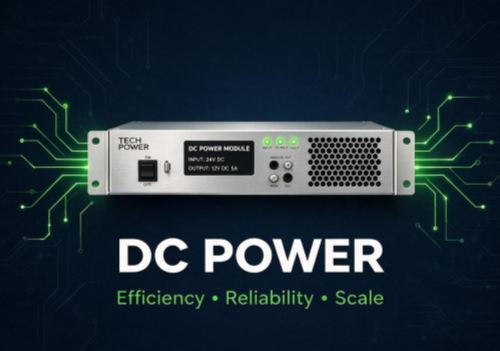
    By Peter Lu, Product Engineer at GreenMore | September 20, 2026 This is the second article in our four-part DC power guide. Part 1 covered how to choose a DC power module for an energy storage cabinet; here we look under the hood at the two numbers engineers argue about most: conversion efficiency and output ripple. Inside every modern cabinet battery converter, transistors switch thousands of times per second, chopping one DC voltage and reshaping it into another. The GreenMore GM-LDC30 and GM-LDC60 use industrial-grade high-frequency conversion to reach peak efficiencies of 98.0% and 98.6%. That sounds like a small gap. Across a 60 kW power stage running day and night, it is not. How Does High-Frequency DC-DC Conversion Work, and Why Is It Efficient? A switch-mode DC-DC converter does not burn off excess voltage the way a linear regulator does. It stores energy briefly in an inductor and transfers it in packets timed by the switch. The ratio of on-time to off-time sets the output voltage. Because the transistor is either fully on or fully off, the average dissipation in the switch stays low. Raise the switching frequency and the passive components shrink. As Texas Instruments explains, the required output inductance and capacitance are both inversely proportional to switching frequency. Double the frequency and you need roughly half the inductance, so the magnetic core gets smaller, lighter, and cheaper. That is the core reason a 60 kW converter fits in a rack-mount enclosure today while needing a cabinet of its own a generation ago. Efficiency is never free, though. At high frequency the loss budget shifts between three main components: Conduction loss I²R heating in switch on-resistance, inductor windings, and busbars Independent of frequency; grows with load Switching loss Energy lost while voltage and current overlap during each turn-on and turn-off Increases directly with frequency Core and drive loss Magnetic hysteresis in the core and energy needed to charge the gate each cycle Increases with frequency Resonant and phase-shifted control schemes soften the voltage-current overlap by timing the switch transition to a zero crossing, cutting the switching term. The designer's job is to pick the frequency, topology, and silicon that balance these terms. At heavy load, conduction loss dominates, so low on-resistance devices win. At light load, switching and core losses dominate, which is why the module draws less than 20 W in standby rather than idling at full magnetizing current. Schematic diagram of low ripple power supply technology What Do 98.0% and 98.6% Efficiency Actually Buy You? Efficiency converts directly into heat, which is what makes a high efficiency DC power supply module worth its price. Take each module at its rated output: Module Rated Output Peak Efficiency Power That Becomes Heat GM-LDC30 30 kW 98.0% ~612 W GM-LDC60 60 kW 98.6% ~852 W Both figures are stated at the favorable operating point; real efficiency varies with voltage ratio and load. Even so, the relationship is fixed. Every 0.1% of efficiency lost at 60 kW adds 60 W of heat, and that heat has to leave the module or it raises component temperatures. Smart air cooling handles it across the full −30 to +55 °C operating range, but hotter capacitors and semiconductors age faster. TDK notes that capacitor life is governed by thermal stress, with heat from ripple and conduction losses the deciding factor. The energy meter notices too. At a common 60 kW output, the gap between 98.0% and 98.6% efficiency is about 373 W of dissipation, or roughly 3,260 kWh per module per year if it ran continuously. Few cabinets run flat-out all year, but sites with long cycling duty see the number on their electricity bill. That is why the standby figure matters. Under 20 W keeps parasitic losses negligible when the cabinet is parked, instead of paying for a converter that wastes more in a day idle than it should. Why Low Ripple Matters for Batteries and Downstream Equipment Ripple is the periodic AC component riding on the DC output, at the switching frequency and its harmonics. It is distinct from random high-frequency noise, though the two get measured together on a scope. The output filter exists to deliver a low ripple DC output that every load on the bus can trust. Batteries are the first victim people cite. A Solis white paper reviewing 16 kW inverter testing reported that 6 A peak-to-peak ripple near 300 Hz accelerated capacity fade by up to 15% compared with smooth DC cycling, driven by localized heating and uneven lithium intercalation (Solis, The Role of Ripple Current on Lithium Battery's Lifecycle). The effect is not universally settled. Long-term academic studies reach different conclusions, and a 2022 battery-aging dataset study in Batteries found ripple effects varied with frequency and cell design. The consistent finding is that low-frequency, high-amplitude ripple does the damage; high-frequency ripple is largely filtered by the cell's double-layer capacitance. No cabinet designer should gamble a battery warranty on that distinction when the conversion stage can simply be clean. Sensitive loads share the same bus: Load How Ripple Hurts It Telecom rectifiers and radios Raises noise floor, can push transmit signal quality out of spec Sensors and analog front ends Small measurement offsets and jitter at the switching frequency Automation controllers and PLCs Logic brownouts and communication errors when dips cross thresholds DC-link capacitors Extra I²R heating shortens service life, the classic wear-out path Ripple is a steady-state power-quality problem, not a fault event. Protection such as OVP, OCP, SCP, and OTP handles abnormal conditions, which is the subject of our protection deep dive. How Should Output Ripple Be Measured? A sloppy probe setup measures the probe's own antenna loop instead of the converter. Industry practice converges on a few rules. Intel's ATX 3.0 power supply design guide defines ripple and noise over 10 Hz to 20 MHz and requires the oscilloscope bandwidth set to 20 MHz, which keeps wideband switching spikes out of the periodic ripple number. On the bench: Put the scope in AC coupling and engage the 20 MHz bandwidth limit for the ripple reading. Use a 1:1 probe or a dedicated power-rail probe for millivolt sensitivity. A 10:1 probe throws away the vertical resolution you need. Connect the probe tip directly across the output capacitor and use the short spring ground clip, not the dangling ground lead. A long ground lead is an antenna. Measure both peak-to-peak and RMS, at no load and full load. When you compare module datasheets, check the conditions first. A ripple number without a bandwidth limit and load point tells you nothing. Where the GM-LDC Modules Fit The GM-LDC30 (30 kW) and GM-LDC60 (60 kW) are bidirectional, rack-mount units. As a DC-DC converter for energy storage duty, each moves power in both directions between battery and bus. The low-voltage side operates from 200 to 900 V and the high-voltage side from 300 to 1000 V, with maximum output current of 75 A for the 30 kW unit and 150 A for the 60 kW unit. Smart air cooling, IP20 ingress protection, RS485 communication, reverse-polarity and surge protection, insulation monitoring, and a three-year warranty come standard, and modules support parallel operation for larger power stages. They sit inside air-cooled and liquid-cooled cabinet systems as well as utility-scale containerized ESS. When your cabinet needs more than 60 kW, our next article covers parallel expansion and current sharing. The GreenMore team has worked in solar and power electronics since 2017. If you are sizing the DC stage for a cabinet or container project and want help matching efficiency and ripple targets to your battery and load, talk to our engineering team.
  • DC Power Modules for Energy Storage Cabinets: An Engineering Buyer's Guide
    DC Power Modules for Energy Storage Cabinets: An Engineering Buyer's Guide Sep 21, 2026
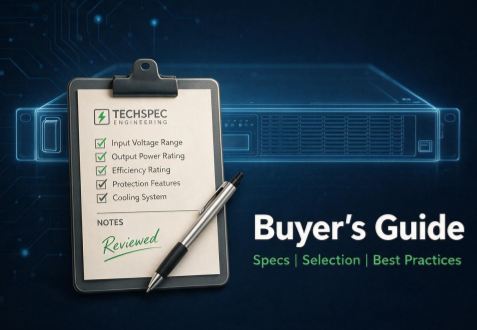
    By Peter Lu, Product Engineer at GreenMore | September 20, 2026 Pick the wrong DC power module and you usually find out six months later. It shows up as a cabinet that trips on hot afternoons, a paralleled string that refuses to share current evenly, or a field trip across the country to replace a unit that never should have been sized at full nameplate. This guide is the first in a four-part series on how to specify an industrial DC power supply without learning those lessons on a live site. The GreenMore team has worked in power electronics since 2017, including the two rack-mount modules covered here: the 30 kW GM-LDC30 and the 60 kW GM-LDC60. What follows is the framework our engineers use when an EPC or integrator asks which DC power module for ESS duty fits their cabinet. What Does a DC Power Module Actually Do in a System? A DC power module sits between the battery side and the higher-voltage DC bus, converting and regulating power so each side sees a stable interface. When the battery charges, power flows one way; when it discharges into the bus, it flows the other. The front end behind it can be an AC/DC rectifier, a PCS, or another converter stage, which is why a wide tolerance for whatever that upstream device delivers matters more than a tidy single-source power architecture. The same job description comes up in four settings: Energy storage systems. Inside air-cooled and liquid-cooled cabinets and utility-scale containers, the module conditions power between LFP strings and the system bus, round the clock. Communication base stations. DC plants have run on a nominal −48 V rail for decades, with positive conductor earthed; ETSI EN 300 132-2 sets the normal service range at −40.5 to −57.0 VDC. Station-level DC conversion and backup follow different voltage tiers, and a module must match the tier it is actually wired into. Industrial automation. PLCs, drives and control boxes live in electrically noisy plants where welding machines and motor starts throw disturbances onto the rails. The IEC 61000 series defines the emissions and immunity environment such an industrial DC power supply has to survive. UPS equipment. IEC 62040-1 covers UPS safety for port voltages up to 1,000 V AC or 1,500 V DC, including systems with energy storage in the DC link. Why does component quality here get so much attention? Because power is where outages start. Uptime Institute's Annual Outage Analysis 2025 reports that power issues remain the most common cause of serious and severe data center outages, and 54% of significant outages cost over $100,000. On the storage side, U.S. Department of Energy analysis notes that recent BESS failures are now driven more by controls and power conversion systems than by cell material, with poor commissioning and miscoded converters named among the causes. The conversion stage is no place to save a few dollars. How to Choose a DC Power Module: The Specs That Matter Datasheets are long. Most selection decisions come down to eight parameters. These are the published figures for the GreenMore modules, not estimates. Rated power 30 kW 60 kW Sets how many modules fill a cabinet Low-voltage DC side 200–900 V, max 75 A 200–900 V, max 150 A Must cover full battery voltage swing, not nominal High-voltage DC side 300–1000 V, max 75 A 300–1000 V, max 150 A Must match the system bus and PCS window Peak efficiency 98.0% 98.6% Drives heat, cooling load and kWh losses Cooling / ingress Smart air cooling, IP20 Smart air cooling, IP20 IP20 means indoor cabinet mounting, not outdoor exposure Operating temperature −30 to +55 °C −30 to +55 °C Check the derating curve near the top end Altitude Up to 3,000 m Up to 3,000 m Above this, dielectric and cooling assumptions change Standby consumption < 20 W < 20 W Matters when dozens of modules sit idle Three more items deserve a line each: Protection and sensing. OVP, OCP, SCP and OTP handle output overvoltage, overcurrent, short circuits and overtemperature. Reverse polarity protection, surge protection and insulation monitoring are built in as well. Communications. RS485 lets the cabinet EMS read status and issue commands. Confirm the protocol register map early, not during commissioning. Mechanical and warranty. Compact rack-mount packaging that fits standard ESS, telecom and industrial cabinets, backed by a 3-year warranty. Two sizing habits separate careful buyers from optimistic ones. First, check the real operating point: 60 kW only exists where voltage and current windows meet at the same moment, so run your actual battery voltage at end of charge and end of discharge through the module's curve. Second, respect altitude and temperature derating. A site at 3,400 m is outside the 3,000 m rating before you load it, and a cabinet in a desert yard can see internal air well above ambient if airflow is poorly planned. If you are integrating at cabinet level, compare how the module fits an air-cooled energy storage cabinet, a liquid-cooled outdoor cabinet, or a 5 MWh containerized ESS. Module heat rejection has to match the cabinet's thermal design. Schematic diagram of DC power supply module application scenarios Efficiency, Paralleling and Protection: Where the Other Three Guides Go Deeper Three topics get buyers into the deepest trouble, and each gets its own article in this series. High-frequency conversion is what makes 98%+ efficiency and low output ripple possible in a compact rack-mount unit, but switching topology and filter design involve real tradeoffs. We unpack them in High-Frequency DC Conversion and Low Ripple. The modular structure exists so multiple units parallel into one system and grow with the project. Current sharing, wiring and redundancy rules are not automatic, though. Modular DC Power Parallel Expansion covers how to configure it without one module carrying the whole cabinet. The intelligent protection suite, including OVP/OCP/SCP/OTP plus reverse polarity, surge and insulation monitoring, determines how a module behaves under fault rather than on a bench. DC Power Protection: OVP, OCP, SCP, OTP Explained walks through what each function should and should not be expected to do. What Selection Mistakes Do Buyers Actually Make? Four mistakes account for most of the problems we see. Buying on peak efficiency alone. A 98.6% figure measured at the sweet spot tells you little about performance at 15% load on a cold morning. Ask for the full efficiency curve and look at where your system actually runs. Ignoring the voltage windows. A battery specified at 800 V nominal still swings from roughly 600 V discharged to over 870 V at charge top, depending on chemistry and configuration. If your DC power module does not cover that full swing with usable current, part of the battery's capacity becomes unusable. Confirm both sides cover the extremes. Treating parallel capacity as plug-and-play. Dropping a second module into a rack does not guarantee equal current sharing. Bus impedance, cable length, unit tolerances and configuration all play a role, which is why the dedicated parallel-expansion article exists. Mounting an IP20 module outdoors or skipping derating. IP20 is an indoor cabinet rating. Outdoor duty needs a properly sealed cabinet, and high-temperature or high-altitude sites need deliberate derating from day one rather than a retrofit after nuisance trips. The safety standards referenced above, including IEC 62368-1 for ICT and audio-video equipment safety, are useful language to put in your specification: asking which standards a module was designed against quickly separates serious suppliers from catalogue resellers. Next Step If your cabinet voltage, battery chemistry or site conditions do not line up cleanly with the tables above, do not guess. Contact a GreenMore engineer with your one-line diagram and site conditions, and we will help you size the GM-LDC30 or GM-LDC60 for the load it will actually carry.

Subscribe To Our Newsletter

Please Read On, Stay Posted, Subscribe, And We Welcome You To Tell Us What You Think. BIPV solar tiles & energy storage — updates for global partners.

Copyright @ 2026 GreenMore All Rights Reserved. Network Supported

Sitemap / Blog / Xml / Privacy Policy

leave a message

leave a message
If you are interested in our products and want to know more details,please leave a message here,we will reply you as soon as we can.
submit

Home

Products

WhatsApp

contact