Transforming Commercial Buildings with Solar Roof Tiles and Storage Systems
Sep 27, 2026
L
Luke
Product Manager, GreenMore · BIPV solar tiles, facades & storage
For businesses and property developers, energy is no longer just a line item on the operating budget. A commercial roof now has to do two things at once: protect the building and play a part in cost control, resilience and sustainability reporting. Solar roof tiles, paired with commercial storage, are one way to meet all three without putting an industrial-looking array on a building that is meant to look good. This guide looks honestly at what they offer a business, where they fit and how they compare with conventional panels.
What Are Solar Roof Tiles?
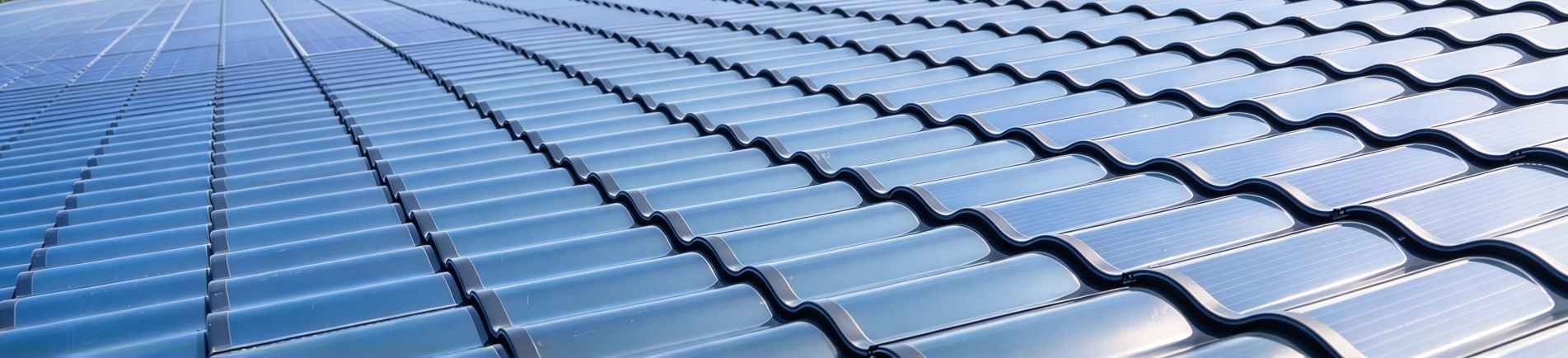
Solar roof tiles are photovoltaic roof coverings — sometimes called solar shingles — that generate electricity while acting as the finished weather surface. Instead of mounting framed panels above an existing roof, the tiles replace the roof covering itself and follow its lines. Our own range, made in our factory, includes the curved three-arch tile for traditional or premium profiles and flat photovoltaic tiles for simpler planes. They are particularly relevant for:
Commercial and public buildings that want a clean, modern or architecturally considered roofline.
Hospitality and cultural projects — hotels, resorts and visitor centres where appearance is part of the product.
Property developers looking to differentiate a new scheme and reduce its running costs from day one.
Comparison of BIPV (Building Integrated Photovoltaics) and BAPV (Building-integrated Photovoltaics
Business Benefits
Cost control and ROI
On-site generation reduces the volume of grid electricity a business buys and insulates it against tariff rises. Combined with commercial energy storage, a site can store midday generation and use it during expensive peak periods rather than exporting it cheaply. The return depends on local tariffs, the load profile and any available incentives, so it should be modelled on the building’s real bills rather than promised as a fixed figure.
Sustainability and compliance
As carbon and building-energy rules tighten, on-site renewables give businesses a verifiable way to reduce scope 2 emissions, support ESG reporting and meet green-building requirements. Generation and self-consumption data from the monitoring system provides the evidence rather than a claim on a brochure.
Resilience and energy independence
Solar plus a battery configured for backup can keep critical loads running during grid outages — important for sites where interruption is costly, such as retail, cold storage, offices with data rooms or guest accommodation. It reduces, rather than removes, dependence on the grid; full independence requires a deliberately oversized off-grid system.
Property value and lettability
For developers, a building with integrated generation and lower running costs is easier to market to tenants and buyers who increasingly expect low-carbon infrastructure. Integrated tiles keep that benefit without changing the building’s silhouette.
Solar Tiles vs. Conventional Panels for Business
Neither option is universally better; they suit different buildings. You may also know our tiled product line as tiled-type photovoltaic tiles.
Feature
Solar roof tiles
Conventional panels
Design integration
Replace the roof covering; clean, flush finish
Mounted above the roof on rails; highly visible
Cost per kW
Higher, as it includes the roof surface
Usually lower for generation alone
Power density
Curved profiles around 103 W/m²; flat tiles near 200 W/m²
Highest; needs the least area per kW
Best fit
New builds and re-roofs where looks matter
Large low-pitch commercial roofs and retrofits
Value created
Generation plus a finished, attractive roof
Primarily energy cost savings
How Storage Strengthens the Business Case
Many commercial sites generate most at midday, when the building may be partly empty, and draw most power in the morning and evening. A battery re-times that energy and adds a few practical functions:
Peak shaving — discharge stored energy to cut demand spikes and reduce both energy and demand charges.
Self-consumption — use solar that would otherwise be exported for little return.
Backup — support critical loads during outages where the system is island-capable.
Control and reporting — an energy management platform coordinates generation, storage and load and supplies the data for reporting.
Why Work With GreenMore
GreenMore is a photovoltaic tile factory rather than a reseller. Our solar tiles, PV bricks and curtain walls are made in our own production facility, and we build the solar and storage systems around them, so a commercial customer sources compatible parts from one team instead of stitching separate suppliers together. We provide:
Solar roof tiles for premium, integrated generation.
Commercial and industrial storage for peak shaving and backup.
Conventional rooftop and ground-mount systems where they suit the building better.
Project-specific layouts and configuration for the destination grid.
We are a focused, growing factory rather than a mass producer, which suits project work: we can tailor colors and profiles, stay flexible and give each project direct technical support. Two warranty points to be clear on: the photovoltaic tiles carry a 25-year power warranty, while the inverter, battery and other non-tile components carry a 3-year warranty. They are specified separately. You can see the breadth of our work in the BIPV solutions section.
Frequently Asked Questions
Are solar roof tiles suitable for a commercial building?
Yes, especially for new builds or re-roofs where appearance matters, such as offices, hotels and public buildings. For very large, low-cost utility-style roofs, conventional panels often give more capacity for the money.
Do commercial solar tiles work without a battery?
Yes. They offset grid use during the day and export surplus like any grid-tied system. A battery mainly helps shift that energy to peak times and provide backup.
How long does commercial solar storage take to pay back?
It varies with demand charges, time-of-use tariffs, incentives and how often the battery cycles, so there is no single figure. We model it from the building’s interval-meter data and quote the assumptions openly.
Can you supply the tiles, inverter and battery together?
Yes. As the tile manufacturer we supply the integrated roof and configure the matching inverter and storage for your grid, so the system is electrically compatible and supported through one contact.
Plan a commercial solar roof with us
Send us the building type, roof area and pitch, country, typical monthly use and target capacity, plus whether you need storage for peak shaving or backup. We will come back with a product recommendation, layout and indicative quote. Reach us through the contact page or email export@gmsolarkit.com.
L
Written by Luke — Product Manager, GreenMore
Luke manages GreenMore's BIPV and commercial storage product line. He has worked on photovoltaic systems since 2017 and helps businesses choose honestly between solar tiles, conventional panels and battery storage based on the building and the numbers.







 Network Supported


