
Welcome to GreenMore
Welcome to GreenMore

A 200-amp house in New Jersey needs 48 kW of backup power to be called whole-home under the 2023 electrical code. The same house, three days into an outage, actually runs on about 700 W: the fridge, a few lights, the router, the furnace board.
That is a 68-fold gap, and it is the most expensive misunderstanding in this purchase. One route to compliance costs $28,500 more than the other and buys nothing you will notice at the wall socket.
Start with the nameplate, not the marketing. A fridge door sticker that says 15 A is telling you the breaker size, not the draw. A modern french-door unit runs near 195 W and surges to roughly 400 W when the compressor kicks. A well pump is a different animal.
| Load | Runs at | Surges to | Why it matters |
|---|---|---|---|
| LED lighting | 100–400 W | same | Count rooms, not bulbs |
| Refrigerator | 150–250 W | 2–3× | Duty cycle matters more than peak |
| Router and networking | 20–50 W | same | Small load, total loss if missing |
| Furnace blower | 300–800 W | 3–4× | The one people forget in winter |
| Well pump, submersible | 800–1,200 W | 5–7× | A 1,050 W pump can demand 7,350 W |
| Central air, 3 ton | 2,800–3,000 W | 5–6× | LRA on the condenser decides it |
| Sump pump | 400–600 W | 3–5× | Two start together in a storm |
Add the running watts of everything you want on at the same time. That total sizes the inverter. The single largest surge sizes its peak rating, and the two numbers are not interchangeable. A 3-ton condenser with a locked rotor rating of 85 A pulls 85 × 240 = 20,400 W for a second or two. A soft-start kit cuts that by 50 to 70 percent, which is why installers fit one rather than sell you a bigger inverter.
Most homes discover their real list is shorter than they assumed. The fridge, the router, the furnace board, four rooms of light. That is 700 W, and it changes the entire quote.
Section 702.4(A)(2) of the 2023 National Electrical Code covers any standby source that connects automatically. It offers two ways to comply: the source carries the entire load on the panel, or an energy management system limits what reaches it and the source covers that smaller figure. There is no third option, and the first one is arithmetic, not opinion.
| Service size | Full load at 240 V | Powerwall 3 units needed | Storage that implies |
|---|---|---|---|
| 100 A | 24 kW | 2.1 | 28 kWh |
| 150 A | 36 kW | 3.1 | 42 kWh |
| 200 A | 48 kW | 4.2 | 56 kWh |
A Powerwall 3 delivers 11.5 kW continuous. Four of them store 56 kWh, cost roughly $9,500 each on top of the first install, and sit in a garage for years waiting for an outage that draws 700 W.
The second path is the one every competent installer takes. A smart panel or power control system sheds the heavy circuits the moment the grid drops, holds the backed-up load under the battery’s ceiling, and lets the compressor come back only when there is headroom. That hardware runs $2,000 to $4,000 installed. The three extra batteries it replaces run $28,500.
Both routes pass inspection. Only one of them is worth paying for.
Capacity decides how long the house runs. The arithmetic is one line:
Required usable kWh = (total running W × hours) ÷ 1,000 ÷ depth of discharge ÷ inverter efficiency
A 700 W list held for 12 hours is 8.4 kWh of energy. Divide by 0.9 for usable depth and 0.94 for conversion loss and you need 9.9 kWh installed. A 10 kWh pack covers it with nothing spare.
Turned around, here is what a single 10 kWh battery actually delivers:
| Load held | Runtime |
|---|---|
| 300 W — fridge, router, lights, boards | 28 hours |
| 500 W — add a TV and a fan | 17 hours |
| 700 W — add the furnace blower | 12 hours |
| 1,000 W — add a microwave cycle | 8.5 hours |
| 2,000 W — add a space heater | 4 hours |
These assume 90 percent usable and 94 percent conversion. Cold weather, an ageing pack and a low state of charge all eat into them, so plan on the low side.
If solar is already on the roof, the pack refills during the day and the nameplate stops being the ceiling. Check that the inverter accepts PV input while islanded. Plenty of storage systems charge from the grid only, which turns a sunny outage into a countdown.
Warranty figures need reading, not skimming. A pack rated for 6,000 cycles at 90 percent depth of discharge is a different product from one rated for 6,000 at 60 percent, and the headline number rarely says which. Ask for both, and for the capacity the warranty guarantees at year ten.
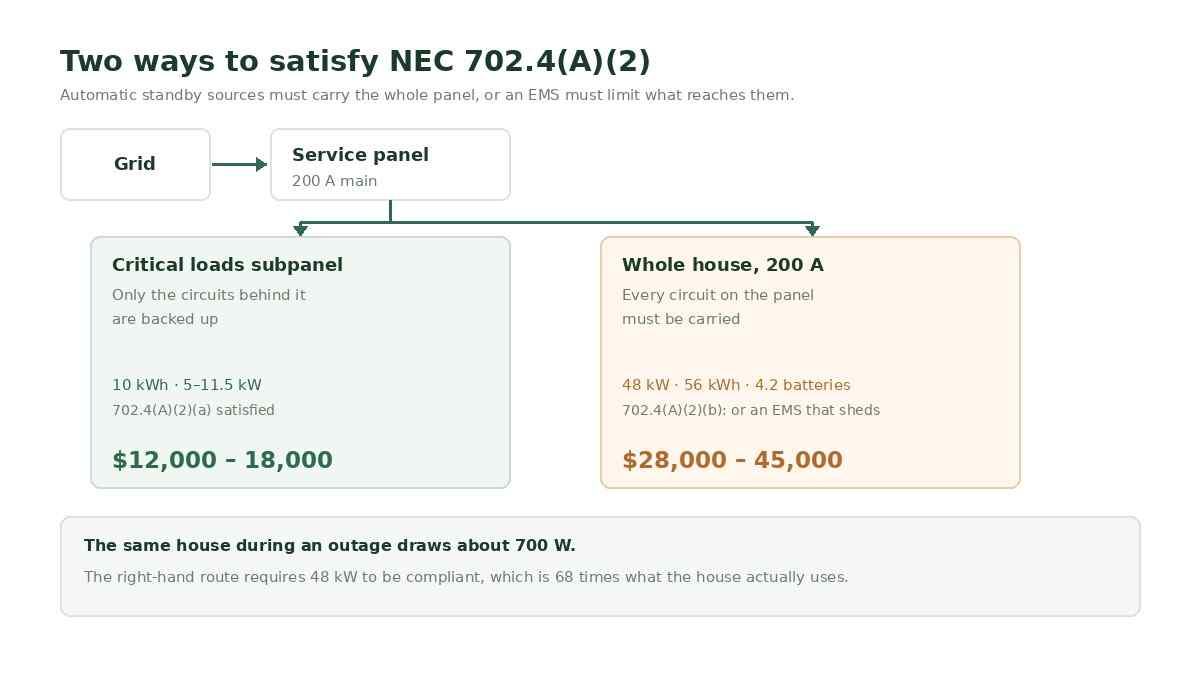
The upper path backs up a subpanel. The lower path has to satisfy the whole service rating, unless the EMS sits in between and sheds load.
An installed essential-loads system in the United States lands between $12,000 and $18,000 in 2026. Roughly 40 to 50 percent of that is labour, permitting, panel work and margin. The battery is the largest single line and still less than half the bill.
| Line | Range | Share of a $16,000 job |
|---|---|---|
| Battery modules | $6,500–9,000 | 41–56% |
| Inverter or gateway | $1,500–2,000 | 9–12% |
| Critical loads subpanel | $1,200–2,000 | 8–12% |
| Labour and conduit | $2,500–5,000 | 16–31% |
| Permit and inspection | $300–900 | 2–6% |
Two quotes $4,000 apart on identical hardware are usually not competing on the battery. They are competing on how much panel work they included, whether the permit is in the number, and who carries the inspection risk. Ask for the five lines separately and the gap explains itself.
Normalised by capacity, an installed system costs $1,000 to $1,500 per kWh. A portable station costs $300 to $500. You are paying three to five times more per stored kilowatt-hour for automatic switchover, code compliance and a warranty on the whole assembly. That premium is worth it if outages are frequent. If they are not, a manual transfer switch and a portable unit is a legitimate answer.
| Essential loads | Whole home | |
|---|---|---|
| Installed cost | $12,000–18,000 | $28,000–45,000 |
| Typical storage | 10–13 kWh | 27–56 kWh |
| Continuous output | 5–11.5 kW | 23 kW and up |
| Panel work | New subpanel, existing main | Main upgrade often needed |
| Runs central AC | Only with a soft start and headroom | Yes |
| Difference | — | $10,000 to $33,000 more |
Whole-home is the right purchase in a narrow set of houses: all-electric with a heat pump, a well, and an outage history measured in days rather than hours. Everyone else is buying reassurance they will never draw on.
Run the arithmetic on your own outage history before picking a tier. A $16,000 system over ten years is $1,600 a year. Three outages of eight hours is 24 hours, which puts the backup at $67 an hour. If your street loses power twice a year for two hours, the same money buys a portable station and a manual transfer switch, and the difference stays in the bank.
There is a middle option worth pricing. Back up the subpanel, but size the battery so the well pump and the furnace can run together. That usually means 15 kWh instead of 10, and it covers the two failures that actually hurt.
| Battery | Standby generator | |
|---|---|---|
| Transfer time | Under 20 milliseconds | 10 to 30 seconds |
| Start | Automatic, silent | Automatic, audible |
| Runtime | Fixed by capacity | Until the fuel runs out |
| Refuelling | Solar, if installed | Propane, gas or diesel |
| Maintenance | Firmware and inspection | Oil, filters, exercise runs |
| Installed cost | $12,000–25,000 | $5,000–15,000 |
| Other value | Self-consumption, time-of-use | None between outages |
Transfer time is the number nobody puts in the brochure and the one that decides whether your afternoon survives. A desktop power supply holds up for 16 to 20 milliseconds when the grid drops. A battery in backup mode closes in under 20, the good ones under 10. At 30 milliseconds the machine reboots. A generator takes 10 to 30 seconds, which means every clock, every router and every desktop in the house goes down and comes back.
The hybrid setup is common in rural areas for a reason. The battery carries the first hours silently and automatically, and a generator with a fuel supply covers day three. Most hybrid inverters accept a generator input for exactly this. Ask whether the one you are quoted does.
Four things decide whether the install passes, and none of them are on the battery datasheet.
The system has to carry a UL 9540 listing. A portable power pack certified to UL 2743 is not an energy storage system, however it is marketed, and an inspector will stop the job on it. Ask for the certificate, not the brochure.
Location is governed by NFPA 855 and whatever the local jurisdiction added on top. Batteries do not go in sleeping rooms, in a closet with no ventilation, or blocking an egress path. Garages and utility rooms are the usual answer. Some jurisdictions want an exterior sign naming the chemistry.
The federal credit is gone. Section 25D ended for property placed in service after 31 December 2025, so a homeowner buying in 2026 has nothing to subtract. Quotes still showing a 30 percent line are working from last year’s rules, and one of them will be used to close the sale.
Permits and interconnection come before the drill. Budget $200 to $1,000 for the permit and check whether the utility wants its own application. A battery that is set never to export still counts as a new source on the service in most territories.
A single-line diagram ties all of it together. It is the one drawing every inspector asks for, and it takes the installer twenty minutes.
Ask each installer for those six lines and the quotes become comparable. Without them you are comparing a number to a number and guessing at the difference.
If the sizing still feels like guesswork, the runtime of a 10 kWh pack is worked through household by household. For houses that already have panels, adding storage to an existing system covers the coupling question separately. The wall-mounted 10 kWh unit, the stacked modular range and the integrated battery and inverter cover the three form factors above, and the full list sits on the home energy storage page. Send the load list through the contact page and we will size it against your own numbers rather than a chart.
For essential circuits, 10 kWh with a 5 to 11.5 kW inverter covers most short outages. Add up the running watts of the circuits you want live, multiply by the hours you expect to be dark, then divide by 0.9 and 0.94. A 700 W list for 12 hours needs 9.9 kWh. Whole-home designs start around 27 kWh and climb from there, because the code question in section 702.4 sets the floor.
It can start one if the inverter’s surge rating clears the compressor’s locked rotor amps. A 3-ton unit at 85 A and 240 V demands 20,400 W for a second or two. A soft-start kit drops that to roughly 7,100 W and makes the job feasible on a residential inverter. Inverter-driven and variable-speed units draw far less inrush and are much easier to carry.
Not for outages measured in hours. A battery switches in under 20 milliseconds and covers the fridge, lights, router and furnace board for a day or more. For multi-day winter events with limited solar, a generator as a charging source is worth pricing, and most hybrid inverters accept one.
Only if it is backup-rated. Some storage systems are grid-tied only and shut down when the grid fails, which is a safety requirement rather than a defect. Confirm the backup function in writing before you buy, and ask for the transfer time in milliseconds.
No. The residential clean energy credit under section 25D ended for property placed in service after 31 December 2025. State and utility programmes continue in many areas and can be substantial, so check those separately. Any quote that still lists a 30 percent federal credit is out of date.
No. A grid-tied battery needs a permit, a utility application and a licensed electrician, and a system that backfeeds a dead service can injure a line worker. A portable station with a manual transfer switch is the self-installable version, and it is a different product with a different price.
Energy Storage Product Manager, GreenMore
Sizes residential storage systems against real load lists, and writes about the parts of the quote that installers leave out.
Updated on November 17, 2026
Stay up to date with GreenMore. We share new BIPV solar tile releases, product and certification updates, and field notes from our projects — no fluff, just the things that matter to installers, distributors, and system integrators. If there's something you'd like to see covered, drop us a line — we read every reply.




Copyright @ 2026 GreenMore All Rights Reserved.  Network Supported
Sitemap / Blog / Xml / Privacy Policy


