
Welcome to GreenMore
Welcome to GreenMore

A 51.2V 200Ah battery stores 10.24 kWh of energy. You get there by multiplying voltage by ampere-hours and dividing by 1,000: 51.2 × 200 ÷ 1,000 = 10.24 kWh. That is one of the most common capacities in 48V-class home storage, and it is usually built from 16 LiFePO4 cells in series, since 16 × 3.2V = 51.2V nominal.
The arithmetic is simple enough to do in your head. The parts worth slowing down for are the ones that decide whether 10.24 kWh is really the number you should be comparing: where the voltage and the ampere-hours each come from, how much of that figure you can actually draw, and what it will run in a real house.
Ampere-hours describe how much charge a battery can move. Volts describe the pressure it moves that charge at. Neither number on its own says how much work the battery can do, which is why a 100Ah rating is meaningless until you know the voltage it belongs to.
The gap is not academic. A 12.8V 100Ah battery holds 1.28 kWh. A 25.6V 100Ah battery holds 2.56 kWh. A 51.2V 100Ah battery holds 5.12 kWh. Same 100Ah label on all three, four times the energy between the smallest and the largest. Buyers who compare packs by Ah across different voltages are comparing the wrong number.
Multiply volts by ampere-hours to get watt-hours, then divide by 1,000 to get kilowatt-hours.
Two things trip people up here. The first is the division by 1,000, which converts watt-hours to kilowatt-hours — skip it and you will be out by a factor of a thousand. The second is that 51.2V is a nominal figure, not a constant. The pack sits somewhere between about 40V and 58.4V depending on state of charge, so the energy it delivers is calculated from the nominal voltage, while the actual current at any moment depends on where in that range it happens to be.
Once the formula is fixed, every 51.2V pack converts to a predictable ladder. The rows below are the sizes that actually show up in residential quotes.
| Capacity at 51.2V | Nominal energy | Where it usually appears |
|---|---|---|
| 50 Ah | 2.56 kWh | Small balcony or backup-only systems |
| 100 Ah | 5.12 kWh | Entry module in a modular stack |
| 150 Ah | 7.68 kWh | Evening self-consumption for a small home |
| 200 Ah | 10.24 kWh | The mainstream residential size |
| 280 Ah | 14.34 kWh | Larger homes, heat pump loads |
| 300 Ah | 15.36 kWh | Three-module stacks and mid-size ESS |
| 400 Ah | 20.48 kWh | Four-module stacks, small commercial |
A lithium iron phosphate cell has a nominal voltage of about 3.2V. Stack 16 of them in series and the voltages add: 16 × 3.2V = 51.2V. That is why 51.2V packs are so common — they are the natural result of a 16-cell series string, and 16 happens to land neatly on the 48V-class inverter input window that the industry standardised on years ago.
Change the cell count and you change the class. Fifteen cells give 48V nominal and are sometimes used for legacy 48V equipment; seventeen give 54.4V. Both exist, but neither is as common as 16S in home storage, and mixing them with a 51.2V inverter usually means a firmware workaround rather than a clean fit.
The 200Ah figure comes from the cell capacity and how many strings run in parallel. A pack built from 200Ah cells needs one parallel string: 16 cells, 16S1P, 51.2V and 200Ah. A pack built from 100Ah cells — the format most Chinese cell makers ship in volume, and the one GreenMore uses — needs two strings to reach 200Ah: 16S2P, 32 cells in total, still 51.2V and 200Ah.
The energy is identical either way. What changes is the internal layout, the cell count, and often the weight and the price. It is worth knowing which one you are being quoted, because a 16S2P pack has twice as many connections to get right and a different failure profile from a 16S1P pack built from large-format cells.
The 10.24 kWh figure is nominal energy. In real use you cannot draw all of it. Most systems hold back a reserve at the bottom of the range to keep the cells out of deep discharge, and some energy is lost in the battery and again in the inverter during conversion, so what reaches your loads is lower than what the label says.
How much lower depends on the depth-of-discharge limit the manufacturer sets. At 90% depth of discharge, a 10.24 kWh pack offers about 9.2 kWh before conversion losses. At 80%, the same pack offers about 8.2 kWh. That spread of roughly one whole kilowatt-hour is bigger than the difference between many competing quotes, which is why a nominal figure alone cannot settle a comparison.
Two units both advertised at 10 kWh can deliver noticeably different energy to the wall. Depth of discharge is the largest factor, round-trip efficiency is the second, and the inverter's own standby draw is the third — a hybrid inverter left on overnight can consume a few tens of watts continuously, which adds up over a long backup event. When you compare, ask for usable kWh, round-trip efficiency and the depth-of-discharge limit as three separate numbers. A supplier who can only give you the nominal figure has not answered the question.
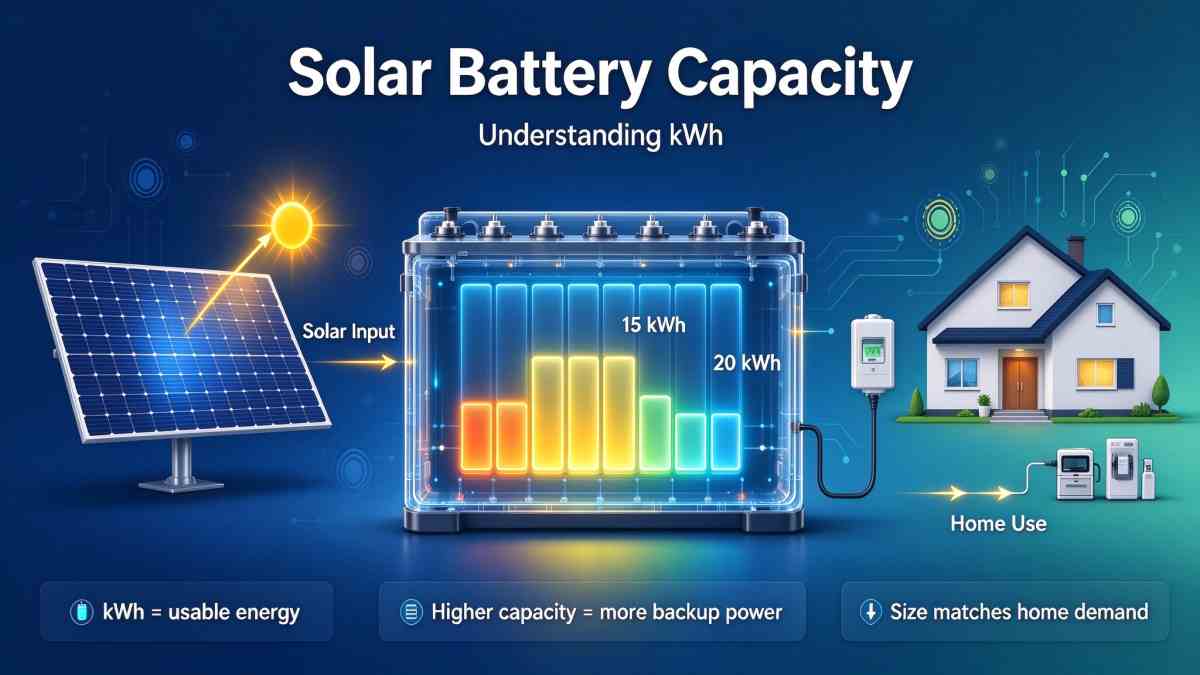
Capacity on the label translates into hours of home use — the larger the pack, the longer the backup.
How far 10.24 kWh goes depends entirely on the household. As a rough guide, it can carry efficient essentials — lighting, a refrigerator, communications and some electronics — through an evening or an outage, while heavy heating, cooling and electric cooking will draw it down quickly. Average daily consumption varies widely by country and by home, so the most reliable estimate comes from your own electricity bills rather than a generic figure.
Take a two- to three-person household in a temperate climate and list only the loads worth backing up. The figures below are typical daily energy, not instantaneous draw.
| Backed-up load | Typical daily energy | Basis |
|---|---|---|
| Refrigerator | 1.5 kWh | Modern 300 L unit, compressor cycling included |
| Lighting, 10 LED lamps | 0.5 kWh | About 5 hours per evening |
| Router and ONT | 0.2 kWh | Continuous, 24 hours |
| Television | 0.6 kWh | About 4 hours |
| Total | 2.8 kWh | Per day |
| Runtime at 8.2 kWh usable | About 2.9 days | No solar recharge, 80% depth of discharge |
Treat those numbers as a starting point rather than a promise. A hot climate moves the refrigerator figure up, a cold one moves it down, and adding a heat pump or an EV charger changes the calculation completely. The point of the exercise is that 10.24 kWh covers days of essentials or hours of heavy loads — the same battery, two very different answers, depending on what you put behind it.
If the load list above looks like your house, one 200Ah unit is a sensible starting point. If it does not, the table below shows what parallel units buy you.
| Configuration | Nominal energy | Typical role |
|---|---|---|
| 1 × 51.2V 200Ah | 10.24 kWh | Evening self-consumption and essential backup for a small to medium home |
| 2 units in parallel | 20.48 kWh | Larger evening load and longer backup runtime |
| 3 units in parallel | 30.72 kWh | Higher-consuming home or extended off-grid use with solar recharge |
Modular 48V-class batteries can often be added in parallel to raise total energy while keeping the same voltage, which lets you start with one unit and add more later. The number of modules supported and the cabling rules depend on the model and its BMS, so check the specification rather than assuming any number can be connected. Adding modules in stages is usually more practical than buying the full capacity up front, provided the inverter and wiring are rated for the final size from the start.
Energy adds up in parallel; current does too. A 10.24 kWh pack running a 5 kW inverter draws roughly 100 A at 51.2V. Put three of them in parallel and the pack can deliver three times that, which is why the busbar, the DC breaker and the cable gauge have to be sized for the final configuration rather than for the first module. Sizing the DC side for 10 kWh and then adding two more units is the most common installation mistake in this class, and it is an expensive one to fix after the wall is closed.
The other half of the equation is the discharge rate. A 10.24 kWh pack on a 5 kW inverter works at about 0.5C, which is a comfortable continuous rate for LiFePO4. The same inverter on a 20.48 kWh pack runs at about 0.25C, which is gentler on the cells and usually extends service life. If you expect to expand, a larger pack with the same inverter is not wasted capacity — it is a lower-stress duty cycle.
GreenMore supplies home energy storage batteries built around 51.2V LiFePO4 modules with a BMS for monitoring, balancing and protection, together with compatible inverters. The stacked series runs from a single 5.12 kWh module to 20.48 kWh across four modules, and the wall-mounted 5 kWh unit covers the fixed-requirement case. We size the number of modules against your actual usage and backup needs rather than quoting a fixed package.
Browse the home storage range, or send us your recent electricity bill through the contact page and we will come back with a module count and a runtime estimate for your loads.
Essentially, yes. A 16-cell LiFePO4 battery has a nominal voltage of 51.2V but is commonly called a 48V system because it works with 48V inverters. Its actual voltage moves with state of charge, from roughly 40V when empty to about 58.4V fully charged. The 48V label is a system class, not a measurement.
Not always. The figure is nominal. Systems typically reserve some energy at the bottom to protect the cells, and conversion through the inverter causes small losses. At 90% depth of discharge you get about 9.2 kWh before losses; at 80%, about 8.2 kWh. Check the stated usable capacity when comparing models, and check it against the same depth-of-discharge basis.
No, and this is the most expensive misunderstanding in the category. At 12.8V, 100Ah is 1.28 kWh. At 25.6V it is 2.56 kWh. At 51.2V it is 5.12 kWh. The Ah figure only becomes energy once you know the voltage, so always convert to kWh before comparing two packs.
Usually, if the model supports parallel expansion and the inverter and cabling are rated for the larger size. Confirm the maximum number of modules and the installation requirements before you buy, so the system can grow without being replaced. If the DC side is sized for the final capacity at the start, adding a module later is a short job.
That depends on daily usage and backup goals. Many homes start with one unit for evening self-consumption and essential backup, adding a second or third if they use more power or want longer runtime. Your electricity bills give the most accurate starting point — a daily figure in kWh, divided by about 8 usable kWh per unit, is a reasonable first approximation.
It needs a charger, or an inverter, whose charge profile matches LiFePO4 and whose current rating suits the pack size. A 10.24 kWh pack is usually charged at somewhere between 0.2C and 0.5C, which is 40 A to 100 A at 51.2V. Charging well below that is safe but slow; charging above it shortens cell life. Check the datasheet for the maximum continuous charge current rather than relying on the inverter's default.
Updated on November 12, 2026
Energy Storage Product Manager, GreenMore
Peter helps homeowners and installers convert battery voltage and Ah figures into usable kWh, size parallel modules against real load profiles, and understand the difference between nominal and usable capacity.
Stay up to date with GreenMore. We share new BIPV solar tile releases, product and certification updates, and field notes from our projects — no fluff, just the things that matter to installers, distributors, and system integrators. If there's something you'd like to see covered, drop us a line — we read every reply.




Copyright @ 2026 GreenMore All Rights Reserved.  Network Supported
Sitemap / Blog / Xml / Privacy Policy


