What size solar battery do I need for my home?
Mar 10, 2025
P
Peter Lu
Energy Storage Product Manager, GreenMore
There is no single correct battery size for every home. A system that is too small runs out during the evening or a long outage; one that is too large costs more than it will ever save. The right number comes from three things: how much electricity the loads you care about actually use, how long you want them to run without the grid, and how much of that energy the battery can realistically deliver. This guide walks through all three and ends with a simple worked example.
Step 1: Build your load profile
Start from your electricity bill, which states daily or monthly kilowatt-hours, rather than guessing from a list of appliances. Then separate the loads you want to keep running during an outage or overnight from the ones you can do without. Refrigeration, lighting, internet, a fan or a small heat-pump circuit usually make the essential list; an electric oven, clothes dryer or whole-house air conditioning often do not.
To make this concrete, read the nameplate power of each essential appliance and multiply by the hours it runs per day. A 150 W refrigerator cycling for 8 hours, for example, uses about 1.2 kWh. Add the essential loads together to get your daily critical load. A small efficient home might land near 5 kWh, a typical family home around 10 to 15 kWh, and a large home with electric heating considerably more.
If your main goal is savings rather than backup, also check your utility's time-of-use schedule. Under a plan with a clear peak and off-peak gap, the battery should be large enough to shift a meaningful share of your evening consumption; where rates are flat all day, size mainly for backup and solar self-consumption. Treat any quoted prices as illustrative — tariffs differ by utility and change over time, so use your own plan.
Step 2: Decide your backup target
Next, decide how long the essential loads must run on their own. Most homes aim to cover one evening and night until solar returns, which is effectively a one-day target. Off-grid and weak-grid homes may want two days or more to ride through cloudy weather. Backup days multiply the energy you need, so this single decision has the biggest effect on cost.
Basic backup — lights, refrigerator and communications for a short outage; roughly 3 to 5 kWh of usable energy.
Comfort backup — adds heating or cooling, a water heater and kitchen circuits; commonly 8 to 15 kWh.
Whole-house or off-grid — running the full home for a day or more; usually 20 kWh upward and often a generator for long stretches.
Step 3: Apply depth of discharge and efficiency
You cannot use 100% of a battery's nameplate capacity repeatedly without shortening its life. The usable share is set by the recommended depth of discharge (DoD), and some energy is lost in the inverter, cabling and battery itself. Lithium iron phosphate (LiFePO4) systems commonly allow about 90% DoD and run at a round-trip efficiency near 90%, but the exact figures come from the product datasheet, and it is sensible to leave a small margin rather than cycle at the limit every day.
Battery capacity (kWh)
= daily critical load × backup days ÷ (DoD × system efficiency)
Worked example
Suppose the essential loads total 12 kWh per day. For one night of backup with a DoD of 0.9 and efficiency of 0.9:
12 × 1 ÷ (0.9 × 0.9) ≈ 14.8 kWh
Rounding up leaves headroom, so a system around 15 to 20 kWh fits a one-night target. If the same home wanted two days of autonomy, the requirement doubles to about 30 kWh — a decision worth comparing against adding a backup generator, which is cheaper for rare multi-day events. Note the distinction between nominal and usable capacity: a battery sold as a certain kWh delivers less to the wall, so always size from usable energy.
Home situation
Typical usable capacity
Configuration
Apartment or small house, short outages
5 to 10 kWh
Single wall-mounted battery, single phase
Family home, one-night backup
10 to 20 kWh
Wall or stacked system, hybrid inverter
Large home or villa, three-phase loads
20 to 30 kWh
Stacked modules, three-phase inverter
Off-grid or two-day autonomy
30 kWh+
Multiple modules, often with a generator
Leave room to grow
A modular battery lets you add capacity later, but only if the inverter and communication bus support it. It is common to start with enough storage for the essentials, add modules when an electric vehicle or heat pump arrives, and integrate solar on the same system. Confirm the expansion limit and that new modules are compatible before buying; not every wall-mounted battery can be extended, and mixing different generations can be restricted.
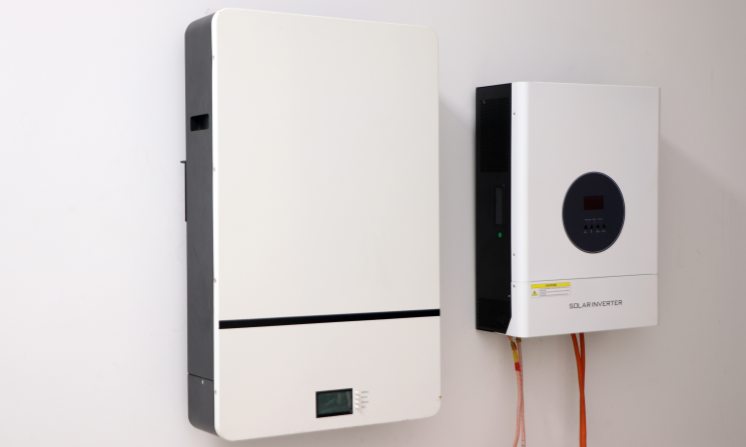
GreenMore energy storage batteries support parallel expansion of up to 15 units
What to check before you buy
Match the battery and inverter. Their voltage windows, power rating and control protocol must be compatible. A battery is only as useful as the inverter it pairs with, so confirm the combination works rather than buying them separately on price.
Check real certifications. Ask for the documents relevant to your market, such as CE and IEC for many regions, plus UN38.3 and MSDS for transport and handling. Safety testing such as IEC 62619 is a good sign; verify the certificate rather than relying on a logo.
Compare usable capacity and warranty, not sticker size. Two batteries with the same nominal kWh can differ in usable energy, cycle life and warranty terms. Read the cycle definition and warranty period — GreenMore covers non-tile storage components for 3 years.
Avoid undersizing on price. A battery that is regularly flattened or pushed past its limits will not reach its rated life. If budget is tight, protect the essential loads and expand later rather than running a small unit at its limit.
You can see the residential range on our home energy storage category page and the home energy storage system product page. If you send us your bill, appliance list, country and backup target, we can work through the sizing with you — use the contact page or email export@gmsolarkit.com.
FAQ
Is a 5 kWh battery enough for a house?
For a small efficient home that only needs to keep lights, a refrigerator and internet through a short outage, around 5 kWh of usable storage can be enough. It will not run heating, cooling or the whole home overnight, and it is tight where outages last more than a few hours.
What is the most common home battery size?
Most grid-connected family homes land between 10 and 20 kWh of usable capacity, which covers the essential loads through one night. The right point within that range depends on your evening consumption, whether you heat with electricity and how long local outages tend to last.
Should I use nominal or usable capacity when sizing?
Use usable capacity. Nominal capacity is the battery's full rating; usable capacity is what remains after the DoD and efficiency limits. A 12 kWh nominal battery might deliver around 10 kWh to your appliances, so sizing from usable energy avoids coming up short.
Is it cheaper to add a battery or a generator for long outages?
For frequent short outages and daily savings, a battery is clean, quiet and automatic. For rare multi-day events, a generator — or a hybrid system that uses a battery first and a generator for extended bad weather — usually costs less than buying enough storage for several days of autonomy.
P
Written by Peter Lu — Energy Storage Product Manager, GreenMore
Peter works with distributors, installers and system integrators to size residential and commercial storage around real load profiles. He focuses on LiFePO4 systems that match the inverter, grid rules and backup needs of each destination market.







 Network Supported

