Long‑Life Double‑Glazed Structure for PV Tiles: Engineering Durability for Modern BIPV Roofing
Sep 27, 2026
L
Luke
Product Manager, GreenMore · BIPV solar tiles, facades & storage
A PV tile has a harder job than a normal solar panel. A panel only has to generate; a tile has to generate while acting as the finished, watertight surface of the roof for decades. That is why our roof-integrated tiles are built as laminated glass–glass units rather than a single glass sheet over a plastic backsheet. This article explains how that double-glazed structure is put together, what it does for durability, and what we do and do not promise on service life.
Why the Structure Matters
Our roof-integrated PV tiles are not mounted above the roof — they replace the covering and sit in the weather-exposed layer. They therefore need to hold their own against the same forces a conventional roof faces: wind uplift, snow and foot traffic, driving rain, humidity, repeated temperature swings and years of UV. A symmetrical glass–glass build gives a tile four properties that matter here:
Mechanical rigidity that spreads loads across the face of the tile.
Low moisture ingress, since glass does not absorb water the way a polymer sheet can.
Strong fire performance from two non-combustible glass layers.
Long-term UV stability, with no backsheet to become brittle over the years.
Comparison diagram of double-glass and single-glass laminated structures
How the Dual-Glass Build Protects the Cells
The cells are the part that actually generates, and they are fragile in isolation. Encapsulating them between two sheets of toughened glass addresses the failure modes that shorten module life:
Moisture — glass is effectively impermeable, so the encapsulant and cells stay dry and insulation resistance stays high, which limits PID (potential-induced degradation).
Microcracks — the stiffer sandwich flexes less under point loads and wind, so cells are less prone to invisible cracks that quietly reduce output.
Thermal cycling — the matched glass layers expand and contract symmetrically, lowering the repeated stress that comes with heating by day and cooling at night.
Service Life and Warranty: What We Actually Promise
We design these tiles for multi-decade service in line with a permanent roof, but we prefer to state warranty terms rather than advertise a round number such as “30 years.” The terms are deliberately separated, because different parts of a system age differently:
Power output — the photovoltaic tiles carry a 25-year power warranty (a defined minimum output at year 25).
Tile product — material and workmanship on the tile itself are covered for 10 years.
Other components — the inverter, battery and other non-tile parts carry a 3-year warranty.
This matters for cost planning: a well-installed glass–glass roof should not need mid-life replacement, but no single blanket figure covers every component, and we would rather quote the real terms than a headline that does not match the warranty document.
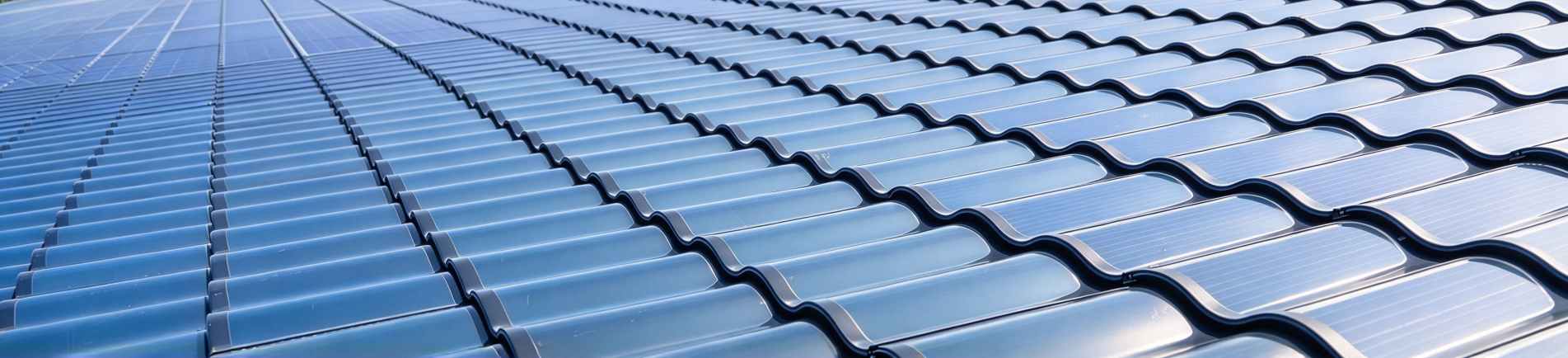
GreenMore All-Black Flat Panel Photovoltaic Integrated Roof
Technical Specifications
The figures below describe the double-glazed tile structure. Exact values vary by model, so the project datasheet remains the controlling document.
Parameter
Value
Layer structure
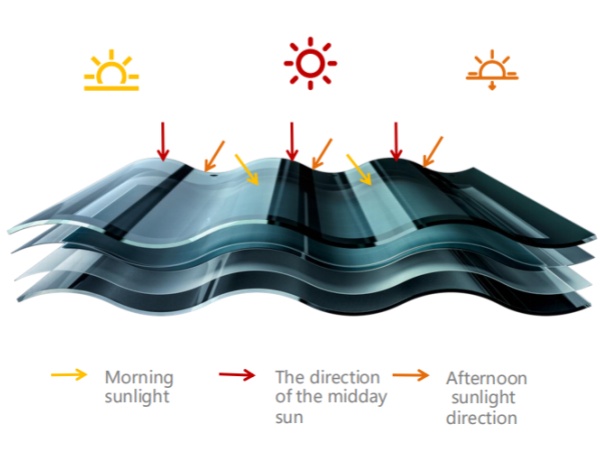
Front glass → encapsulant film → solar cells → encapsulant film → back glass (frameless)
Front glass
3.2 mm toughened ultra-clear low-iron glass; light transmittance ≥91%
Back glass
3.2 mm toughened glass, carrying the rear load
Encapsulant
EVA / PVB / PO / ionomer; PVB is common in laminated tiles
Cell type
CIGS thin film; back-contact (BC) cells used on higher-efficiency lines
Front load
≥5400 Pa
Rear load
≥2400 Pa
Max system voltage
1000 V
Fire rating
Class A, non-combustible glass build
Operating temperature
−40 °C to +85 °C
PID behaviour
Low risk thanks to the glass–glass seal; the array is still bonded and grounded for safety
Standards
IEC 61215 and IEC 61730
Reviewed September 27, 2026
PV Tiles vs Conventional Framed Modules
Integration
Framed modules sit above an existing roof; PV tiles replace the covering and form one continuous surface.
Back protection
A polymer backsheet can weather over decades; a glass back keeps its mechanical and sealing properties rather than relying on that sheet.
Trade-off
Glass–glass tiles are slightly heavier than backsheet modules and cost more per watt, and curved profiles carry fewer watts per square metre than large panels. The payoff is a roof that is durable and fully integrated, as shown across our BIPV systems and our curved triple-arch tiles.
Frequently Asked Questions
Why use a double-glazed structure?
Because a PV tile is part of the roof, it needs stronger environmental protection than a typical module. Sealing the cells between two sheets of toughened glass gives better resistance to moisture, load, fire and temperature cycling.
Does the second sheet of glass reduce efficiency?
Not meaningfully. The front uses high-transmittance low-iron glass (≥91%), so the added durability comes without a practical loss of generation, and output over the long term is typically more consistent.
What is the actual warranty period?
The tiles carry a 25-year linear power warranty; the inverter, battery and other non-tile parts carry 3 years. We do not advertise a blanket “30-year” figure that the warranty documents do not support.
Are glass-glass tiles heavier?
They are slightly heavier than a backsheet module but remain within the load limits of a standard roof structure. We confirm this against the roof design for each project.
Does a glass-glass tile still need grounding?
Yes. Glass–glass construction lowers PID risk, but the array and mounting still require equipotential bonding and grounding for safety and to meet installation codes. “No grounding needed” would be incorrect.
Specifying double-glazed PV tiles?
Tell us the roof type and area, pitch, country, target capacity and whether storage is included. As the tile manufacturer, GreenMore will send the matching datasheet, layout and quote. Use the contact page or email export@gmsolarkit.com.
L
Written by Luke — Product Manager, GreenMore
Luke manages GreenMore's BIPV tile and storage product line. He has worked on photovoltaic systems since 2017 and writes about how the tiles are actually built, tested and warranted rather than repeating marketing figures.





 Network Supported

