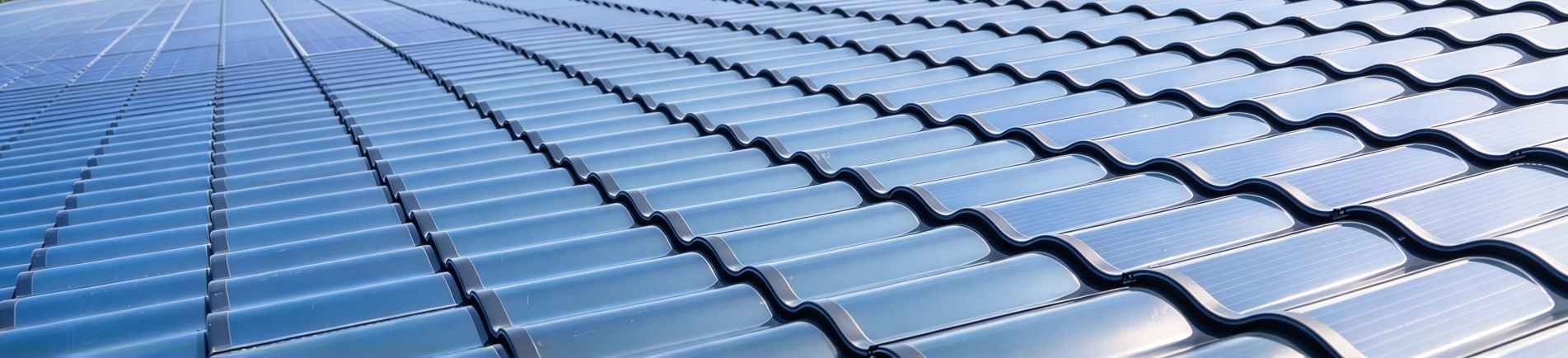
Large-area BIPV curved solar tile roof array for commercial buildings by GreenMore
Home

Solar Tile Lifetime Cost

Solar Tile Lifetime Cost

  • Seamless Solar Tiles: Roofing and Power Generation in One
    Seamless Solar Tiles: Roofing and Power Generation in One Nov 13, 2026
    Most rooftop solar is added to a building. A seamless solar tile is part of the building. The tile that keeps the rain out is the same tile that generates the electricity, and there is no second layer sitting on top of it. That distinction sounds small until you stand in front of the house. Rack-mounted panels announce themselves from the street: rails, standoffs, visible frames, a stepped silhouette against the sky. Tiles do not. From ten metres away, a well-installed solar tile roof reads as a roof, and most visitors will not notice anything unusual until they look closely at the surface. This article covers what "seamless" means in structural terms rather than marketing terms, the specifications that decide whether a tile roof actually performs, and the cases where the approach stops making sense. A full curved-tile roof from street level. The array is the roof surface, not an addition to it. What "seamless" actually means in a solar tile A conventional rooftop array is a three-layer assembly. The roof structure carries the load, a waterproof membrane keeps water out, and the panels sit above both on aluminium rails. Each layer has its own installer, its own warranty and its own failure mode. A solar tile collapses those three layers into one product. The tile is the weather barrier. The tile is the structural covering. The tile is the generator. There is no membrane underneath the array and no rail above it, which is why the surface stays flat. This is what building-integrated photovoltaics means in practice. BIPV is not a panel that has been made to look nicer. It is a building component that happens to produce electricity. That is the same line IEA PVPS Task 15 draws when it separates BIPV from BAPV, or building-applied photovoltaics. The difference from rack-mounted panels   Seamless solar tiles Rack-mounted panels Layers on the roof One Three: structure, waterproofing, PV Roof penetrations None beyond standard tile fixing Rails anchored through the waterproofing Visual profile Flush with the roof plane Raised above the roof surface Replacement cycle Roof and PV age together Roof may need redoing underneath the array Best suited to New roofs and full re-roofs Sound existing roofs, flat roofs Why the roofline matters more than most buyers expect Aesthetics is usually framed as a personal preference, which undersells the problem. On a lot of projects the roofline is a planning constraint. In historic quarters across southern Europe, roof replacements in protected zones are reviewed against the surrounding streetscape. In Mediterranean villa developments, the roof is the most visible elevation from the road and from neighbouring properties. Homeowners' associations in the United States routinely reject visible arrays on street-facing slopes. In all three cases, the objection is not that solar looks bad. It is that the roof no longer matches what the building was designed to be. A tile that matches the profile, the colour and the reflectivity of the original covering solves a problem that a more efficient panel does not. That is the trade a BIPV roof makes, and it is worth being clear about it: you are choosing architectural continuity over the last few percent of conversion efficiency. How the tile becomes the roof "It replaces your roof tiles" is easy to claim and harder to engineer. Three things have to be true at once: water has to leave the roof, the tile has to carry load, and the electrical parts have to survive twenty-five years of the same weather the roof does. Interlocking and drainage GreenMore tiles connect through sealed interlocking channels rather than a separate underlay. The curved profile on the curved BC tile sheds water the way a traditional clay tile does, which also means less dust accumulation than a flat panel and fewer cleaning cycles over the year. The triple-arch tile uses a stacked interlocking profile with built-in windproof hooks and an integrated drainage path, so the water management is part of the tile geometry instead of an added membrane. The tile-strip system goes further, laying long strips across the roof with a bottom cement tile course and a dedicated ridge detail, which is closer to how a metal standing-seam roof is built than to how a panel array is built. Side lap channel, interlocking tooth and sealing strip on the triple-arch tile: water is managed by the profile, not by a membrane underneath. Double-glass construction GreenMore tiles use tempered photovoltaic glass on both the front and the back. There is no polymer backsheet anywhere in the assembly. This matters more than it sounds. A conventional module sandwiches its cells between front glass and a plastic backsheet. The backsheet is the part that fails first in hot, humid and high-UV conditions: it yellows, it cracks, and eventually it delaminates from the encapsulant. A glass-to-glass assembly removes that failure path entirely, at the cost of extra weight. On a 720 × 500 mm tile the penalty is 6.5 kg, which is well within the range a tiled roof already carries. We covered the durability comparison in more detail in this comparison of double-glass and conventional modules. What the load figures mean The headline number on every GreenMore tile datasheet is 5400 Pa of front static load. That is roughly 550 kg per square metre, applied evenly across the surface. It is the figure that decides whether a roof survives a design snow load or a storm event, and it is tested to the same protocol that a conventional module is tested to. We walk through how that test is actually run in this breakdown of the 5400 Pa rating. The triple-arch tile adds two figures that matter in hail country: impact resistance to 25 mm hailstones at 23 m/s, and an operating range of −40 °C to +85 °C. For reference, 25 mm is just under an inch across, and 23 m/s is close to the terminal velocity a stone that size reaches falling from a severe storm cell. One figure that is frequently misread is the IP rating. When a datasheet says IP68, it refers to the junction box and the connectors, not to the whole tile. The tile itself is waterproof by geometry, through interlocking and drainage. The IP rating covers the point where the electricity enters and leaves, which is the part that actually needs sealing. The specifications behind the claim GreenMore manufactures three tile formats. All three are produced in-house, and all three carry a 25-year linear power warranty. Model Pmax Tile size (mm) Weight Junction box Front load GM-HW50BCCurved BC 50 W 720 × 500 × 32 6.5 kg IP68, MC4 5400 Pa GM-HW32LTriple-arch 32 W 700 × 500 × 33 6.5 kg IP67, MC4 5400 Pa GW30Flat tile 110 W 1060 × 650 × 35 8.9 kg IP68, MC4 5400 Pa Curved, triple-arch and flat formats share the same fixing logic but not the same output per piece. The flat tile is the highest-output format per piece at 110 W, but the largest at 1060 × 650 mm. The curved BC tile is the smallest at 50 W, which is the price of matching a traditional curved profile. There is also a tile-strip system for long-span roofs, which carries 109 to 115 W per strip at 1817 × 420 mm and is specified per project rather than from a standard table. Do not convert these numbers into watts per square metre of roof without allowing for overlap. Tiles lap over one another, and edges and ridges consume area that never gets covered. The useful figure for a given roof comes from a layout drawing, not from dividing one number by another. Two cell technologies on the same roof GreenMore builds the same tile shapes around two different cell technologies. They are not interchangeable, and the choice should follow the roof rather than the datasheet. BC back-contact: the highest output per tile Back-contact cells move all the electrical contacts to the rear of the cell. With no busbars on the front, the entire face collects light, and the surface reads as one uniform dark plane instead of a grid. On the GM-HW50BC this delivers 24.1% module efficiency, the highest figure in the range. The 42 W and 37 W variants of the same tile come in at 23.9%. There are two practical consequences beyond the headline number: less shading loss when one part of the roof is partially covered, and better behaviour in heat, which matters in Gulf and southern Mediterranean markets where roof surface temperatures climb well above ambient. CIGS thin-film: flexibility and weak light The thin-film route uses a CIGS absorber on a flexible substrate, at roughly 100 to 105 W per square metre and 32 W per tile. Two things make it worth the lower power density: the substrate bends, so the tile follows a three-curve roof profile naturally instead of approximating it, and the material holds output better under overcast skies and at high angles of incidence. If you are evaluating thin-film tiles, ask about the front encapsulation by name. ETFE front sheets have a documented history of delamination in hot and humid service, and the failure is slow enough that it often appears after the installation warranty has expired. We wrote up the mechanism and how to test for it in this analysis of ETFE peeling on three-curve tiles. Which one fits which roof   BC back-contact CIGS thin-film Module efficiency Up to 24.1% About 100 to 105 W/m² Power per tile 37, 42 or 50 W 32 W Appearance Uniform dark, no front busbars Ultra-uniform, no grid lines Weak light Good Better Geometry Rigid glass Flexible substrate follows curves Best for Maximum output on a defined roof plane Complex and strongly curved roof geometry A practical rule: if the roof is a clean plane and the goal is the highest annual yield, take BC. If the roof is genuinely curved, or the building's character depends on that curve, thin-film is the only route that does not compromise the shape. GreenMore supplies both, which is the reason we can say that without steering you. The technology comparison in this overview of three-curve tile technologies goes deeper into the trade-offs, and the reason TOPCon never appears on a curved tile is a separate question of cell geometry. What a seamless roof costs over its life A solar tile roof costs more per square metre than plain roof tiles. It is also more expensive than a cheap panel array on a sound existing roof. Both statements are true and neither is the whole picture. The comparison that matters is against the combined cost of a new roof plus a separate solar installation, because that is the alternative on a new build or a full re-roof. Two systems mean two mobilisations, two sets of scaffolding, two trades on site at different times, and two warranties that expire on different schedules. One integrated system means the roofer and the electrician work the same surface in the same visit. There is a second saving that shows up years later. When a roof under a rack-mounted array reaches the end of its life, the array has to come off before the roof can be replaced, and the racking and flashing have to be redone afterwards. On an integrated roof there is nothing to remove, because the tiles are the roof. The two components reach end of life together, which is the whole design intent behind pairing a 25-year power warranty with a roof covering rated for the same horizon. What we will not do is quote a payback period. It depends on your electricity tariff, your irradiance, your roof area, your subsidy regime and how much of the roof you cover. Anyone who gives you a single number before seeing those inputs is guessing. Where seamless tiles work, and where they do not Good fit New builds and full re-roofs are the natural case. If the roof is coming off anyway, the marginal cost of going solar in the same operation is the lowest it will ever be. Pitched roofs on villas, hotels, cultural buildings and protected-street properties are where the aesthetic return is highest. Large-format flat tiles suit modern architecture and larger roof planes; curved and triple-arch profiles suit Mediterranean and Middle Eastern vernacular. The full tile range covers all of them. Poor fit Three situations where we tell buyers to look elsewhere. A flat or low-slope roof with a sound membrane is better served by a ballasted or adhered array, because there is no tile geometry to integrate with. A roof structure that cannot carry the additional dead load needs an engineer before it needs a product, and 6.5 kg per tile adds up quickly across a large area. And a building where only one slope is being redone, with no plan to touch the rest, will end up with two different roof surfaces that will never quite match. The honest summary: this is a roofing decision that produces electricity, not a solar decision that happens to look better. Adding storage to a solar tile roof A tile roof on its own exports everything it makes during the day. Add a hybrid inverter and a battery, and the same roof starts covering evening load and grid outages. Sizing follows the load, not the roof. A 10 kWh battery covers a typical household's critical circuits overnight; a 20 kWh pack starts to look reasonable once heating, cooling or an EV enters the picture. The roof's job is to refill it, and on a well-oriented tile roof in a sunny climate that happens most days outside winter. We go through the interaction between tile output and battery capacity in this guide to pairing tiles with storage. One point that gets missed in planning: the roof and the battery have different lifetimes. A tile roof is designed to outlast one battery replacement, so the inverter and battery should be specified with that in mind, and mounted somewhere accessible rather than tucked into the roof assembly. Six questions to ask any solar tile supplier The market has filled up with suppliers who resell tiles made by someone else. That is not automatically a problem, but it changes what you can expect when something goes wrong in year eight. These are the questions that separate the two. 1. Do you manufacture the tile, or buy it? Ask for the factory, not the catalogue. GreenMore has been building BIPV products since 2017 and manufactures tiles, photovoltaic bricks and photovoltaic curtain walls in-house. 2. Which certifications apply, and to what? IEC 61215 covers design qualification and IEC 61730 covers safety qualification, and both are module-level standards. EN 14782 covers self-supporting roofing elements, which is the standard that matters for the roof function rather than the electrical function. Ask for the certificates, and check that the model on the certificate is the model you are buying. We explain what each one actually tests in this article on EN 14782 and IEC 61215. 3. What is the IP rating on, exactly? A supplier who says "IP68 tile" is either simplifying or does not know. The rating applies to the junction box and connectors. Anything above IP65 is fine for a roof; what matters is that the box is correctly potted and the connectors are the MC4 type rather than a proprietary clip. 4. Double glass, or glass and backsheet? On a roof, glass-to-glass. A polymer backsheet on a surface that reaches 70 °C in summer is the weakest link in the assembly. 5. How long is the tile warrantied, separately from the power output? These are two different promises. A 25-year linear power warranty says nothing about whether the tile still keeps water out in year 20. GreenMore tiles carry a 25-year linear power warranty; the triple-arch tile carries a 30-year tile warranty on top of it. 6. Can I see a roof that has been up for a few years? A completed project tells you more than a datasheet. The Netanya project in Israel used 407 tiles across a single integrated roof, and the installation sequence is documented in this installation walkthrough. Frequently asked questions Do solar tiles replace regular roof tiles? Yes. They are the primary roof covering, not an addition to it. The covered area needs no clay or concrete tiles underneath, and the interlocking profile provides the weather barrier. What stays underneath is the roof structure and battens, exactly as it would be for a conventional tiled roof. How efficient are seamless solar tiles? The BC curved tile reaches 24.1% module efficiency at 50 W, which is at the top of what crystalline silicon delivers in a tile format. CIGS thin-film tiles run at roughly 100 to 105 W per square metre. A tile roof will always be slightly less productive per square metre than a large-format panel, because tile geometry and overlap consume area. The comparison that matters is against the alternative you can actually build on that roof. Can solar tiles match a traditional roof style? That is the point of them. Triple-arch profiles reproduce the shape of classic clay tiles, and the range is available in grey, green, red and black matte finishes. On a protected-street renovation the roof reads as a matching replacement rather than an intervention, which is usually the difference between approval and rejection. What warranty comes with a solar tile roof? A 25-year linear power warranty on output across the range, plus a 30-year tile warranty on the triple-arch profile. Both are backed by factory testing under IEC 61215 and IEC 61730, with CE and EN 14782 conformity for the roofing function. Can I install solar tiles on just part of a roof? Yes, and it is a sensible way to control cost. Cover the sun-facing slopes and leave the rest as conventional tiles, provided the two coverings are profiled and coloured to match. What we would avoid is a partial replacement on one slope that leaves the building with two visibly different roof surfaces. How do they hold up over twenty-five years? The double-glass assembly removes the backsheet, which is the component that usually fails first on a conventional module. The remaining risks are the junction box seals and the interlocking joints, both of which are addressed by the IP rating and the tile geometry rather than by a coating. Field data from ageing and weathering tests is summarised in this long-term weathering review. L Luke Product Manager, Solar Roof Tiles Works with installers and project developers on BIPV roof specifications, from tile layout drawings through to commissioning. Updated on November 16, 2026
  • When a BIPV Project Fails: Spares, Timelines, Repair Costs
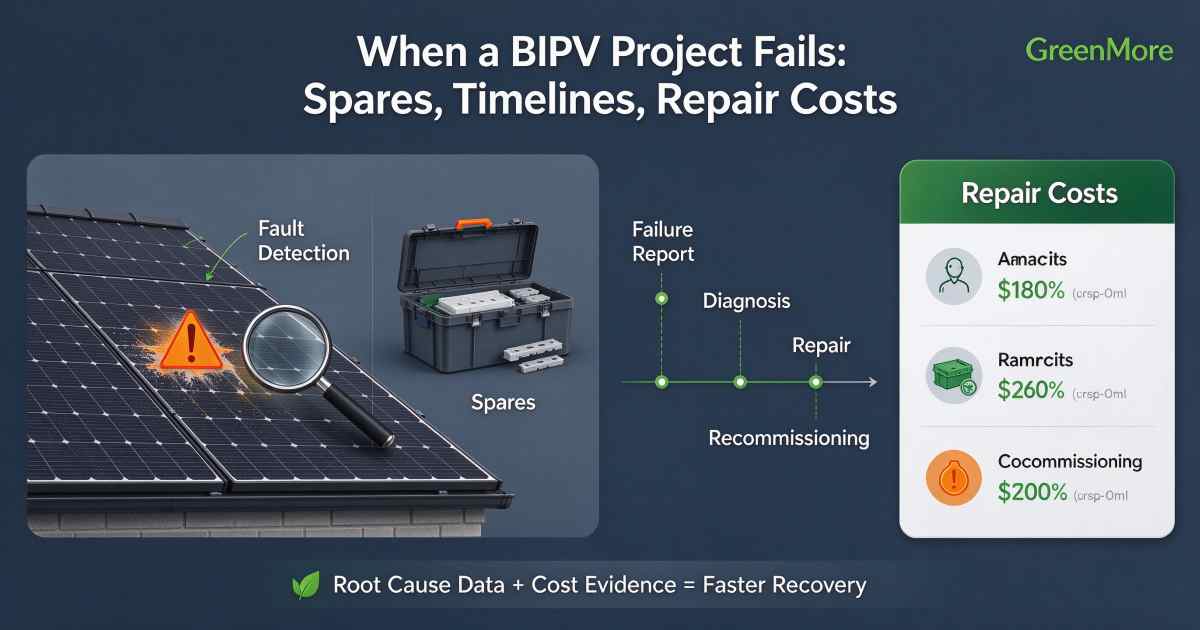
    When a BIPV Project Fails: Spares, Timelines, Repair Costs Jul 16, 2026
    Every supplier publishes what its support covers. Very few publish what happens when something actually fails: who answers, how long it takes, what the part costs, and who pays for the flight. That is what this page is about. It is not a list of services. The service and support page covers what GreenMore offers across planning, installation, commissioning and operation, including the training programme, documentation set and warranty terms. This page takes one narrow subject: the failure path, from the first message to the part arriving on site, with the timelines and costs attached to each step. If you are evaluating whether the support package is adequate, read the service page. If you are planning a project and want to know what a bad week looks like and what it will cost, read this. Most cases are resolved with three things on the table: the drawing, the log and a photograph. How a factory-based support model behaves GreenMore is a factory, not a service network. There are no regional service partners and no local stock of every part in every market. What exists is an engineering team at the plant that has built and commissioned these systems, reachable by email, messaging and video call, with a typical response time of 24 hours on business days. Four consequences follow, and they are better understood before a project starts than after: Response time is about a day, not an hour. A fault raised on Friday evening is answered on the next business day. For a residential system that is fine. For a commercial system losing revenue per hour, it argues for holding spares on site. English is the working language. For other languages we work through a translator or machine translation. That is adequate for documents and written questions and slow for a live fault-finding call. The first reply usually comes from your sales contact. Not because engineers are hidden, but because not every engineer is confident speaking English, and a routed question gets an accurate answer faster than a direct one that gets misread. There is no local technician to send. Remote diagnosis is the default. An engineer attends site only when remote work has been exhausted, and the travel is charged at cost. None of this is unusual for a manufacturing exporter. It is unusual to see it written down. The five failures behind most support tickets Across the projects we support, the same handful of problems keeps appearing. They are worth knowing because four of the five are installation errors rather than product faults, and all five are cheaper to prevent than to fix. 1. Communication that works but does not report The system generates, the inverter display looks normal, and the monitoring platform shows nothing. The usual causes are RS485 or CAN wiring reversed, termination resistors missing at the end of a long bus, or a meter address set to the wrong channel. This is the most common ticket we receive, and it is almost always resolved remotely in one session. It is also the one that damages trust most, because the owner concludes the system is broken when it is only unobserved. 2. Firmware mismatch between inverter, battery and EMS Everything energizes, then the battery refuses to charge above a set rate because two devices disagree about the protocol version. Nothing is faulty. The fix is a version alignment, which takes minutes once identified and can take two weeks to identify if nobody thought to check the firmware builds against each other. 3. The CT clamp that charges when it should export Fitted backwards, or clamped to the wrong conductor. The system behaves correctly according to what it measures and incorrectly according to what the building needs. On a sunny commissioning day this is invisible. On the first evening it is obvious, and by then the installer has left. The same clamp logic applies to the residential storage systems, where import and export direction decides whether the battery charges or discharges. 4. String voltage that is fine in summer A string designed at 25 degrees can exceed the inverter window at minus 10. The commissioning reading looks acceptable, the system runs all summer, and the first cold snap takes the inverter out. This one is not an installation error at all: it is a design error that no amount of site work will correct. The check is simple and worth doing on every project. Take the module open-circuit voltage at STC, apply the temperature coefficient at the lowest expected ambient for the site, multiply by the number of modules in the string, and compare against the inverter maximum. If it is close, shorten the string. 5. The roof detail that leaks at the valley Cut tiles at a hip or valley are unavoidable. What matters is whether the cut lands on a lap or on an exposed face. A cut through the drainage channel will track water sideways, and the leak appears a metre away from where it was made. The BC curved tile carries its channel along the vertical lap for exactly this reason, which is why the cutting sequence matters more than the cutting tool. This is the only one of the five that genuinely requires a site visit in most cases, because it cannot be seen remotely. Four of the five common failures can be diagnosed from a photograph and a log. The fifth cannot. What a usable support request contains The single biggest cause of delay is a request that cannot be actioned. Not a difficult fault, not a slow engineer: a message without a serial number. Without it we cannot tell which firmware build, which batch or which production revision the unit came from, and the first reply becomes a question instead of an answer. A request that gets resolved in one round contains six things: Model and serial number. Every unit, including batteries and inverters, not just the one that looks faulty. Fault code or error text. Photographed from the display or exported from the platform, rather than paraphrased. A log extract covering the period before the fault. The hour before an alarm usually explains it. Photographs. The installation, the connector in question, the label plate, and the reading on the meter. What changed. New firmware, new load, new tariff setting, grid outage. Most faults have a trigger. Site conditions at the time. Weather, ambient temperature, snow cover, and whether the grid was stable. With those, most cases close in one exchange. Without them, the case becomes a conversation, and a conversation across time zones costs days rather than hours. How long each kind of case takes These are working figures for a business-day timeline, from the moment a complete request arrives. They are not service-level commitments, and a case that turns out to be a hardware failure takes longer than one resolved by configuration. Case type First response Resolution What shortens it Monitoring or communication fault Within 24 hours Same session in most cases Log extract, platform access, photographs Firmware or configuration issue Within 24 hours 1–3 days Current versions of all three devices Suspected hardware failure Within 24 hours Diagnosis in 1–2 days, part lead time after Serial number, fault history, meter readings Roof or waterproofing issue Within 24 hours Site visit or installer rework Photographs of the detail, not the roof Spare part quotation Within 24 hours Dispatch depends on stock and shipping Model, quantity, destination, order reference Out-of-warranty repair Within 24 hours Assessment first, then part and travel Fault history, photographs, site access Two things are outside this table and should be planned separately: shipping time, which depends entirely on destination and customs, and site attendance, which depends on visas and flight availability. Neither can be compressed by working faster. Language, and who you end up talking to English support means English support. Most of our engineers read technical English well and speak it with varying confidence. For a drawing, a written diagnosis or a document, that is not a limitation. For a live fault-finding call with three people on a roof in the rain, it is. In practice the route is: your sales contact receives the question, identifies whether it is installation, commissioning, configuration or hardware, and routes it to the right engineer. When the problem is genuinely difficult, the engineer joins directly and the sales contact stays on the call as translator. That is why the first reply often comes from a commercial contact rather than a technical one. Two things make this work better. Written questions get written answers, which are accurate and can be forwarded to the installer. Live calls are scheduled rather than improvised, so a translator is available. If the installation team does not work in English, nominate one English-speaking coordinator on your side. It costs less than a call-out. Spare parts: two models and the arithmetic There are two ways to handle spares, and the right choice depends on how far the site is from the factory and what a day of downtime costs. Model one: pre-purchased with the order A percentage of the order quantity is configured as spares at the time of purchase, typically 3 to 5 percent depending on project size and criticality. They ship with the main consignment, clear customs with it, and sit on site from day one. This is the right model for remote projects, for projects where the installer is not local, and for anything where a two-week wait for a part is unacceptable. The cost is visible in the quotation up front, which some buyers resist, but it is the cheapest way to guarantee a same-week repair. Model two: factory stock, shipped on demand No spares are purchased in advance. Parts are held at the plant and dispatched when a failure is confirmed. This suits distributors with a local warehouse, projects on a fast shipping lane, and buyers who would rather not tie up capital in stock that may never be used. The trade-off is time. A part that has to be quoted, invoiced, packed and shipped internationally will not arrive this week. For a commercial system with a revenue loss per day, that arithmetic usually settles the question in favour of model one. Pre-purchased spares ship with the main consignment and clear customs with it. What spares cost Spare parts are not free, including during the warranty period. The warranty covers the defective part; it does not cover a stock of replacements held on site. Pre-purchased spares are charged at the time of order and discounted against the project, with the discount depending on volume and mix.   Pre-purchased with the order Shipped from factory stock Quantity Typically 3–5% of order As required Shipping Travels with the main consignment Separate shipment, separate customs Cost timing Paid with the order, discounted Charged when the part is needed Best for Remote sites, non-local installers, high downtime cost Local distributors, short shipping lanes, low downtime cost Lead time after failure Same day, part already on site Quotation, then production and shipping Repair after the warranty ends Batteries, hybrid inverters and ESS cabinets carry a three-year warranty. Solar roof tiles carry a 25-year linear power warranty. Once those have expired, or where a fault is not covered, repair is charged at cost: no margin on the part, no fixed call-out fee. There are two routes, priced differently. Remote support. Diagnosis, configuration guidance and firmware work over email, messaging or video call. Provided without charge beyond the component cost, because it costs engineering time rather than travel. Engineer on site. Used when the problem cannot be resolved remotely. The engineering time is not the expensive part. The travel, accommodation, visa and local transport are, and those are charged to the buyer at cost. The practical advice is to exhaust the remote route first. Most faults that look like they need a site visit turn out to be configuration or communication problems that a scheduled call with the right photographs will resolve. Where attendance is genuinely required, the travel cost is quoted before anything is booked, so there is no invoice surprise afterwards. Requests start on the contact page, with the model and serial number in the first message. Where this model fails Being specific about the limits is more useful than another list of capabilities. No 24/7 coverage. A fault on Friday evening is answered on the next business day. Acceptable for residential; for commercial systems with revenue at stake, it argues for pre-purchased spares and a local technician who can act on written instructions. No regional service network. There is no partner in your country who can arrive the same day. If that is a project requirement, it has to be built locally, and it is better to know that at quotation stage. Language limits on live calls. Written English is not a constraint; a spontaneous technical conversation in a second language is. Schedule calls and involve a translator where needed. Support is not a substitute for a competent installer. Four of the five failures above are installation errors. The engineering team can diagnose and advise, but it cannot install a roof remotely, and the biggest determinant of how a project goes is who is on the roof. For the installation side of that equation, see how the tile system is installed by one person. For the approval and sample stage that comes before a project order, see how sample customization works. For customization scope and certification by market, see the full-chain customization guide. For territory and stock terms, the distributor programme covers the commercial framework. Frequently asked questions How quickly does GreenMore respond to a technical question? Typically within 24 hours on business days, and that means a substantive answer rather than an acknowledgement. Requests that arrive with a model number, serial number, fault code and photographs are usually resolved in the first reply. Missing serial numbers are the most common cause of a second round of questions. What languages does technical support cover? English is the working language. For other languages we work through a translator or machine translation, which is fine for documents and written questions but slow for a live fault-finding call. If the installation team does not work in English, nominate one English-speaking coordinator on the buyer side and schedule calls rather than improvising them. Should I buy spare parts with the order? If the site is remote, the installer is not local, or downtime has a real cost, yes. Pre-purchased spares are typically 3 to 5 percent of the order quantity, travel with the main consignment and are discounted against the project. If you hold a local warehouse or the project is on a fast shipping lane, factory stock shipped on demand is usually cheaper overall. Are spare parts free during the warranty period? No. The warranty covers the defective part, not a stock of replacements held on site. Pre-purchased spares are charged at the time of order and discounted against the project. Replacement of a covered failure is provided under the warranty terms, but spares held in reserve are not. What happens after the warranty expires? Repair is charged at cost, with no margin on the part and no fixed call-out fee. Remote diagnosis and configuration support are provided without charge beyond the component cost. If an engineer needs to attend site, travel, accommodation and local transport are charged to the buyer at cost, quoted before anything is booked. Can I speak directly to an engineer? Yes, for installation difficulties, commissioning problems and confirmed faults. Day-to-day questions normally go through your sales contact, who routes them to the right engineer and stays on the call as translator where needed. Direct engineer sessions are scheduled rather than immediate, so bring the drawing, the fault log and photographs. S Smith Technical Director Leads engineering support from system planning through long-term operation, reviewing designs and commissioning plans with partners before energizing. Updated on November 14, 2026

Subscribe To Our Newsletter

Stay up to date with GreenMore. We share new BIPV solar tile releases, product and certification updates, and field notes from our projects — no fluff, just the things that matter to installers, distributors, and system integrators. If there's something you'd like to see covered, drop us a line — we read every reply.

Copyright @ 2026 GreenMore All Rights Reserved. Network Supported

Sitemap / Blog / Xml / Privacy Policy

leave a message

leave a message
If you are interested in our products and want to know more details,please leave a message here,we will reply you as soon as we can.
submit

Home

Products

WhatsApp

contact