
Welcome to GreenMore
Welcome to GreenMore
The most expensive misunderstanding in off-grid and weak-grid storage is this one: that adding a battery to a grid-tied system means the lights stay on when the grid goes down. It does not. A grid-tied inverter is required to stop energising its output the moment the grid disappears, and it will do that whether or not a battery is connected to it. The battery is still there, fully charged, and the sockets are still dead.
That single fact decides most of the hardware in a weak-grid installation. This article sets out what actually changes between a grid-tied system and one built for a grid that cannot be relied on, in the order the decisions have to be made.
“Weak grid” covers at least four different situations, and they call for different equipment. Buyers tend to describe all four the same way, which is why so many systems end up specified for the wrong one.
| Condition | What the customer experiences | What it changes in the system |
|---|---|---|
| Scheduled load shedding | Two to eight hour blocks, published in advance | Capacity sized to the block length, plus enough charge rate to refill inside the on-window |
| Frequent unplanned outages | Several events a week, thirty minutes to four hours, no warning | Transfer time and cycle life move ahead of capacity in importance |
| Voltage and frequency wander | The grid is present but the inverter keeps tripping and restarting | Configurable protection windows and a wide input range, not more battery |
| No grid at all | Never connected, or connected for a few hours a day | Black start, generator interface, and a PV array large enough to carry the daily load alone |
The third row is the one that gets missed. A site with voltage wandering between 190 and 250 V does not need a bigger battery; it needs an inverter whose under-voltage and over-frequency thresholds can be set wide enough to stay connected, and a BMS that can absorb the resulting current swings. Adding capacity to that site changes nothing except the invoice.
Anti-islanding is not a setting. Every grid-tied inverter sold into a market with a grid code is tested to stop exporting within a defined time after the grid is lost, because a line worker repairing a fault must not meet a live conductor fed from a roof. The US Department of Energy’s explanation of solar plus storage puts the same point plainly: backup capability is a feature of the inverter, not of the battery.
There are only three ways to get power out of a battery while the grid is down:
Which of these fits depends on what is already installed. The difference between a storage inverter and an off-grid inverter is set out in this comparison of the two inverter types, and it is the first thing to establish before quoting a battery to a weak-grid customer.
Once a backup output exists, the next number that matters is how long the gap lasts. It is quoted loosely by most suppliers, so here is the range by topology.
| Transfer method | Typical gap | What rides through it |
|---|---|---|
| Double-conversion UPS | None | Everything, at the cost of continuous conversion losses |
| Line-interactive UPS | Two to four milliseconds | Servers, network gear, anything with a switch-mode supply |
| Hybrid inverter backup output | Usually ten to twenty milliseconds | Lamps, fans, fridges, most desktop supplies; a router may drop and re-sync |
| Mechanical changeover switch | One hundred to three hundred milliseconds | Lamps and motors; anything with a processor reboots |
Two details sit behind that table. First, a desktop power supply only holds its output for ten to twenty milliseconds at rated load, so a twenty-millisecond transfer is marginal and a three-hundred-millisecond one is not survivable. Second, compressor loads need a restart delay of two to three minutes after any interruption, or the refrigerant pressure will stall the motor. A backup output that re-closes instantly is worse for a fridge than one that waits.
In most weak-grid markets the system is not grid or battery, it is grid, battery and a diesel set. Whether those three work together is decided by one interface on the inverter: a potential-free contact that starts and stops the generator, plus a setting for the generator’s rated output.
Three things go wrong without it.
That last point is also the fuel argument. A set burning at twenty-five per cent load uses not much less than half the fuel it burns at full load, so the fuel per kilowatt-hour delivered at light load is roughly half again what it is at two-thirds load. Running the generator for three hours at high load instead of eight hours at low load cuts fuel without cutting energy delivered. The wider version of that argument, including when a battery bank displaces a generator completely, is in the comparison with diesel generator backup.
The choice between a 51.2 V system and a 400 V system is usually presented as an efficiency question. In weak-grid installations it is a logistics question first.
| At 5 kW output | 51.2 V system | 409.6 V system |
|---|---|---|
| DC current | About 98 A | About 12 A |
| Cable and breaker | 35 to 50 mm² copper, 125 A DC breaker | 4 to 6 mm² copper, 32 A DC breaker |
| Module weight | 5.12 kWh module, carried by two people | 20.48 kWh unit at 126 kg, needs three people or a hoist |
| Failure behaviour | Modules in parallel; one can be isolated and the rest keep running | Cells in series; one weak block pulls the string |
| Who can service it | Any installer with a multimeter and a torque wrench | Needs DC high-voltage discipline and insulated tools |
This is why the low-voltage stacked format keeps winning in places where the site is three hours from the nearest town. A 5.12 kWh module that two men can carry up a stairwell, and swap in twenty minutes, beats a more efficient unit that needs a crane and a factory return. Our own stacked range runs from 5.12 kWh to 20.48 kWh in a single stack, with parallel stacks above that; the higher-voltage single units reach 20.48 kWh each. The electrical comparison between the two architectures is set out in the 48 V and 512 V comparison, and the practical limits of stacking are in what a stackable battery can and cannot do.
A 51.2 V nominal pack runs from about 40 V empty to 58.4 V full. The inverter has to accept that whole span and keep its output steady, because in a weak-grid site the pack will spend a lot of its life at the ends of that range rather than in the middle. On the PV side the constraint is sharper: the low-frequency transformer models we build take an MPPT window of roughly 60 to 145 V, which limits string length to a few tiles or a small number of modules, while the high-voltage models take 180 to 850 V and allow a normal string design.
The other side of the same problem is export. Where there is no net metering, or where export is penalised, the inverter has to hold zero export at the meter using a current transformer. The important part is what happens when that CT signal is lost: the inverter must fail to zero export, not to full output. A unit that fails open will push power into a grid that cannot take it, and the utility will disconnect the customer.
Our home batteries are rated IP54 with natural cooling and an operating range of −20 to +60 °C. Those figures describe the envelope the unit survives, not a flat performance guarantee across it. Two things change as ambient temperature climbs: the BMS limits charge current above roughly 45 °C to protect the cells, and usable capacity falls slightly as internal resistance rises. In a market where summer shade temperature passes 40 °C, that is a sizing input, not a footnote.
Natural cooling also means the fins are the cooling system, so they clog. A unit mounted in a metal shed with the sun on the door will run hotter than one on a shaded wall with 100 mm of clearance behind it, and the difference shows up as derating in the afternoon. Dust and salt air make the service interval a real number rather than an annual formality. The protection layers behind all of this are described in the five-layer protection system.
Most monitoring is built on the assumption that the data link is more reliable than the grid. In weak-grid regions it often is not. A site can be offline for days, and the first thing the dealer loses is the ability to tell a real fault from a dead SIM card.
What matters in the hardware is local logging with store-and-forward, so the gap fills in when the link returns, and a local display or RS485 port that shows state of charge, fault code and per-cell voltages without a laptop. If a technician has to drive four hours to read a fault code, the cost of the visit exceeds the cost of the part. CAN and RS485 are also what let the battery talk to inverters from other brands, which is the difference between a system that can be repaired locally and one that has to be shipped back.
Here is the arithmetic for a typical household, using the loads people actually want to keep running rather than the whole house.
| Load | Average draw | Hours in the outage | Energy |
|---|---|---|---|
| Fridge and freezer | 300 W compressor at about 35% duty, so 105 W | 8 | 0.84 kWh |
| LED lighting | 60 W | 5 | 0.30 kWh |
| Router and ONT | 15 W | 8 | 0.12 kWh |
| Ceiling fan | 55 W | 8 | 0.44 kWh |
| Television | 100 W | 4 | 0.40 kWh |
| Phones and laptop | 65 W | 4 | 0.26 kWh |
| Inverter standby | 25 W | 8 | 0.20 kWh |
The total is 2.56 kWh for eight hours. At a usable depth of discharge of ninety per cent, that is 2.84 kWh of nameplate, so one 5.12 kWh module carries it with margin and would run the same loads for about fourteen hours. Extend the same loads across a full day, with the fridge and router running around the clock, and the figure reaches 4.88 kWh, which needs 5.42 kWh of nameplate: one module is not enough and two are comfortable.
Then check the surge, which the energy figure never shows. A fridge compressor draws three to five times its running power for a second or two, so 0.9 to 1.5 kW. A 0.75 kW borehole pump starts at around 2.2 kW. A 5 kW inverter with a two-second overload rating covers both, but a single-phase backup output will not run a three-phase pump no matter how large the battery is, and that is a conversation to have before the order rather than after. The broader method, including how to handle commercial load profiles, is in the kWh sizing guide, and the household version is in what size battery a home actually needs. For sites with no grid at all, the packaged route is an all-in-one off-grid unit for remote sites rather than a component build.
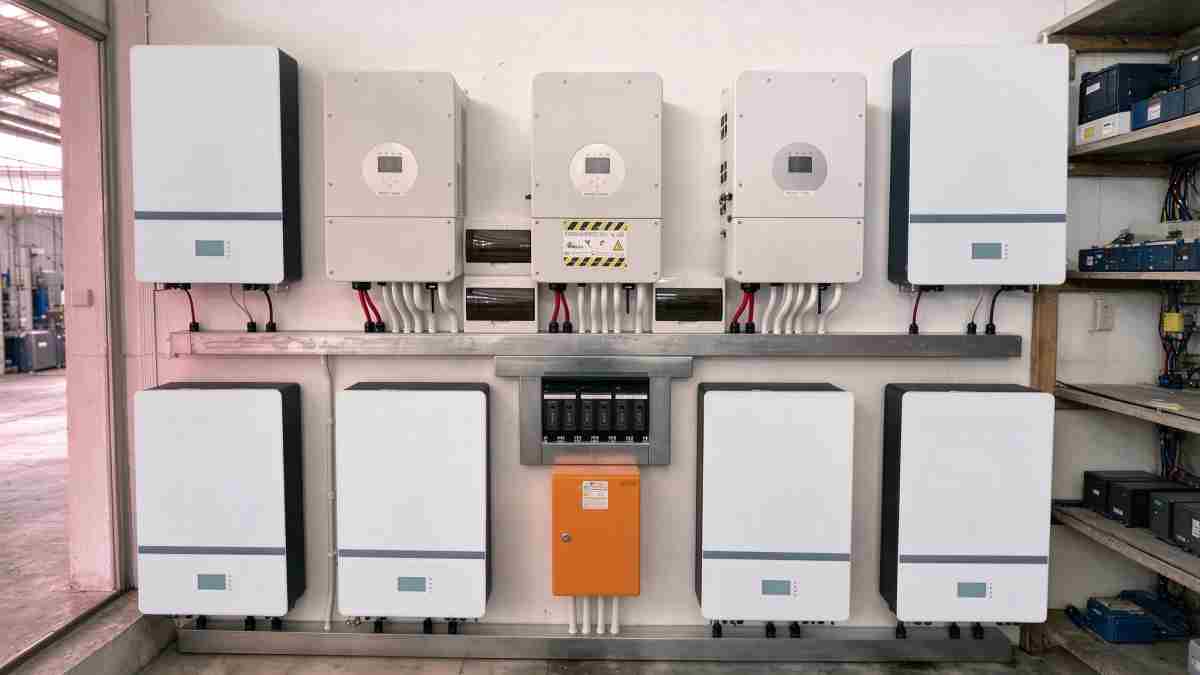
Hybrid inverters on the factory test wall. On site, a battery bank and a generator changeover panel are added to this arrangement.
In these markets the purchase decision is rarely made on the datasheet. It is made on what happens in year three when a module fails.
Three things decide that. Spares: whether a single 5.12 kWh module and a BMS board can be shipped on their own, or whether the whole unit goes back. Firmware: whether a protocol update for a GoodWe, Victron or Solis inverter can be applied on site, because the dealer’s other lines will not change to suit us. Response: whether a fault report gets an answer in two days or two weeks. A dealer who has been left waiting once will not stock the brand twice.
This is also where the honest version of the off-grid market matters. The World Bank’s energy access tracking and the GOGLA off-grid market data both show a market that is growing but is served largely by small standalone systems, not by house-sized battery banks. The customers who buy 10 to 20 kWh are the ones with a connection that works some of the day, a business that loses money when it stops, or a generator bill they are trying to cut. Selling to that group means being reachable and repairable, not being the cheapest per kilowatt-hour.
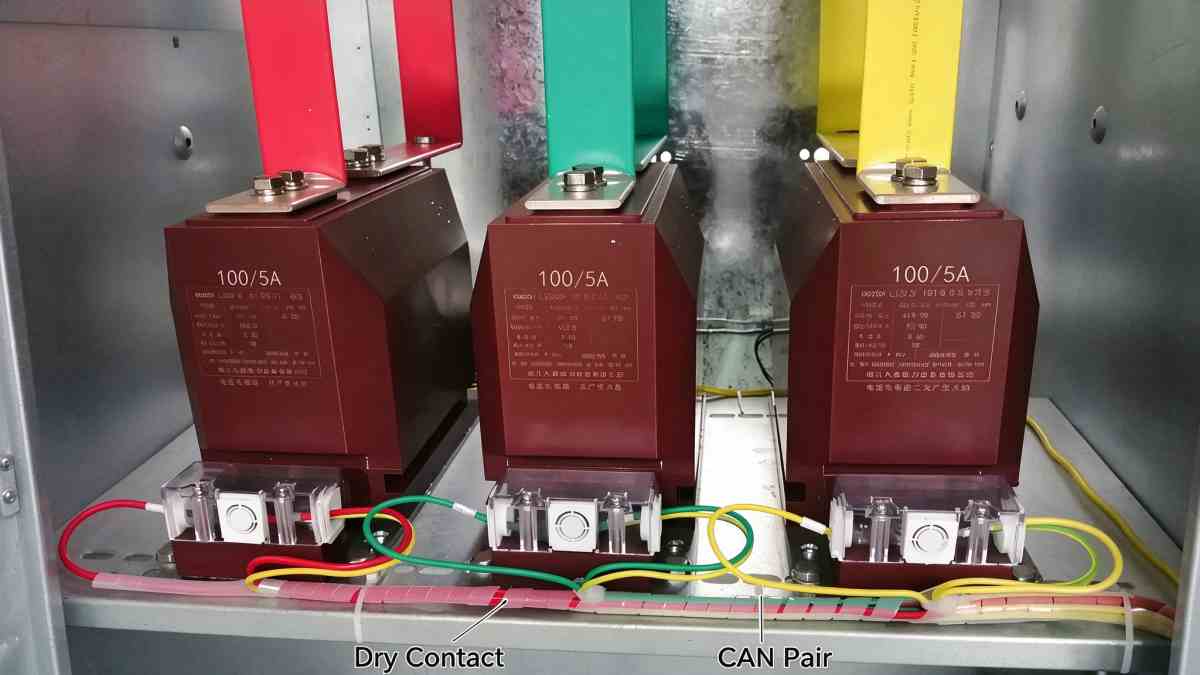
Three 100/5 A current transformers on the phase busbars. Their secondary wiring carries the signal the inverter uses to hold export at zero.
No. A grid-tied inverter without a backup output is required to shut down when the grid is lost, and it will do so with a battery connected. You need either a hybrid inverter with a backup output and a separate loads panel, or an off-grid inverter added alongside the existing one.
A hybrid inverter with a backup output typically transfers in ten to twenty milliseconds. A desktop power supply holds its output for a similar time at rated load, so it is marginal rather than guaranteed. Network equipment and anything with a switching supply usually re-sync. A mechanical changeover switch takes one to three hundred milliseconds and everything with a processor will reboot.
Yes, if the inverter has a generator input with a potential-free start contact and a generator rating setting. The setting caps charge power so the set is not overloaded, and the accept window has to be wide enough for the frequency droop of a small diesel engine. Without both, the inverter will reject the generator and the site stays on battery while fuel burns.
For the loads in the table above, about 2.56 kWh delivered, which is 2.84 kWh of nameplate at ninety per cent usable depth of discharge. One 5.12 kWh module covers it and would run roughly fourteen hours. For a full day of the same loads, budget 5.42 kWh of nameplate and fit two modules.
It should not. Zero-export control with a current transformer holds export at the meter, and the inverter has to fail safe to zero export if that signal is lost rather than defaulting to full output. Confirm the fail-safe direction before ordering, because a unit that fails open will get the customer disconnected.
Yes. Our home batteries are rated for −20 to +60 °C and IP54 with natural cooling, but that is the operating envelope, not a flat rating. Above roughly 45 °C the BMS limits charge current, and usable capacity falls slightly as internal resistance rises. Mounting on a shaded wall with clearance behind the unit matters more in these markets than the headline capacity figure.
Energy Storage Product Manager
Works on residential and C&I storage configurations, mostly on sites where the grid is the variable and the battery has to be sized around its behaviour.
Updated on November 16, 2026
Stay up to date with GreenMore. We share new BIPV solar tile releases, product and certification updates, and field notes from our projects — no fluff, just the things that matter to installers, distributors, and system integrators. If there's something you'd like to see covered, drop us a line — we read every reply.




Copyright @ 2026 GreenMore All Rights Reserved.  Network Supported
Sitemap / Blog / Xml / Privacy Policy


