
Welcome to GreenMore
Welcome to GreenMore
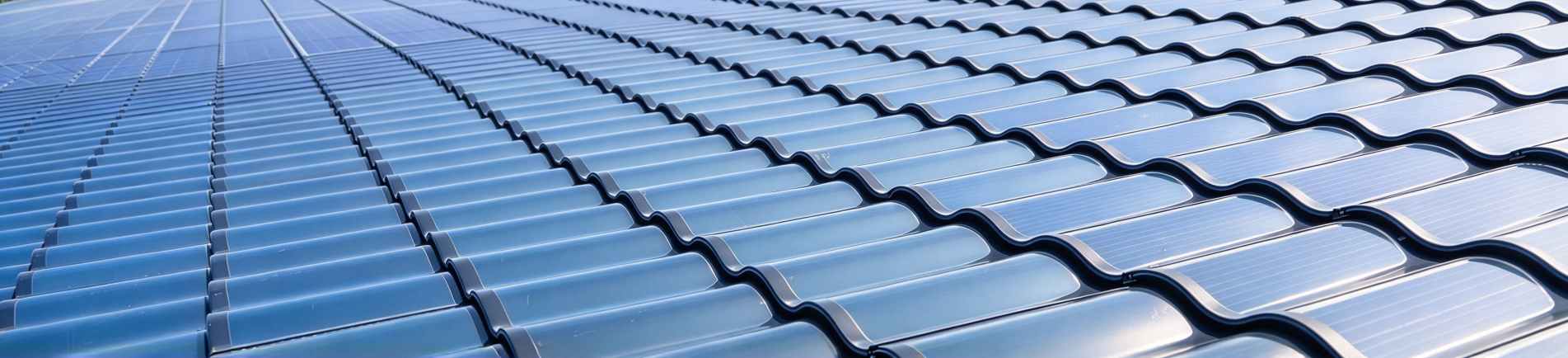
For a long time, rooftop solar was something you added to a finished building: rails were fixed over the existing covering, panels were clamped to the rails, and the roof underneath simply carried the load. That is changing. The current generation of PV tiles is designed the other way round — the tile is the roof covering and the generator at the same time.
That only works if the tile is engineered as a building component first. It has to keep water out for decades, carry wind and snow loads, resist fire and ultraviolet light, and still produce electricity every day. This article looks at the structural design that makes that possible.
It helps to start with the distinction between BAPV and BIPV, because it explains why the construction is so different.
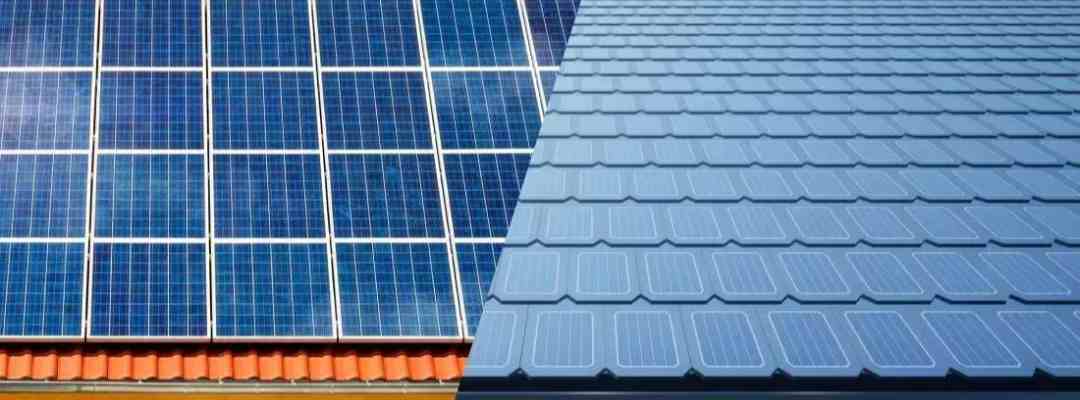
Comparison of solar roof tiles and traditional photovoltaic panels
Integrated design removes duplicated layers. Instead of a tile roof plus rails plus panels, the roof does both jobs at once. That is also where the engineering bar is higher: once the tile is part of the weather envelope, it cannot afford to leak, crack, or delaminate. You can read more about how these systems are put together in our BIPV system guides.
A properly detailed integrated roof is a stack of layers, each with a clear function. From the inside out, the typical build includes the structural deck, a levelling layer, a waterproof underlay, insulation where the design calls for it, battens or a fixing rail, and the photovoltaic tiles themselves — finished with edge, ridge, and verge pieces.
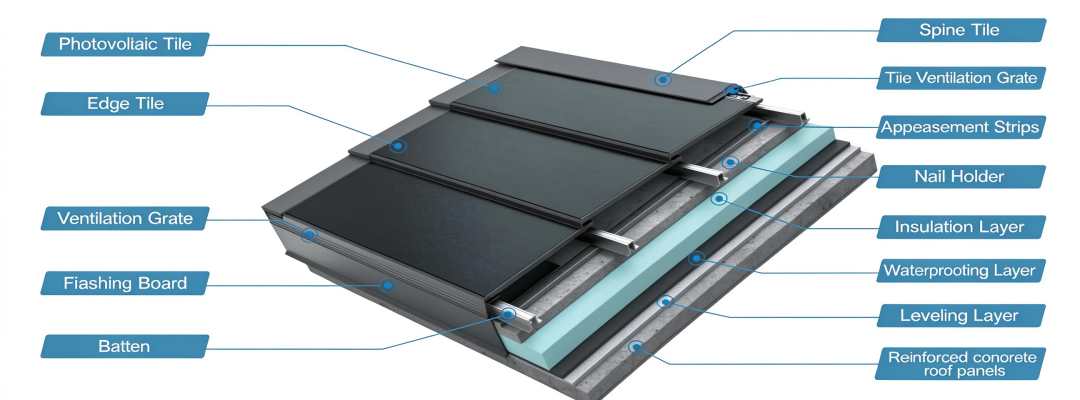
Cross-sectional view of a multi-layer installation structure for a solar tile pitched roof
A few points in that stack are worth understanding, because they are where cheaper integrated designs tend to fail.
PV tiles are laid like roof tiles, not glued like wall panels. Each course overlaps the one below, and the side joints interlock. Water running down the roof travels over the overlaps and is carried away; it never depends on a single seal. EPDM or similar durable strips are used at the joints that need compression sealing.
Even with overlapping tiles, a waterproof underlay (a breather membrane or reinforced waterproofing layer, depending on roof type) is installed over the deck. This belt-and-braces layer catches wind-driven rain and any meltwater, and it protects the structure during construction before the tiles are laid. An integrated tile roof should never rely on the glass alone to stay watertight.
Battens or rails hold the tiles slightly off the underlay, leaving a ventilated cavity. Air entering at the eaves and leaving at the ridge carries away heat and moisture. This keeps the cells closer to their efficient operating range and stops condensation building up against the structure — important in both hot and cold climates. We describe the benefit as lower operating temperatures, rather than quoting a fixed extra percentage, because the real gain depends on the cavity, the pitch, and the weather.
The active tile has to survive hail, falling branches, snow, decades of ultraviolet light, and repeated freeze–thaw cycles — while protecting live electrical parts. Our flat and curved tiles meet this with a laminated, double-glazed build rather than a single sheet.
Because both faces are glass, there is no plastic backsheet that can chalk or crack over time, and the symmetrical build is less prone to the moisture- and voltage-driven degradation known as PID. We cover the testing behind this in our article on waterproof photovoltaic roof tiles.
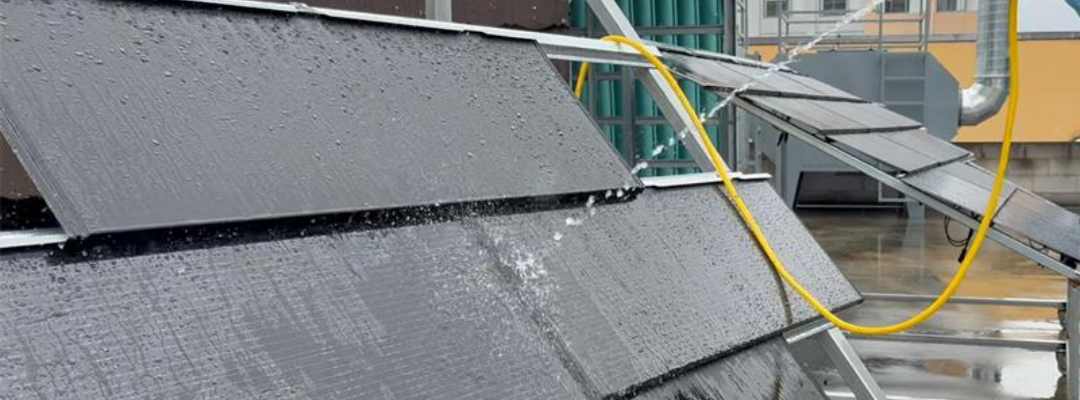
GreenMore Solar Tile Pitched Roof Groove Rain and Water Spray Test
As a building component, a PV tile is judged on more than watts. These are the structural properties that matter, and the logic behind them.
Roof covering standards and PV standards both test mechanical loading. Our PV tiles are designed for a frontal (downward, snow/foot-style) load of 5400 Pa and a rear (upward, wind-uplift-style) load of 2400 Pa, verified in static load testing. The fixing system — battens, clips, or rails and their fasteners — is designed for the specific building’s wind region; the tile and the fixing are a system, not separate purchases.
Tiles are rated for fire performance to the applicable roof and PV standards, with our tiles meeting a Class A rating. Glass and a cementitious or mineral deck do not sustain flame, and the ventilated cavity is designed so it cannot act as an open chimney for embers. In bushfire or wildland-urban settings this detail is often as important as the electrical rating.
A dark roof surface can be far hotter than the surrounding air, and well below freezing in winter. Our tiles are rated for an operating range of −40 °C to +85 °C and are put through thermal-cycling and humidity-freeze tests, which repeatedly expand and contract the glass, encapsulant, and frame to expose weak bonds before they reach a building.
A frameless glass–glass tile reduces aluminium on the roof, but it does not remove the need for earthing. The array, mounting metalwork, and inverter enclosures still require protective earthing and equipotential bonding, with surge protection and, where required, rapid shutdown of the DC side. These are code requirements for safety and fire-service access, and a reputable integrated design will include them from the start rather than treat them as optional.
Underlying these points is a long-run trend: measured at the module level, commercial silicon products have climbed from the low-teens to around 20–22 percent efficiency, with research cells considerably higher. Independent sources such as Fraunhofer ISE, the U.S. National Renewable Energy Laboratory (NREL), and the IEA’s PVPS programme track these figures. For an installed tile, though, the whole-unit number is the one to use, because frames and overlaps use area that does not generate.
To make the design discussion concrete, here are the actual published parameters for our framed, double-glazed flat photovoltaic tile (LDM series). These are datasheet figures, not estimates.
| Parameter | Specification |
|---|---|
| Models | LDM109 / LDM112 / LDM115 |
| Maximum power (STC) | 109 / 112 / 115 W |
| Cell | 210 mm monocrystalline silicon |
| Product size | 1817 × 420 × 29 mm |
| Glass module size | 1732 × 418.5 × 5 mm |
| Weight | 9.6 kg per tile |
| Structure | Double-glass, black aluminium frame |
| Whole-tile efficiency | Approx. 15 percent (installed footprint) |
| Front / rear static load | 5400 Pa / 2400 Pa |
| Operating temperature | −40 °C to +85 °C |
| Max. system voltage | 1000 V DC |
| Connector / junction box | IP68 connector; IP67 junction box with two diodes |
| Cables | 700 mm positive and negative |
| Power temperature coefficient | −0.34 percent/°C |
Updated on September 27, 2026
A note on the efficiency figure: the solar cells inside the tile are considerably more efficient than 15 percent, but the rated whole-tile output divided by the full installed footprint — including the frame and the overlaps — is the number the roof actually delivers per square metre. It is worth keeping the two straight when comparing products. The same applies to the IP ratings: IP68 describes the electrical connectors and IP67 the junction box. The roof’s waterproofing comes from the overlapping tiles and the underlay, which is a different mechanism than an electrical ingress rating.
The tiles generate direct current, which has to be converted to grid-compatible alternating current. Tiles are connected in series into strings; the combined string voltage must sit inside the inverter’s window over the full temperature range, so string sizing is an engineering calculation rather than a fixed count.
On larger or partly shaded roofs, module-level power electronics help: microinverters convert at each tile, or optimizers condition each tile before a string inverter. These reduce the impact of shading on one tile and give panel-level monitoring, at a slightly higher equipment cost. You can see our solar inverter options for the supported architectures.
Adding a home battery lets the roof store midday generation for the evening, run essential loads during outages, and increase self-consumption. Because a battery sees DC power in and out, matching the battery voltage and the inverter/charger is part of the design. Our article on all-in-one off-grid backup systems shows how these pieces are packaged, and you can browse the full solar tile range for flat and curved profiles.
The shift is structural rather than just a better solar cell. Instead of panels added over a finished roof, the tile is engineered as the weatherproof roof layer, with laminated glass–glass construction, overlapping joints, a secondary waterproof underlay, and a ventilated cavity. Higher-efficiency cells sit inside that structure, but the integration is the main change.
We state this through the warranty rather than a marketing lifespan: the tiles carry a 25-year linear power warranty. The inverter, battery, and other non-tile components carry a 3-year warranty. Glass and mineral roof components are durable materials, but we do not claim a 30-year service life that the warranty does not back.
The framed flat tile weighs 9.6 kg per unit; the curved triple-arch tiles are lighter per square metre. The roof structure should be checked against the local code for the added dead load, in the same way it is checked for slate, clay tile, or an add-on array. For new builds this is simply part of the structural design; for retrofits an engineer confirms the existing structure is suitable.
Yes, through roofing design rather than an electrical IP rating. The tiles overlap and interlock so water drains over the joints, durable EPDM seals compress where needed, and a waterproof underlay provides a second line of defence. Independent water-spray and weather testing verify the build, and proper detailing at eaves, ridges, verges, and penetrations is part of the installation.
It depends on the project. Add-on panels remain cheaper per watt and make sense when an existing sound roof only needs generation. PV tiles cost more per watt but replace the roof covering itself, so on a new build or a re-roof the comparison should be against the cost of the roof plus a panel array. They are most attractive where appearance, planning requirements, or a heritage-style profile matter — which is exactly where our curved triple-arch tiles are aimed.
GreenMore is a photovoltaic tile manufacturer: our solar tiles, photovoltaic bricks, and photovoltaic curtain walls are produced in-house, with inverters and batteries supplied as the supporting parts that complete the system. We work with distributors, installers, and project owners from the earliest design stage, helping match the tile profile, structure, electrical architecture, and storage to the building and the local code.
If you are planning a project, send us the building type, roof area, location, and target generation, and our team will come back with a real, buildable proposal rather than a generic datasheet. Reach us through our contact page or email export@gmsolarkit.com.
Luke manages GreenMore’s photovoltaic building-material range, from the curved triple-arch tile to flat tiles and PV curtain walls. Working in the solar industry since 2017, he focuses on designs that are genuinely buildable: clear structure, correct electrical sizing, and warranty terms that match what is actually shipped.
Stay up to date with GreenMore. We share new BIPV solar tile releases, product and certification updates, and field notes from our projects — no fluff, just the things that matter to installers, distributors, and system integrators. If there's something you'd like to see covered, drop us a line — we read every reply.




Copyright @ 2026 GreenMore All Rights Reserved.  Network Supported
Sitemap / Blog / Xml / Privacy Policy


