What China's 2026 Solar Policy Shift Means for BIPV Buyers
Oct 23, 2026
L
Luke
Product Manager, GreenMore · Photovoltaic building materials
A BIPV roof is specified by cell technology, roofing certification and load path — not by the wattage race alone.
Every autumn, buyers planning roofs for the following year ask us the same question: what is actually happening inside China’s solar industry, and what does it do to supply, pricing and specification for a BIPV order?
October 2026 gave an unusually clear answer. The country’s main industry body, the China Photovoltaic Industry Association (CPIA), told a technology conference in Beijing that the sector is still in a deep adjustment phase, with domestic output and installations under pressure, while exports remain resilient and technological innovation is what carries companies through the cycle.
That sentence is easy to read past. It sits on top of a month of concrete rules and figures that will shape quotations in 2027.
This post translates the October 2026 signals into four things every distributor, EPC and developer specifying solar roof tiles should know, then shows where a specialist BIPV maker like GreenMore fits.
What CPIA Actually Said in October 2026
On 15 October 2026, CPIA held its PV technology conference in Beijing, with officials from the Ministry of Industry and Information Technology (MIIT) and the National Development and Reform Commission in the room. The association’s points, as reported by Chinese financial media the same week, were direct:
The industry remains in a deep adjustment, and the next phase is quantity reduction, not growth at any cost.
Exports stay resilient: China’s PV product exports rose 24.3% year on year in the first half of 2026 to about US$17.2 billion, with module export value up 14% — the first increase since the second half of 2023 — even as domestic production fell across all four manufacturing stages.
Manufacturers must use technology upgrades to cut cost and hold the quality line; the application side shifts from building power stations to operating them.
The association will keep a platform for technical exchange and push back against cut-throat price competition — the policy widely referred to in Chinese media as fan neijuan, or “anti-involution.”
Two rules landed in the same week and put teeth behind the words. MIIT opened consultation on the 2026 edition of the PV manufacturing specification conditions, setting separate efficiency floors for new capacity by route — TOPCon, HJT and xBC — and removing legacy P-type entries. Separate reporting detailed industry-agreed price floors for exports and tenders: BC modules no lower than RMB 0.86/W and TOPCon modules no lower than RMB 0.79/W.
Neither number is abstract to a buyer; both tell you the era of the bottomless Chinese module price is being deliberately closed.
Signal 1 — Exports Are the Growth Side of the Market
The headline numbers point in opposite directions until you read them together. In the first half of 2026, CPIA data show polysilicon output down 9.8%, wafers 7.3%, cells 21.9% and modules 35.1% year on year — the first time all four stages have contracted together. Over the same period PV product exports rose 24.3%. Customs data for the first three quarters separately recorded PV product export value up 10.3% year on year.
Read carefully, this is not a picture of collapsing demand. Global installations continue, Chinese products remain competitive, and the deepest output cuts are happening at home where overcapacity sits. Overseas module assembly is expanding at the same time, so Chinese makers are increasingly meeting foreign demand from specialist, differentiated products — and from closer-to-market capacity — rather than from plain commodity panels alone.
Buyer takeaway: supply of generic modules is tightening and re-pricing, but the export channel for differentiated building products — curved tiles, coloured and custom profiles, certified roofing components — is exactly where Chinese makers still have room and incentive to serve overseas partners well.
Signal 2 — the Coming Efficiency Standard Favours the BC Route
A mandatory energy-efficiency standard for PV modules takes effect on 1 January 2027. GB 47834-2026 was published on 27 June 2026 and grades ground-mounted n-type crystalline silicon modules into three efficiency tiers, with tier 3 as the market floor. Below that line, a module cannot be made, sold or imported in China.
Test data compiled by the National Institute of Metrology over a full year, and cited by CPIA’s executive secretary in a late-October interview, show a sharp split between cell routes:
Cell route
Tier 3 or above
Tier 1
Share of market
TOPCon
25.33%
2.12%
70–80%
HJT
Below TOPCon
Not disclosed
Small
BC
Over 80%
About 15%
Growing
With 70–80% of today’s market on TOPCon, the room for upgrades is real, and the retrofit is not cheap. The draft manufacturing specification points the same way, listing separate entry efficiencies for new capacity:
Route
New cell capacity
New module capacity
TOPCon
26.2%
24.2%
HJT
26.0%
24.0%
xBC
26.6%
24.4%
BC is not magic — speakers at the same event expected routes to converge over five years, with tandem cells and reduced-silver metallisation as the next frontiers — but for products shipping in 2027 and warranted for 25 years, the route matters today.
One point that gets lost in most English coverage: GB 47834-2026 does not apply to BIPV modules. Its scope covers ground-mounted n-type crystalline silicon modules and expressly excludes building-integrated PV, consumer products, perovskite-silicon tandems and modules using silver-free metallisation. Products made for export are governed by contract rather than by the Chinese mandatory standard.
For a solar roof tile shipped to the Middle East or Europe, that means two exemptions at once. The standard will not decide whether your tile is legal. What it does decide is the shape of the supply chain underneath: cell capacity that cannot clear tier 3 loses its domestic market, BC lines gain relative advantage, and the price spread between routes widens. That is the channel through which the 2027 rules reach a BIPV quotation — through cell availability, lead time and cost, not through a certificate on the tile.
Buyer takeaway: for a roof being specified now for installation next year, ask which cell route the tile uses, and ask separately whether the tile itself carries the roofing certification your market requires. The efficiency tier is a supply-chain signal, not a compliance document for a BIPV product.
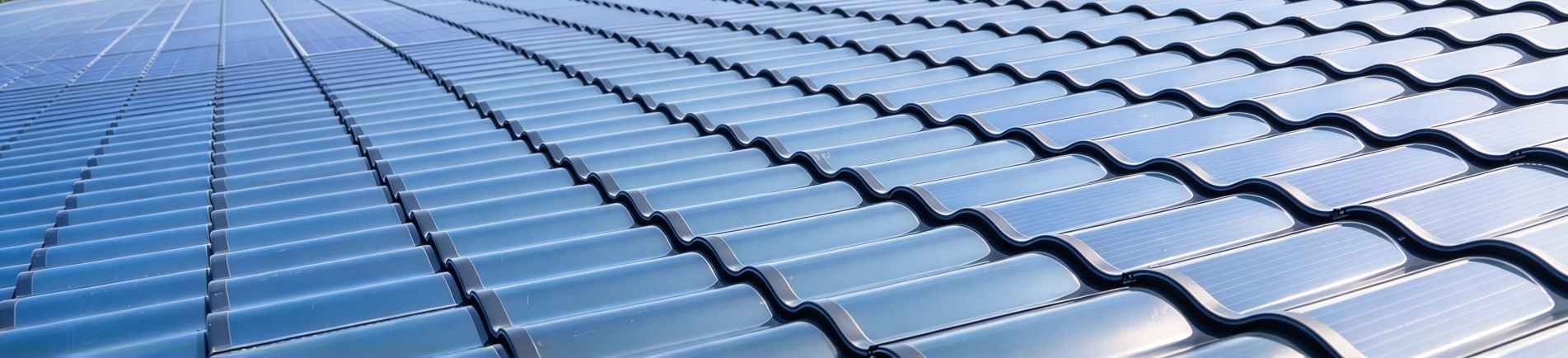
GreenMore’s curved tiles are built on BC cells because the front contact-free surface suits the appearance a roof demands, and because BC lines are where the efficiency headroom sits as the 2027 rules bite — we publish the cell route on every product specification sheet.
Two questions, one roof: the cell route inside the tile, and the load rating it has to carry.
Signal 3 — Price Floors Change How to Read a Quote
Since August 2026, leading Chinese manufacturers have signed anti-involution commitments; a closed-door meeting in Hangzhou on 11 October turned those commitments into production discipline and explicit floors:
Item
Floor
Applies to
Polysilicon
RMB 43,000/tonne
Domestic, export, tender
BC module
RMB 0.86/W
Domestic, export, tender
TOPCon module
RMB 0.79/W
Domestic, export, tender
A note on the wording: Chinese coverage splits on whether the 0.86 and 0.79 figures are cell prices or module prices. China Securities Journal reported cells; Shanghai Securities News and Securities Times reported modules; at least one company in the room said pricing was not discussed at all. Treat both numbers as directional discipline rather than a published tariff.
MIIT’s parallel consultation — open for comment until 15 November 2026 — uses standards rather than negotiation to push the least efficient capacity out of the market. Analysts quoted in the coverage are candid that module-sector discipline is harder to enforce than polysilicon, and list-price versus transaction-price gaps remain.
Even so, the direction is set: a quote that sits far below everything else in the market in 2027 will increasingly mean one of two things — stock built before the rules, or a product that could not meet them — rather than a genuine efficiency advantage.
Buyer takeaway: stop comparing bids on per-watt price alone. For a BIPV roof, compare the certified roofing component (EN 14782, EN 1090-1 and CE for European projects), the mechanical load rating front and back, the IP rating of the junction box, and the warranty structure, then price. How those numbers are tested is covered in our notes on 5,400 Pa frontal load on BIPV tiles and Class C fire ratings for solar roof tiles.
Signal 4 — Technology Export Rules Do Not Block Products
A separate 16 October proposal from the Ministry of Commerce and the Ministry of Science and Technology would add twelve PV manufacturing technologies — five prohibited, seven restricted — across polysilicon, wafer and cell making to the catalogue of controlled technology exports, together with the core equipment that carries them.
Read the fine print before worrying your supply. The catalogue targets process packages and the machines that run them; it does not list finished modules or tiles, and the reading across Chinese brokerage research is that products made with those technologies remain freely exportable. Finished tiles and modules continue to ship normally.
For overseas buyers the practical effect is on timing and partnership depth, not on goods availability: expect Chinese manufacturers to keep protecting core process know-how while competing harder on finished-product quality, certification and service. That favours buyers who build a real specification and certification dialogue with a factory over those rotating suppliers purely on spot price.
What to Check on Your Next BIPV Enquiry
Four questions put every 2027 quotation on a comparable basis:
Cell route and grade. BC, TOPCon or HJT, and evidence of where those cells sit against the 2027 efficiency tiers — read as a supply-risk signal rather than a compliance claim for the tile.
Roofing certification: CE plus EN 14782 and EN 1090-1 where the destination market requires them — a PV test certificate alone does not make a roof component legal.
Structural ratings: Front and back static load in Pa, junction-box IP rating, and the fixing detail at eaves and ridge.
Warranty split: Power-output warranty and weather-sealing warranty stated separately, with a named issuer.
China’s 2026 adjustment is, from a buyer’s seat, a quality and specification reset rather than a supply emergency. The commodity end of the market is being disciplined by standards and floors; the differentiated, certified building-product end is where export-serving factories are doubling down.
GreenMore’s own position has not changed with the headlines — a focused BC-cell curved-tile line, roofing-product certification, documented load and fire performance, and one-to-one engineering support through customized services. A completed installation in the European market shows the result on a real roof: 15 kW residential solar tile project in Greece.
Bring us your climate zone, roof build-up and 2027 timeline — we will answer the four questions for your project in writing via the contact page.
Frequently Asked Questions
Does China’s 2027 module efficiency standard apply to BIPV tiles?
No. GB 47834-2026 covers ground-mounted n-type crystalline silicon modules and expressly excludes building-integrated PV. Exported products are governed by contract rather than by the Chinese mandatory standard. The regulation reaches a BIPV order indirectly, through cell supply, lead time and pricing rather than through a certificate on the tile.
Do the Hangzhou price floors apply to export orders?
Yes. The commitments reported from the 11 October meeting cover export sales, public procurement and tenders as well as domestic sales, with floors of RMB 0.86/W for BC modules and RMB 0.79/W for TOPCon modules.
Will the technology export controls stop solar tiles from shipping?
No. The 16 October proposal covers manufacturing processes and core equipment, not finished products. Tiles and modules continue to export normally. What changes is how openly a Chinese factory will share process detail with an overseas partner.
What should a BIPV buyer compare instead of price per watt?
The certified roofing component (EN 14782, EN 1090-1, CE), front and back mechanical load in Pa, junction-box IP rating, fire classification, and the split between power-output and weather-sealing warranties — then price.
Related Reading
What EN 14782 and IEC 61215 Actually Prove About a Solar Tile
How BIPV Roof Tiles Withstand 5,400 Pa of Frontal Pressure Without Cracking
What Class C Fire Rating Means for Your Solar Roof Tiles
Sources
The statements and figures above are drawn from October 2026 public reporting of CPIA’s 15 October conference in Beijing, MIIT’s manufacturing-specification consultation, and Chinese customs and industry data:
2026 PV Industry Technology Conference — event report (BJX, citing CPIA)
MIIT consultation on the 2026 PV manufacturing specification conditions
CPIA on whole-industry-chain collaboration and the move to value leadership (GMT Eight)
Hangzhou industry meeting: production discipline and BC/TOPCon price floors (English wire report)
Output, export and grading figures were additionally cross-checked against CPIA’s first-half 2026 production data, interviews with CPIA’s executive secretary in Huaxia Times (22 October 2026), and customs briefings reported by China Electric Power News (14 October 2026). Proposed rules remain in consultation and figures may be revised in the final text.
L
Luke
Luke works with distributors, installers and EPC contractors to match GreenMore photovoltaic tiles with the wind, snow, certification and grid requirements of each market. Send him your site’s climate zone, roof build-up and target installation date for a specification review.







 Network Supported


